Vidyanjali Portal Boosts Community Participation in School Education
Source:PIB ↗
ఇది ఎందుకు ముఖ్యం
The article demonstrates how the government is actively operationalizing the community participation mandate of NEP 2020 through digital platforms like Vidyanjali. It offers excellent fodder for GS-2 answers regarding the role of Civil Society Organizations (CSOs) and CSR in augmenting state capacity, while NITI Aayog's NGO DARPAN illustrates governance mechanisms to ensure transparency. Furthermore, the transition to PARAKH for national educational assessment is a key factual update for education-related questions.
సారాంశం
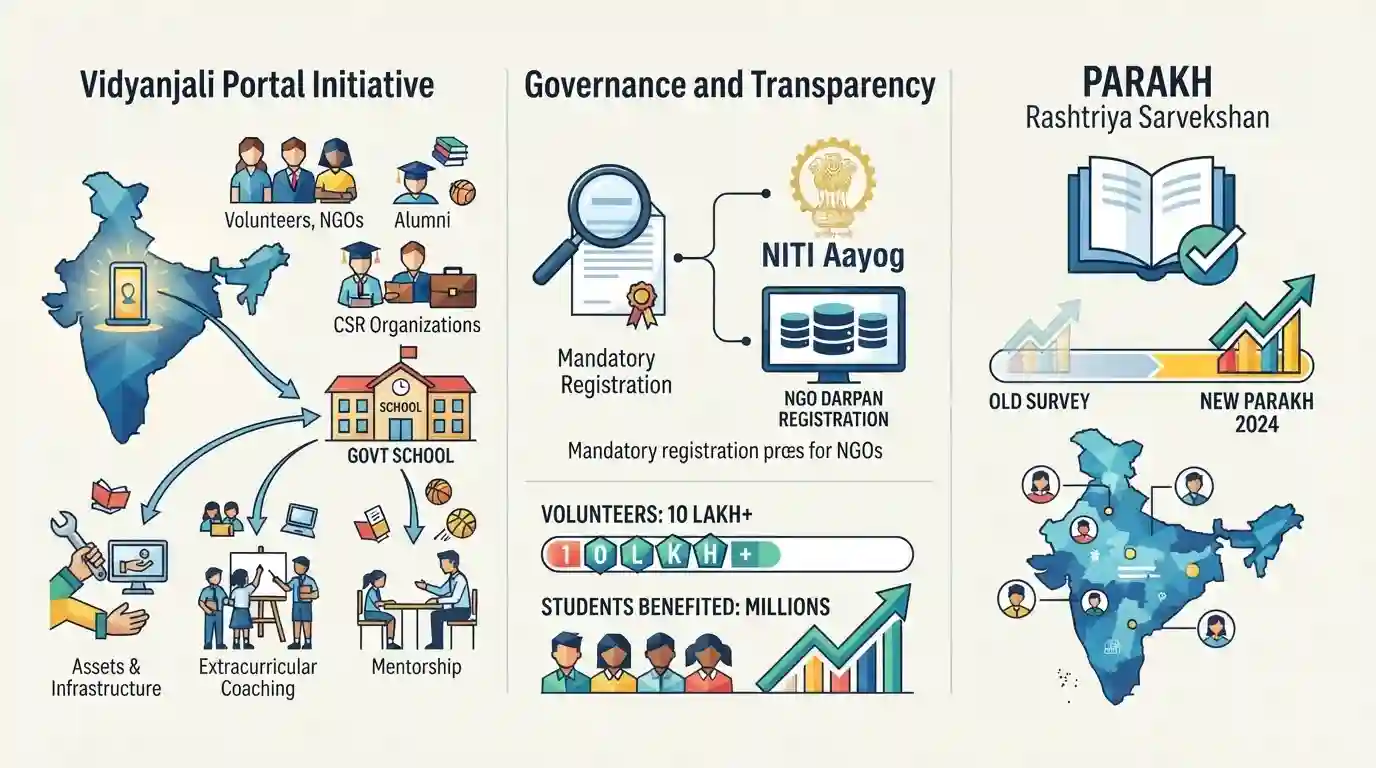
The Ministry of Education highlighted the progress of the Vidyanjali portal, an initiative designed to enhance community participation in school education in line with the National Education Policy (NEP) 2020. The platform allows volunteers, NGOs, alumni, and CSR organizations to directly support government and government-aided schools by providing mentorship, extracurricular coaching, and essential assets or infrastructure. To ensure transparency, participating non-profits must be registered on NITI Aayog's NGO DARPAN portal. Currently, over 10 lakh volunteers are registered, significantly benefiting millions of students. Additionally, the National Council of Educational Research and Training (NCERT) has replaced the National Achievement Survey with the PARAKH Rashtriya Sarvekshan 2024 to evaluate the educational health and foundational learning standards across India.
ముఖ్య అంశాలు
- The Vidyanjali initiative enables community and volunteer participation by connecting them directly with Government and Government-aided schools, aligning with NEP 2020.
- Volunteers, alumni, professionals, NGOs, and Corporate Social Responsibility (CSR) organizations contribute through mentorship, remedial classes, and providing physical infrastructure or learning materials.
- To ensure transparency and authenticity, NGOs and CSR organizations are verified via the NITI Aayog’s NGO DARPAN portal before onboarding.
- Over 10 lakh volunteers and organizations are registered on Vidyanjali, benefiting over 1.76 crore students across various states and UTs.
- PARAKH (under NCERT) conducted the Rashtriya Sarvekshan 2024 (replacing the National Achievement Survey) to assess the foundational learning and overall health of the schooling system.
ముఖ్యమైన పదాలు
Vidyanjali portal

A school volunteer management initiative by the Ministry of Education connecting community members, corporate donors, and NGOs with government schools to offer voluntary services, mentorship, and infrastructure support.
UPSC context
GS Paper II (Education & Governance): Tests strategies for community participation and public-private partnership models in public service delivery.
National Education Policy (NEP) 2020
A comprehensive framework launched to reform and modernize India's education system from preschool to higher education, aligning it with 21st-century goals and SDG 4.
UPSC context
GS Paper II (Social Justice - Education): Evaluates institutional education reforms and developmental planning policies.
NGO DARPAN portal
An e-governance platform managed by NITI Aayog acting as an interface between NGOs/Voluntary Organizations and government departments, facilitating registration, background authentication, and grant transparency.
UPSC context
GS Paper II (Role of NGOs & Governance): Evaluates transparency, state-NGO interfaces, and development monitoring tools.
PARAKH
Performance Assessment, Review, and Analysis of Knowledge for Holistic Development; India's first national assessment regulator established under NCERT to standardize evaluation guidelines across all school boards.
UPSC context
GS Paper II (Education): Assesses student evaluation standardization and removing state-to-state academic disparities.
PARAKH Rashtriya Sarvekshan 2024
Formerly the National Achievement Survey (NAS), it is a nationwide large-scale diagnostic assessment survey designed to monitor the learning health and outcomes of India's school education system.
UPSC context
GS Paper II (Human Resources/Education): Tests data-driven policy planning and foundational learning standard assessments.
ప్రిలిమ్స్ ఉచ్చు
Under the Vidyanjali 2.0 portal, registered civil society organizations and CSR entities can make direct financial donations to school bank accounts.
Vidyanjali 2.0 strictly prohibits any direct monetary transactions. Contributions are restricted to non-monetary classes: activity-based service support (like teaching) and physical assets/material infrastructure donations.
అనుసంధానమైన స్థిర భావనలు
What is the NGO DARPAN portal and its role in governance?
- Nodal ownership: Maintained by NITI Aayog and NIC to serve as a single-window interface between voluntary organizations and Union ministries.
- Mandatory identifier: Offers a unique DARPAN ID, which is a mandatory prerequisite for any NGO seeking government grants or scheme partnerships.
- Financial transparency: Enhances accountability by tracking non-profit credentials, activities, and utilization of public developmental funds across ministries.
What is PARAKH and its core mandate under NEP 2020?
- Institutional setup: Established as an independent, constituent unit within NCERT to act as India's first national assessment regulator.
- Board standardization: Mandated to formulate assessment guidelines across 60+ state and central boards to establish equivalence of student qualifications.
- Competency-based shift: Reforms classroom evaluation from rote learning to high-order cognitive skills, implementing 360-degree Holistic Progress Cards.
అంతర-అంశ నమూనాలు
NGO DARPAN & Foreign Funding Compliance
Links voluntary sector tracking with internal security, showing how DARPAN registration aligns with FCRA monitoring to ensure financial transparency in foreign-funded educational NGOs.
Education Federalism & Board Parity
Links PARAKH's central benchmarking to school-level federalism under the Concurrent List, illustrating the structural tension between state board curricula and national testing uniformity.

PARAKH's structural role under NCERT, the 2026-27 NIPUN Bharat timeline, and Vidyanjali's non-monetary rule are high-probability 2026 topics.
అనుసంధాన PYQలు · 3
అనుసంధాన PYQలు · 3
- 2020MainsGS2
National Education Policy 2020 is in conformity with the Sustainable Development Goal-4 (2030). It intends to restructure and reorient education system in India. Critically examine the statement.
- 2025MainsGS2
Civil Society Organizations are often perceived as being anti-State actors than non-State actors. Do you agree? Justify.
- 2024MainsGS2
Public charitable trusts have the potential to make India's development more inclusive as they relate to certain vital public issues. Comment.
