Artificial Intelligence Curriculum Integration in Government Schools
Source:PIB ↗
આ શા માટે મહત્વનું છે
Integrating AI into foundational schooling is critical for India's transition to a knowledge-based economy and ensuring its demographic dividend is equipped with future-ready skills. This development illustrates the practical application of NEP 2020 and highlights federal dynamics in executing national curriculum frameworks.
સારાંશ
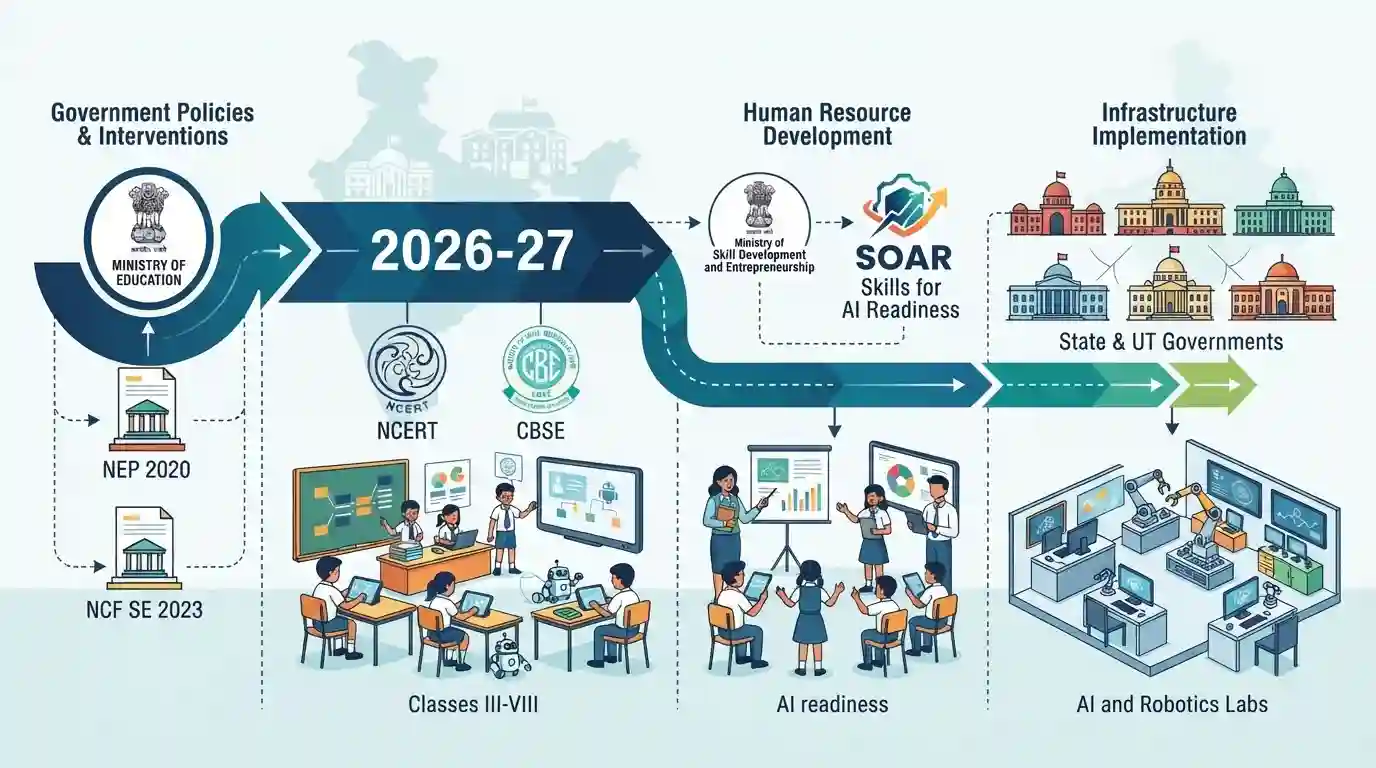
The Ministry of Education is driving the integration of Artificial Intelligence (AI) and digital education into Indian schools as envisioned by the National Education Policy (NEP) 2020 and the National Curriculum Framework for School Education (NCF SE) 2023. NCERT and CBSE will implement a targeted AI curriculum for Classes III-VIII from 2026-27. Simultaneously, the Ministry of Skill Development and Entrepreneurship introduced the 'SOAR' initiative to build AI readiness among students and teachers. The execution of infrastructure, such as setting up AI and robotics labs, falls to State and UT governments under the concurrent nature of education.
મુખ્ય મુદ્દા
- The National Education Policy (NEP) 2020 and National Curriculum Framework (NCF SE) 2023 prioritize the integration of Artificial Intelligence (AI) and computational thinking in school education.
- NCERT and CBSE are introducing a dedicated AI and computational thinking curriculum for Classes III to VIII starting in the 2026-27 academic year, with the curriculum for higher classes already finalized.
- The Ministry of Skill Development and Entrepreneurship has launched 'SOAR' (Skilling for AI Readiness) to foster AI literacy among educators and foundational AI awareness in students from classes 6 to 12.
- Since education is a concurrent subject, establishing AI and robotics labs in government schools is the responsibility of State and UT governments.
મહત્વપૂર્ણ શબ્દો
National Education Policy (NEP) 2020

India's comprehensive educational reform framework approved in 2020, overhauling school and higher education. It replaces the 1986 policy, introducing a 5+3+3+4 school structure and multidisciplinary higher education.
UPSC context
GS Paper II: Issues relating to the development and management of Social Sector/Services relating to Education.
National Curriculum Framework for School Education (NCF SE) 2023
A curricular framework developed under NEP 2020 that reorganizes Indian school education (ages 3–18). It outlines pedagogical structures, multilingual learning, flexible subject choices, and biannual board exams to ease academic pressure.
UPSC context
GS Paper II: Government policies and interventions for development, specifically addressing structural reforms in the education sector.
SOAR (Skilling for AI Readiness)
A national initiative launched by MSDE in 2025 to integrate artificial intelligence (AI) literacy into school curricula (Classes 6-12) and equip teachers with foundational "AI for Educators" learning modules.
UPSC context
GS Paper III: Science and Technology — developments, applications, and effects of artificial intelligence in daily life.
National Council of Educational Research and Training (NCERT)
An autonomous government body established in 1961 that advises Central and State governments, conducts academic research, and publishes model textbooks and curricula for qualitative improvement in Indian school education.
UPSC context
GS Paper II: Statutory, regulatory, and various quasi-judicial bodies; policy implementation agency in school education.
Ministry of Skill Development and Entrepreneurship (MSDE)
The nodal union ministry in India responsible for coordinating skill-development initiatives, enhancing youth employability, and bridging the demand-supply gap in skilled manpower across diverse sectors.
UPSC context
GS Paper II: Government policies, and GS Paper III: Indian Economy, employment, and youth resource mobilization.
પ્રિલિમ્સ ટ્રેપ
The SOAR initiative is implemented by the Ministry of Education to establish physical AI and robotics labs in government schools.
SOAR is launched by the Ministry of Skill Development and Entrepreneurship (MSDE). Additionally, establishing physical school infrastructure like labs remains a state responsibility under the Concurrent List, not a central mandate.
સંલગ્ન સ્થિર ખ્યાલો
What are the structural features of the National Credit Framework (NCrF)?
- Unified credit system: Integrates general, vocational, and experiential learning into a single credit accumulation, storage, and transfer system.
- Academic mobility: Permits seamless horizontal and vertical mobility, allowing students to switch between vocational training and mainstream academics.
- NSQF alignment: Maps specialized skill levels to academic credits, standardizing the recognition of formal and informal skills.
How is the power to legislate on Education distributed under the Constitution of India?
- Concurrent List status: Moved from State to Concurrent List by the 42nd Amendment, 1976, enabling joint Union-State legislative and executive jurisdiction.
- Article 21A: Establishes free and compulsory education for children aged 6–14 as a fundamental right, inserted via the 86th Amendment, 2002.
- Article 45 (DPSP): Directs the State to endeavor to provide early childhood care and education for all children until they complete six years.
આંતર-વિષય પેટર્ન
Federalism + Digital Divide
While the Union designs digital and AI frameworks, physical execution of high-cost robotics labs relies on State budgets, potentially widening regional education quality gaps.
Vocationalization + Demographic Dividend
Integrating skill-based micro-credentials directly into secondary school systems targets structural unemployment by aligning basic education with market-ready AI competencies.

UPSC may contrast MoE's academic AI curricula with MSDE's vocational SOAR program, testing credit-transfer mechanisms under the NCrF.
સંલગ્ન PYQ · 4
સંલગ્ન PYQ · 4
- 2020MainsGS2
National Education Policy 2020 is in conformity with the Sustainable Development Goal-4 (2030). It intends to restructure and reorient education system in India. Critically examine the statement.
- 2023MainsGS3
Introduce the concept of Artificial Intelligence (AI). How does Al help clinical diagnosis? Do you perceive any threat to privacy of the individual in the use of Al in healthcare?
- 2020PrelimsGS1
With the present state of development, Artificial Intelligence can effectively do which of the following? 1. Bring down electricity consumption in industrial units 2. Create meaningful short stories and songs 3. Disease diagnosis 4. Text-to-Speech Conversion 5. Wireless transmission of electrical energy Select the correct answer using the code given below:
- 2019PrelimsGS1
Atal Innovation Mission is set up under the
