Higher Education Reforms Introduce Binary and Graded Accreditation
Source:PIB ↗
ఇది ఎందుకు ముఖ్యం
Improving the quality and regulation of higher education is essential for leveraging India's demographic dividend. These reforms streamline institutional assessment, boost global competitiveness, and help students make informed choices about educational quality.
సారాంశం
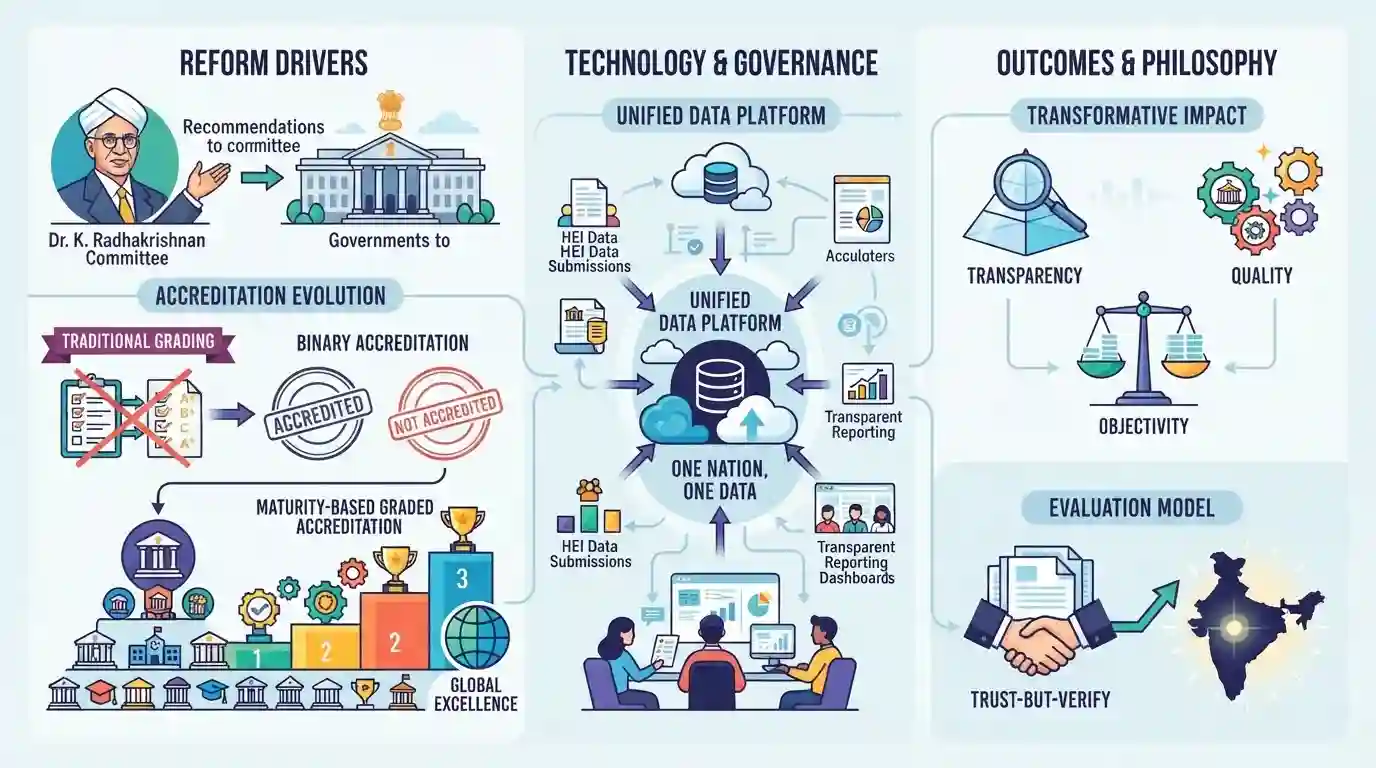
The Ministry of Education is implementing transformative, time-bound accreditation reforms for Higher Education Institutions (HEIs) in India, driven by the Dr. K. Radhakrishnan Committee recommendations. Key changes include replacing the traditional grading mechanism with a Binary Accreditation system to encourage broader participation, followed by a Maturity-Based Graded Accreditation to foster global excellence. To streamline the assessment process and reduce administrative burdens, a unified 'One Nation, One Data' platform will be established. These reforms, aligned with the National Education Policy (NEP) 2020, aim to enhance transparency, objectivity, and overall quality in India's higher education sector, moving towards a 'trust-but-verify' evaluation model.
ముఖ్య అంశాలు
- Transition from NAAC's traditional CGPA grading to a Binary Accreditation system (Accredited vs. Not Accredited) to widen the base of accredited institutions.
- Introduction of Maturity-Based Graded Accreditation (Levels 1 to 5) to help high-performing institutions achieve global excellence.
- Creation of a 'One Nation, One Data' platform to consolidate institutional data, thereby reducing the compliance and reporting burden on Higher Education Institutions (HEIs).
- The reforms are based on the recommendations of the Dr. K. Radhakrishnan Committee and align with the National Education Policy (NEP) 2020 goals.
- Adoption of a 'trust-but-verify' model prioritizing transparent, data-driven self-disclosure to minimize subjectivity and manual interference in accreditation.
ముఖ్యమైన పదాలు
National Education Policy (NEP) 2020

A comprehensive framework launched in 2020 to transform India's education system, aiming for 100% gross enrolment in schools by 2030 and 50% in higher education by 2035 through holistic, multidisciplinary learning.
UPSC context
GS Paper II (Social Justice/Education); tests understanding of policy reforms, federal coordination, and educational governance.
One Nation One Data platform
A unified digital portal proposed by the Ministry of Education to consolidate and standardize data submission from Higher Education Institutions, eliminating redundancies across different regulatory and accrediting bodies like UGC, NAAC, and NIRF.
UPSC context
GS Paper II (Governance/E-Governance); tests understanding of digital governance initiatives, administrative streamlining, and data integration.
National Assessment and Accreditation Council (NAAC)
An autonomous institution established by the UGC in 1994 to evaluate and accredit higher education institutions in India, assessing their overall quality, infrastructure, teaching, and research standards.
UPSC context
GS Paper II (Governance/Statutory Bodies); tests regulatory mechanisms, quality control, and recent reforms in higher education.
University Grants Commission (UGC)
A statutory body established under the UGC Act, 1956, responsible for coordinating, determining, and maintaining academic standards, as well as providing funding to recognized universities and colleges in India.
UPSC context
GS Paper II (Constitutional & Statutory Bodies); tests regulatory oversight of higher education, administrative structures, and funding mechanisms.
Binary Accreditation
An entry-level evaluation model where higher education institutions are certified simply as "Accredited" or "Not Accredited" instead of receiving multi-tiered CGPA grades, fostering broader participation and reducing grading pressure.
UPSC context
GS Paper II (Issues related to Education); tests knowledge of quality-assurance reforms and reducing administrative bias in education.
Maturity-Based Graded Accreditation
A five-level progression framework (Levels 1 to 5) that accredited higher education institutions can optionally pursue to showcase continuous improvement, institutional depth, and graduate toward global excellence.
UPSC context
GS Paper II (Social Sector/Education); tests evaluation methodologies, excellence-building policies, and standards-setting in education.
Ministry of Education
A ministry of the Government of India responsible for formulating and implementing national education policies, overseeing technical education, and improving accessibility and quality in the country's educational framework.
UPSC context
GS Paper II (Governance/Executive Structure); tests institutional mechanisms of the executive branch and national social development policies.
ప్రిలిమ్స్ ఉచ్చు
"The Radhakrishnan Committee has replaced all graded accreditations with a single Binary pass/fail framework."
The new system uses a Binary baseline to widen participation, but still relies on Maturity-Based Graded Accreditation (Levels 1-5) for institutions to showcase global excellence.
అనుసంధానమైన స్థిర భావనలు
What is the functional distinction between UGC, AICTE, and NAAC?
- UGC: Statutory body responsible for coordinating, determining, and maintaining standards of university education, including the disbursement of grants.
- AICTE: Statutory body tasked with planning, formulating, and coordinating technical and management education systems across India.
- NAAC: An autonomous body established and funded by the UGC to assess and accredit higher education institutions based on quality benchmarks.
How does NEP 2020 envision accreditation and institutional restructuring?
- Meta-accrediting body: Envisions a National Accreditation Council (NAC) as a 'meta-accreditor' to oversee independent accrediting institutions rather than executing direct accreditations itself.
- Phased Autonomy: Aims to phase out the system of affiliated colleges over 15 years, granting them graded autonomy to become independent, degree-granting entities.
- Light but tight: Recommends a regulatory regime based on transparent, self-disclosed data to minimize manual interference, adopting a 'trust-but-verify' approach.
అంతర-అంశ నమూనాలు
"One Nation, One Data" & E-Governance
Consolidating NIRF, AISHE, and NAAC portals mirrors overarching e-governance drives (e.g., UDISE+, APAAR), replacing fragmented departmental silos with interoperable digital public infrastructure.
Skilling & the Demographic Dividend
Expanding HEI accreditation participation—historically avoided by 85% of colleges—is structurally linked to closing the skill-employability gap necessary to reap India's demographic dividend.

Expect a multi-statement Prelims question testing the Radhakrishnan Committee's Binary vs Maturity-based accreditation structures.
అనుసంధాన PYQలు · 2
అనుసంధాన PYQలు · 2
- 2020MainsGS2
National Education Policy 2020 is in conformity with the Sustainable Development Goal-4 (2030). It intends to restructure and reorient education system in India. Critically examine the statement.
- 2015MainsGS2
The quality of higher education in India requires major improvements to make it internationally competitive. Do you think that the entry of foreign educational institutions would help improve the quality of higher and technical education in the country? Discuss.
