India First Telecom Manufacturing Zone in Madhya Pradesh
Source:PIB ↗
આ શા માટે મહત્વનું છે
The creation of India's first Telecom Manufacturing Zone represents a major shift toward high-tech self-reliance (Aatmanirbhar Bharat). It demonstrates how cooperative federalism (using a 51:49 joint SPV structure) can be operationalized to build robust manufacturing ecosystems, move up the value chain from service delivery to IP-creation, and reduce strategic import dependencies in critical communication technologies.
સારાંશ
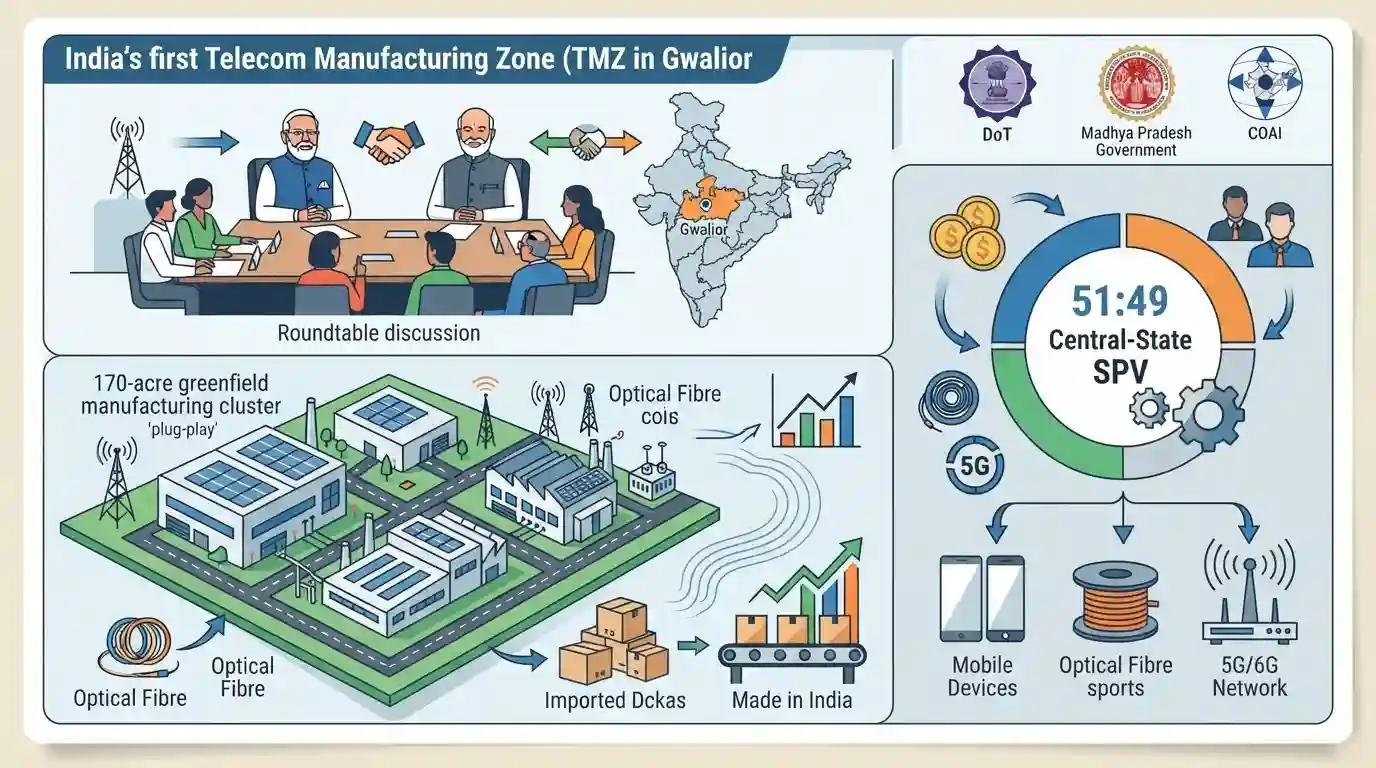
Union Minister of Communications Jyotiraditya M. Scindia and Madhya Pradesh CM Dr. Mohan Yadav jointly chaired investor and strategic roundtables in Mumbai to advance India's first Telecom Manufacturing Zone (TMZ) in Gwalior, MP. Spearheaded by the Department of Telecommunications (DoT) in partnership with the MP Government and COAI, the zone is a 170-acre plug-and-play greenfield manufacturing cluster. It seeks to transition India from a services-led to a product-led economy, reducing dependency on telecom imports and generating massive employment. Backed by a 51:49 Central-State SPV, the project has already secured over ₹5,500 crore in private investment commitments from major tech and telecom giants to manufacture mobile devices, optical fibre, and 5G/6G components.
મુખ્ય મુદ્દા
- Strategic Pivot: Serves as a primary driver of India’s economic transition from a services-led model to a product-led economy by retaining domestic intellectual property (IP) and boosting telecom exports.
- Unique Central-State SPV Model: The project will be executed through a Special Purpose Vehicle (SPV) with 51% equity held by the Government of Madhya Pradesh and 49% by the Department of Telecommunications (DoT).
- Financial & Land Commitments: The Central Government is providing 100% funding support of ₹493 crore for Phase-I development, while the Madhya Pradesh Government is providing 170 acres of land free of cost along with state-specific investor incentives.
- Ecosystem Co-Location: Major telecom operators (Airtel, Jio, Vi) have pledged to actively direct their global hardware and infrastructure vendors to set up manufacturing units within the zone, helping establish a self-sustaining ecosystem.
- Comprehensive Tech Coverage: The plug-and-play cluster is designed to manufacture optical fibre, mobile devices, core telecom equipment, and high-tech hardware for 5G and 6G technologies.
- Massive Economic Outlay: The investor roundtables in Delhi and Mumbai have successfully garnered investment commitments worth over ₹5,500 crores, projecting the creation of more than 18,000 employment opportunities in Gwalior.
મહત્વપૂર્ણ શબ્દો
Telecom Manufacturing Zone (TMZ) Project

A 350-acre integrated plug-and-play greenfield manufacturing cluster in Gwalior, Madhya Pradesh, developed under a Central-State SPV to boost indigenous production of telecom devices and 5G/6G equipment.
UPSC context
GS Paper 3 (Industrial Policy). Tests awareness of domestic electronics manufacturing hubs, Make in India, and federal cooperation in infrastructure.
Department of Telecommunications (DoT)
A department under the Ministry of Communications responsible for formulating telecom policies, licensing, spectrum management, and promoting domestic telecom equipment manufacturing in India.
UPSC context
GS Paper 2 & 3. Relevant for governance, regulatory bodies, and digital infrastructure initiatives in the telecom sector.
Cellular Operators Association of India (COAI)
An influential non-governmental trade association and advocacy group representing India's major telecom service providers and equipment manufacturers, collaborating with the government on sector policies.
UPSC context
GS Paper 2 & 3. Tests knowledge of key industry bodies influencing India's telecom regulations, net neutrality, and digital economy.
Aatmanirbhar Bharat
A flagship national vision aimed at making India self-reliant through robust domestic manufacturing, reduced import dependency, and global supply chain integration, particularly in strategic sectors.
UPSC context
GS Paper 3 (Indian Economy). Crucial for questions on industrial strategy, import substitution, and economic resilience.
Make in India
A central government initiative launched to encourage companies to manufacture products in India, aiming to transition the nation from a services-led to a product-led economy.
UPSC context
GS Paper 3 (Industrial Policy). Central to discussions on boosting the manufacturing sector's GDP share and large-scale employment generation.
પ્રિલિમ્સ ટ્રેપ
The TMZ SPV is majorly owned by the Central Government because it provides 100% of Phase-I funding.
While the Centre provides 100% funding for Phase-I, the State (MP) holds majority equity (51%) by providing land. Aspirants often wrongly equate full central funding with central ownership.
સંલગ્ન સ્થિર ખ્યાલો
What is a Special Purpose Vehicle (SPV) in infrastructure projects?
- Definition: A legal entity created for a specific, well-defined objective, such as building and managing a designated project, to isolate financial risk.
- Risk Isolation: It protects the parent entities (like state or central governments) from the financial liabilities and bankruptcy risks of the project itself.
- Financial Independence: An SPV has its own balance sheet and typically relies on project cash flows for debt servicing rather than sovereign guarantees.
How does the PLI Scheme support telecom manufacturing?
- Incentive Mechanism: Offers financial incentives linked to incremental sales of products manufactured in India, offsetting domestic disability costs.
- Target Sectors: Specifically targets the local manufacturing of core transmission equipment, 5G/6G networking products, and optical fibers.
- Value Addition: Promotes design-led manufacturing to shift the industry from mere hardware assembly to high-value domestic intellectual property (IP) creation.
આંતર-વિષય પેટર્ન
Cooperative Federalism in Infra SPVs
The 51:49 State-Centre equity model mirrors structures seen in Smart Cities and PM MITRA, effectively balancing state land assets against central capital grants to avoid land-acquisition delays.
Telecom import substitution strategy
India relies on imports for 80% of internal mobile components. The TMZ aligns with PLI schemes to shift India from a low-value assembly hub to an IP-holding product exporter.
Synergy with the BHAVYA Scheme
The TMZ’s "plug-and-play" underground utility corridor serves as a direct practical template for the newly approved ₹33,660 crore BHAVYA scheme aiming to set up 100 industrial parks.

Expect a multi-statement question in 2026 blending TMZ's unique equity-funding split (51% state/49% centre) with the BHAVYA scheme.
સંલગ્ન PYQ · 3
સંલગ્ન PYQ · 3
- 2023PrelimsGS1
Consider the following statements: Statement-I: India accounts for 3.2% of global export of goods. Statement-II: Many local companies and some foreign companies operating in India have taken advantage of India's 'Production-linked Incentive' scheme. Which one of the following is correct in respect of the above statements?
- 2023MainsGS3
Faster economic growth requires increased share of the manufacturing sector in GDP, particularly of MSMEs. Comment on the present policies of the Government in this regard.
- 2025MainsGS3
India aims to become a semiconductor manufacturing hub. What are the challenges faced by the semiconductor industry in India? Mention the salient features of the India Semiconductor Mission.
