CAQM Dust Mitigation Norms Extension Across NCR Local Bodies
Source:PIB ↗
Why It Matters
The initiative provides a practical example of leveraging decentralized governance (ULBs) to address complex environmental challenges (air pollution in NCR). It is highly relevant for GS3 (Environment/Pollution) and GS2 (Role of Local Government in Governance).
Summary
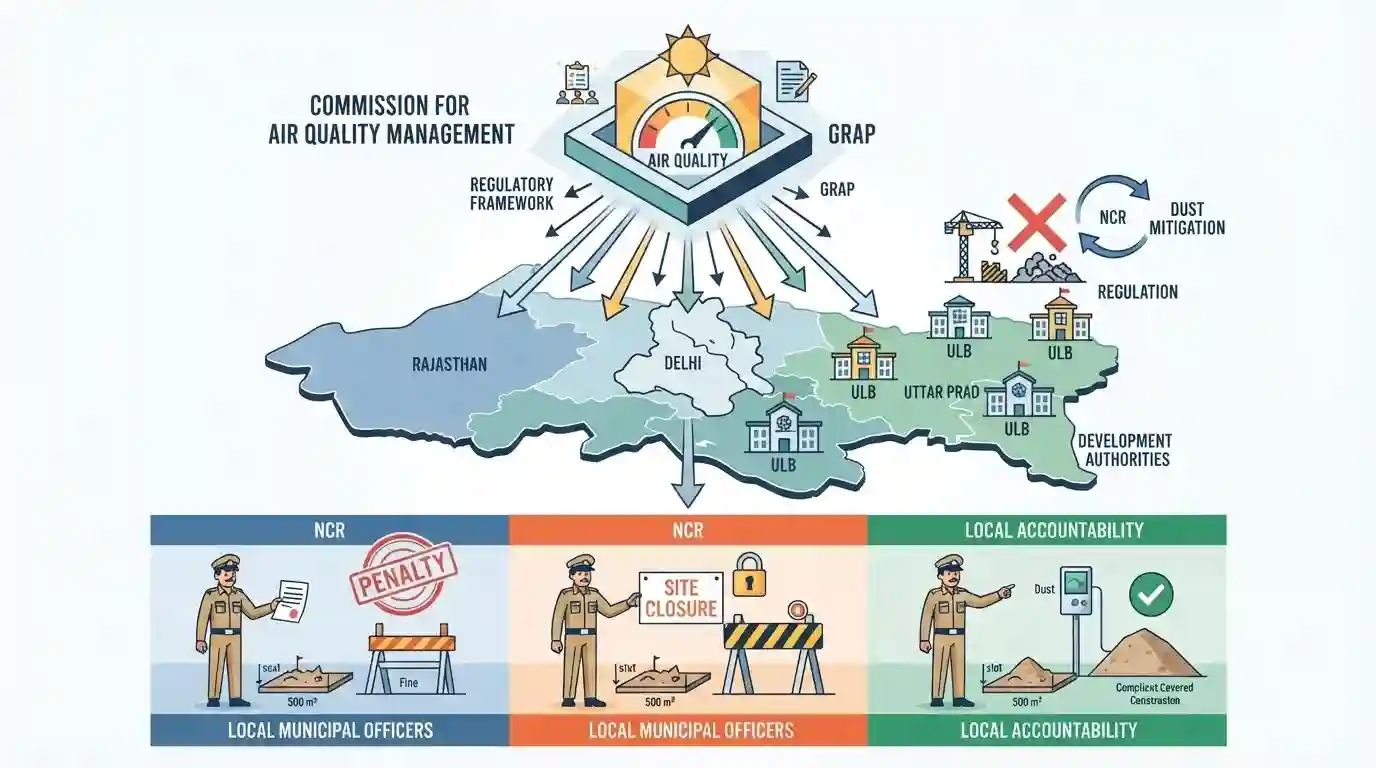
The Commission for Air Quality Management (CAQM) has extended its regulatory framework for dust mitigation by empowering a broader range of Urban Local Bodies (ULBs) and Development Authorities across the National Capital Region (NCR). Focused on curbing air pollution from Construction & Demolition (C&D) activities—specifically on plots smaller than 500 square meters—the updated mandate authorizes local authorities in Haryana, Uttar Pradesh, and Rajasthan to penalize violators of the Graded Response Action Plan (GRAP). By enabling local bodies to impose Environmental Compensation and enforce site closures, the CAQM is decentralizing environmental governance and increasing local accountability to address the region's chronic air quality crisis.
Key Points
- CAQM has expanded the enforcement mandate for dust mitigation at Construction & Demolition (C&D) sites to more Urban Local Bodies (ULBs) and Development Authorities across the NCR.
- The directive focuses strongly on C&D sites with plot areas smaller than 500 square meters, which often escape strict regulatory oversight.
- Empowered local bodies can now order site closures and impose Environmental Compensation (EC) on gross violators of the Graded Response Action Plan (GRAP).
- This regulatory expansion shifts environmental enforcement from a centralized mechanism to localized governance across extended NCR cities like Meerut, Rohtak, and Alwar.
Important Terms
Commission for Air Quality Management (CAQM)

A statutory body established under the CAQM in National Capital Region and Adjoining Areas Act, 2021, responsible for coordinating, research, and resolving air quality issues across Delhi-NCR and neighbouring regions.
UPSC context
GS Paper III (Environment) and Paper II (Governance); tests statutory environmental bodies, governance frameworks, and inter-state coordination.
Graded Response Action Plan (GRAP)
A predictive, stage-wise emergency framework enforced by the CAQM to combat worsening air quality in Delhi-NCR, activating progressively stricter measures based on Air Quality Index (AQI) thresholds.
UPSC context
GS Paper III (Environment); tests policy measures for environmental protection, urban pollution management, and institutional responses to winter smog.
Urban Local Bodies (ULBs)
Urban self-governing administrative units—such as Municipal Corporations and Municipalities—constitutionalized under the 74th Amendment Act to deliver civic services and execute urban planning.
UPSC context
GS Paper II (Polity and Governance); tests democratic decentralization, fiscal devolution, and local governance capacity in implementing environmental mandates.
Prelims Trap
The CAQM's jurisdiction and enforcement powers are confined exclusively to the National Capital Territory (NCT) of Delhi.
CAQM's jurisdiction is not limited to Delhi; it covers the entire NCR and adjoining areas in Punjab, Haryana, UP, and Rajasthan that impact Delhi's air quality.
Static Concepts Connected
What is the Commission for Air Quality Management (CAQM)?
- Statutory Body: Established under the CAQM Act 2021, replacing the non-statutory Environment Pollution (Prevention and Control) Authority (EPCA).
- Overriding Jurisdiction: Its orders override those of the Central Pollution Control Board (CPCB) and State PCBs in Delhi, Punjab, Haryana, UP, and Rajasthan regarding air quality.
- Farmer Exemption: Stubble burning is decriminalized; farmers are exempt from the standard 5-year imprisonment or ₹1-crore fine, though liable for environmental compensation.
What is the Graded Response Action Plan (GRAP)?
- Origin: An emergency response mechanism formulated in 2017 following a Supreme Court directive in the M.C. Mehta case.
- AQI Triggers: Actions are tied to the National Air Quality Index (AQI), automatically kicking in when pollution reaches specific thresholds.
- Four Stages: Operates across four stages: Stage I (Poor: 201-300), Stage II (Very Poor), Stage III (Severe), to Stage IV (Severe+: >450).
Cross-Topic Patterns
Environmental Governance + 74th Amendment
Shifting GRAP enforcement to ULBs highlights the growing intersection of statutory environmental bodies (CAQM) and the functional domain of local self-government under the 74th Constitutional Amendment.
Decentralized Urban Dust vs Stubble Burning
While stubble burning dominates news, expanding ULB oversight to small construction plots (<500 sqm) signals a policy shift towards micro-managing decentralized urban particulate matter (PM10/PM2.5) year-round.

Expect a 2026 Prelims question testing CAQM's statutory overriding powers over State PCBs, paired with its move to empower ULBs.
Linked PYQs · 2
Linked PYQs · 2
- 2021MainsGS3
Describe the key points of the revised Global Air Quality Guidelines (AQGs) recently released by the World Health Organisation (WHO). How are these different from its last update in 2005? What changes in India's National Clean Air Programme are required to achieve these revised standards?
- 2024MainsGS2
Analyse the role of local bodies in providing good governance at local level and bring out the pros and cons merging the rural local bodies with the urban local bodies.
