Yuva Sangam Phase VII under Ek Bharat Shreshtha Bharat
Source:PIB ↗
ఇది ఎందుకు ముఖ్యం
This initiative is a practical manifestation of the National Education Policy (NEP) 2020's focus on experiential learning and holistic youth development. In the context of UPSC, it demonstrates how institutional collaborations, youth exchanges, and 'Whole of Government' policy designs are utilized as soft-power tools to bridge regional disparities, foster emotional integration, and preserve India's 'Unity in Diversity' at the grassroots level.
సారాంశం
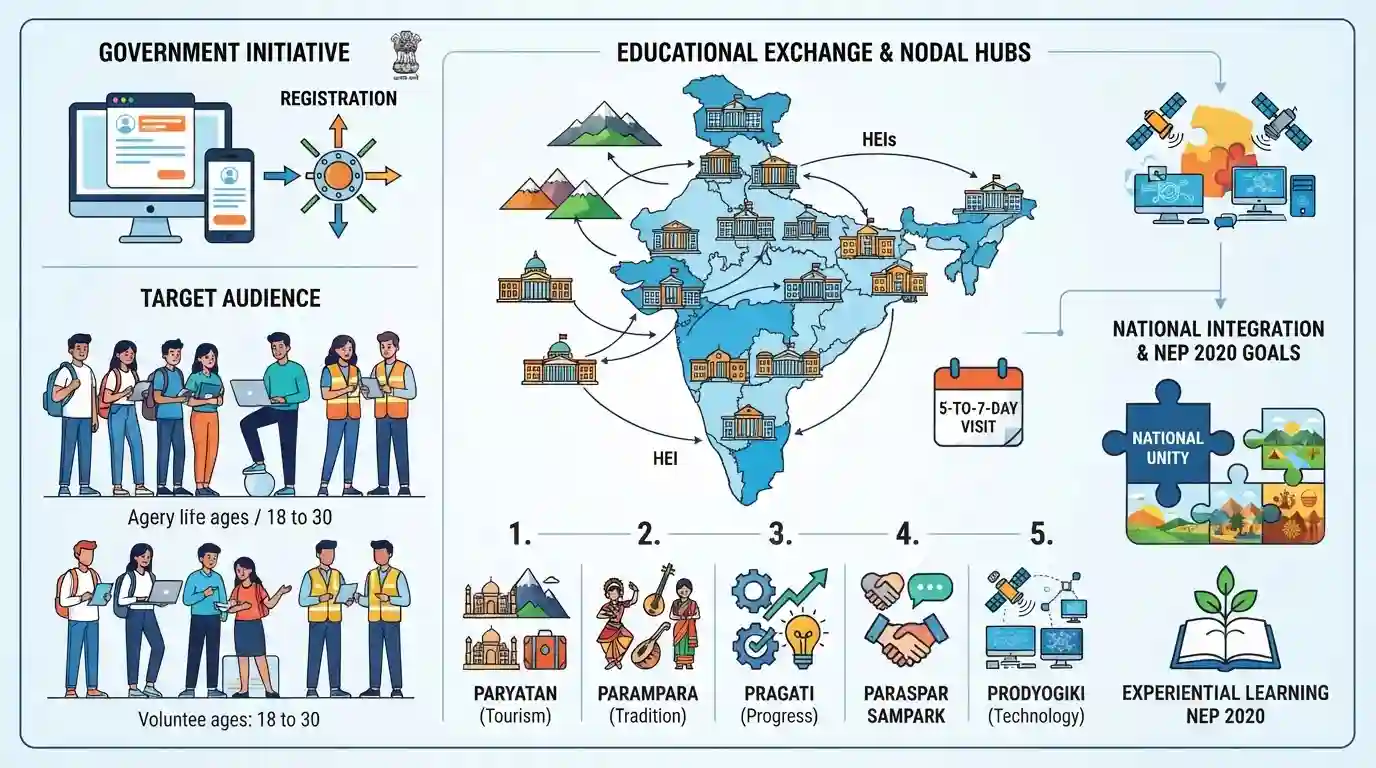
The Ministry of Education has commenced online registrations for Yuva Sangam Phase VII under the Ek Bharat Shreshtha Bharat (EBSB) initiative, targeting youth aged 18–30 (including college students, young professionals, and volunteers). Facilitated by 20 premier Higher Education Institutions (HEIs) acting as nodal hubs, the program provides structured 5-to-7-day educational and cultural exchange visits between paired states/UTs. Built around the five thematic pillars of Paryatan, Parampara, Pragati, Paraspar Sampark, and Prodyogiki, the project uses a collaborative 'Whole of Government' approach to promote emotional integration, break down regional divides, and implement the experiential learning goals of the National Education Policy (NEP) 2020.
ముఖ్య అంశాలు
- The Ministry of Education has opened registrations for Yuva Sangam Phase VII, a flagship youth exchange programme under the Ek Bharat Shreshtha Bharat (EBSB) initiative.
- Eligible participants are youth aged 18–30 years, including higher education students, NSS/NYKS volunteers, and young professionals.
- The exchange program is facilitated by 20 premier Higher Education Institutions (IITs, IIMs, Central Universities, and NITs) serving as paired nodal centers across different States and Union Territories.
- Participants go on 5-to-7-day structured exposure visits to paired states/UTs to experience local culture, development projects, governance, and technology first-hand.
- The program is based on five thematic pillars (the 5 Ps): Paryatan (Tourism), Parampara (Traditions & Culture), Pragati (Development & Governance), Paraspar Sampark (People-to-People Connect), and Prodyogiki (Technology & Innovation).
- Implemented via a 'Whole of Government' approach, the initiative aligns with the experiential learning and national integration goals of the National Education Policy (NEP) 2020.
ముఖ్యమైన పదాలు
Ek Bharat Shreshtha Bharat

A Union government initiative launched in 2015 to enhance national integration and mutual understanding among citizens of paired States and Union Territories through structured, year-round engagements.
UPSC context
GS Paper II: Government Policies; GS Paper I: National Integration. Tests knowledge of cooperative cultural partnerships.
Yuva Sangam
A youth exchange program under Ek Bharat Shreshtha Bharat targeting youth aged 18-30 to promote national integration, cultural exchange, and experiential learning through structured state-to-state visits.
UPSC context
GS Paper II: Government Policies. Tests youth development schemes, cooperative federalism, and experiential learning integration.
National Education Policy 2020
India's comprehensive education reform framework aiming to transform school and higher education through holistic, flexible, multidisciplinary curricula and experiential learning models.
UPSC context
GS Paper II: Social Sector/Education. Tests conceptual understanding of structural academic reforms and human capital development.
All India Council for Technical Education (AICTE)
A statutory apex advisory and regulatory body under the Ministry of Education responsible for planning, formulation, and standard-setting in technical and management education in India.
UPSC context
GS Paper II: Statutory and Regulatory Bodies. Tests educational administration, quality assurance, and technical education governance.
National Service Scheme (NSS)
A Central Sector voluntary community service scheme launched in 1969 to build civic responsibility, social consciousness, and personality development among school and university-level students.
UPSC context
GS Paper II: Government Interventions. Tests institutionalized youth volunteerism, community mobilization, and social sector service delivery.
Nehru Yuva Kendra Sangathan (NYKS)
An autonomous grassroots youth organization under the Ministry of Youth Affairs and Sports established to channelize rural youth energies toward community development and nation-building.
UPSC context
GS Paper II: Government Policies. Tests grassroots rural youth leadership models and public-private-community development partnerships.
ప్రిలిమ్స్ ఉచ్చు
Yuva Sangam is a youth program designed and executed solely by the Ministry of Youth Affairs and Sports.
While it targets youth and partners with youth organizations, Yuva Sangam is led by the Ministry of Education, leveraging higher education institutions as nodal hubs.
అనుసంధానమైన స్థిర భావనలు
What is the 'Whole of Government' governance model?
- Definition: An approach integrating public agencies across portfolio boundaries to eliminate departmental silos and address complex, multi-sectoral national challenges.
- Collaboration mechanism: Utilizes shared resources, joint committees, and inter-ministerial coordination, shifting from competitive bureaucracy to collaborative policy execution.
What is the 'Ek Bharat Shreshtha Bharat' initiative?
- Origin: Launched in 2015 on Sardar Vallabhbhai Patel's 140th birth anniversary to systematically promote structured national integration.
- State pairing: Establishes continuous engagement by pairing States and UTs to foster cultural, linguistic, and educational exchanges.
అంతర-అంశ నమూనాలు
NEP 2020 + experiential pedagogy
Yuva Sangam operationalizes the National Education Policy's focus on experiential, community-based, and cross-cultural learning outside formal classroom boundaries.
Soft power + internal security
Fostering regional empathy and reducing geographic alienation acts as a critical soft-governance strategy to counter deep-seated regionalism and internal security vulnerabilities.

Prelims 2026 may test the '5 Ps' of Yuva Sangam, its unique 18-30 age bracket, and coordination under the Ministry of Education.
అనుసంధాన PYQలు · 2
అనుసంధాన PYQలు · 2
- 2020MainsGS2
National Education Policy 2020 is in conformity with the Sustainable Development Goal-4 (2030). It intends to restructure and reorient education system in India. Critically examine the statement.
- 2024MainsGS1
What is regional disparity? How does it differ from diversity? How serious is the issue of regional disparity in India?
