PM-AJAY Adarsh Gram Scheme and Educational Infrastructure
Source:PIB ↗
આ શા માટે મહત્વનું છે
The article highlights crucial data regarding the government's flagship scheme for Scheduled Castes (PM-AJAY). It acts as an excellent case study for Mains GS2 answers concerning the performance of welfare schemes for vulnerable sections and the role of educational infrastructure in social empowerment.
સારાંશ
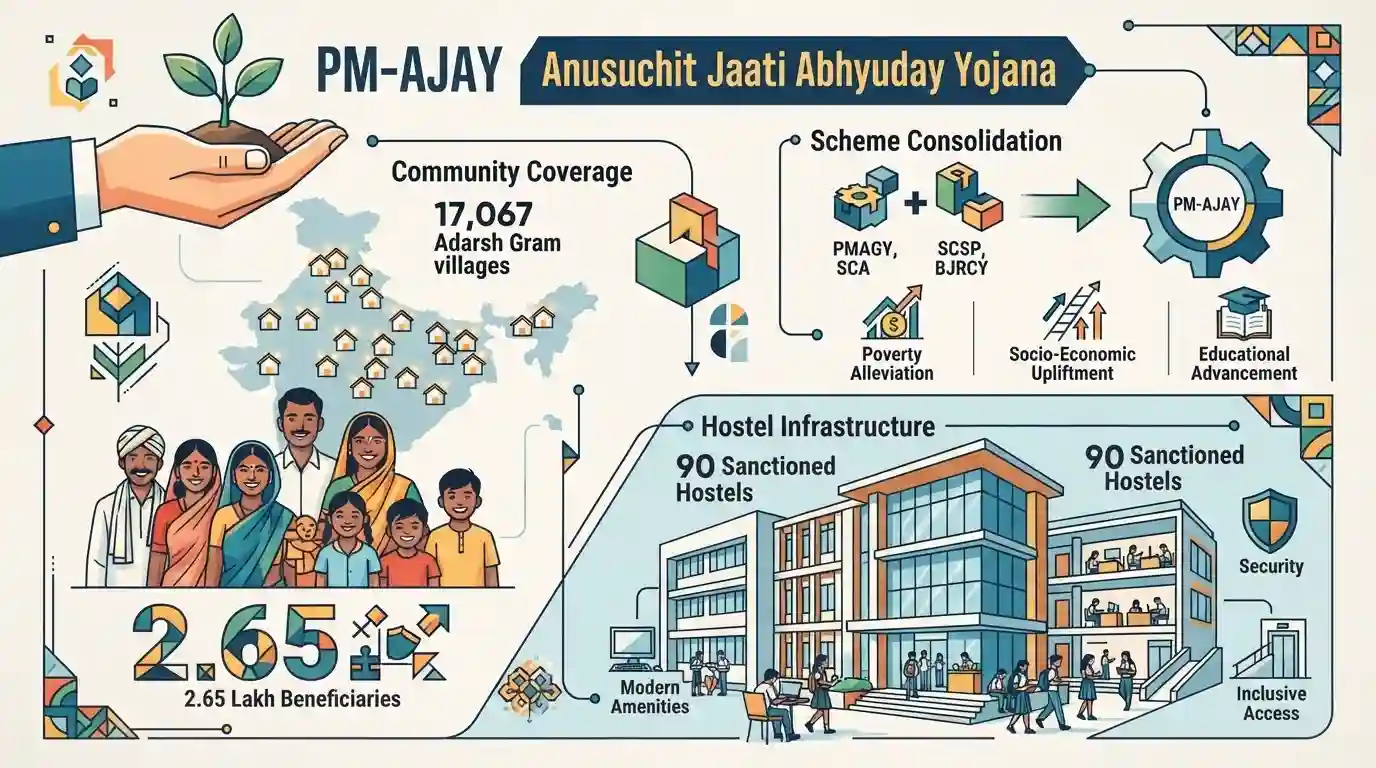
The Ministry of Social Justice and Empowerment has successfully covered over 2.65 lakh Scheduled Caste (SC) beneficiaries under the educational component of the Pradhan Mantri Anusuchit Jaati Abhyuday Yojana (PM-AJAY) across 17,067 Adarsh Gram villages. PM-AJAY, formed by merging three older schemes (PMAGY, SCA to SCSP, and BJRCY), focuses on poverty reduction, socio-economic upliftment, and educational advancement for SC communities. A key achievement includes sanctioning 90 hostels for SC students with an investment of ₹198.50 crore, featuring modern amenities, security, and inclusive access to foster higher education among marginalized youth.
મુખ્ય મુદ્દા
- The PM-AJAY scheme is a comprehensive initiative launched by the Ministry of Social Justice and Empowerment to promote the educational and socio-economic development of Scheduled Caste communities.
- It is an amalgamation of three Centrally Sponsored Schemes: Pradhan Mantri Adarsh Gram Yojana (PMAGY), Special Central Assistance to Scheduled Castes Sub Plan (SCA to SCSP), and Babu Jagjivan Ram Chhatrawas Yojana (BJRCY).
- Over 2.65 lakh SC beneficiaries have been covered under the educational domain across 17,067 PM-AJAY Adarsh Gram villages.
- 90 hostels for SC students have been sanctioned from FY 2021-22 to FY 2025-26 with an expenditure of ₹198.50 crore, providing facilities like security, medical care, coaching, and disabled-friendly access.
મહત્વપૂર્ણ શબ્દો
Pradhan Mantri Anusuchit Jaati Abhyuday Yojana (PM-AJAY)

A centrally sponsored scheme for the socio-economic upliftment of Scheduled Castes. It merges PMAGY, SCA to SCSP, and BJRCY to reduce poverty, build model villages (Adarsh Grams), and improve educational infrastructure.
UPSC context
Crucial for GS Paper II (Welfare Schemes). Tests knowledge of umbrella initiatives and convergence strategies for SC empowerment.
Pradhan Mantri Adarsh Gram Yojana (PMAGY)
A scheme merged into PM-AJAY focusing on the integrated development of villages with over 50% SC population. It uses convergent implementation of existing schemes along with gap-filling funds for unmet infrastructural needs.
UPSC context
Relevant for GS Paper II (Social Justice). Highlights area-based rural development approaches to eliminate SC and non-SC socio-economic disparities.
Babu Jagjivan Ram Chhatrawas Yojana (BJRCY)
A scheme, now part of PM-AJAY, that provides central financial assistance to construct and expand hostel facilities for SC students. It aims to reduce dropout rates and support educational access, especially for girls.
UPSC context
Important for GS Paper II (Education/Vulnerable Sections). Tests understanding of targeted infrastructure interventions that improve higher education access.
Special Central Assistance to Scheduled Castes Sub Plan (SCA to SCSP)
A sub-scheme of PM-AJAY providing additive central funds to state governments' SC Sub-Plans. It specifically targets poverty reduction by supporting income-generating activities and skill development for SC families below the poverty line.
UPSC context
Essential for GS Paper II and III (Inclusive Growth). Tests knowledge of center-state financial mechanisms supporting localized SC economic empowerment.
Ministry of Social Justice and Empowerment
The nodal central ministry responsible for the welfare, social justice, and empowerment of marginalized groups, including Scheduled Castes, OBCs, and persons with disabilities, primarily by implementing protective legislation and welfare schemes.
UPSC context
Core to GS Paper II (Governance). UPSC often tests which ministry is the nodal authority for specific social welfare initiatives.
પ્રિલિમ્સ ટ્રેપ
PM-AJAY is classified as a Central Sector Scheme because of its 100% central funding model for key components.
PM-AJAY is officially a Centrally Sponsored Scheme, not a Central Sector Scheme. Also, the Adarsh Gram component strictly requires a village SC population of 50% or more.
સંલગ્ન સ્થિર ખ્યાલો
What constitutional provisions protect and promote the interests of Scheduled Castes?
- Article 17: Abolishes untouchability and forbids its practice in any form.
- Article 46: Mandates the State to promote educational and economic interests of weaker sections, especially SCs/STs.
- Article 338: Establishes the National Commission for Scheduled Castes to safeguard their rights and investigate violations.
How do Centrally Sponsored and Central Sector schemes differ?
- Funding source: Central Sector schemes are 100% Union-funded, whereas Centrally Sponsored Schemes typically involve shared funding with states.
- Implementation agency: Central Sector schemes are directly executed by Union ministries; Centrally Sponsored schemes are implemented by state governments.
આંતર-વિષય પેટર્ન
Geographic targeting in welfare
Combining PM-AJAY's SC-concentration threshold (50%) with tribal-village schemes (PM-JANMAN) highlights India's shift toward hyper-localized, demographic-specific rural development.
Hostels and educational dropout
Interlinking physical assets like SC student hostels with human capital outcomes showcases how infrastructure directly resolves socio-economic retention issues in higher education.

Multi-statement questions in 2026 may target the 50% SC population threshold for 'Adarsh Gram' and the specific schemes merged under PM-AJAY.
સંલગ્ન PYQ · 2
સંલગ્ન PYQ · 2
- 2019MainsGS2
Performance of welfare schemes that are implemented for vulnerable sections is not so effective due to absence of their awareness and active involvement at all stages of policy process. Discuss.
- 2020PrelimsGS1
Which part of the Constitution of India declares the ideal of Welfare State?
