Post-Matric Scholarship Scheme Reforms for SC Higher Education
Source:PIB ↗
কেন এটি গুরুত্বপূর্ণ
It exemplifies how addressing structural bottlenecks in Centrally Sponsored Schemes—such as reforming Centre-State funding patterns and utilizing digital governance (DBT and Aadhaar)—can improve the delivery and transparency of social justice programs for marginalized communities.
সারসংক্ষেপ
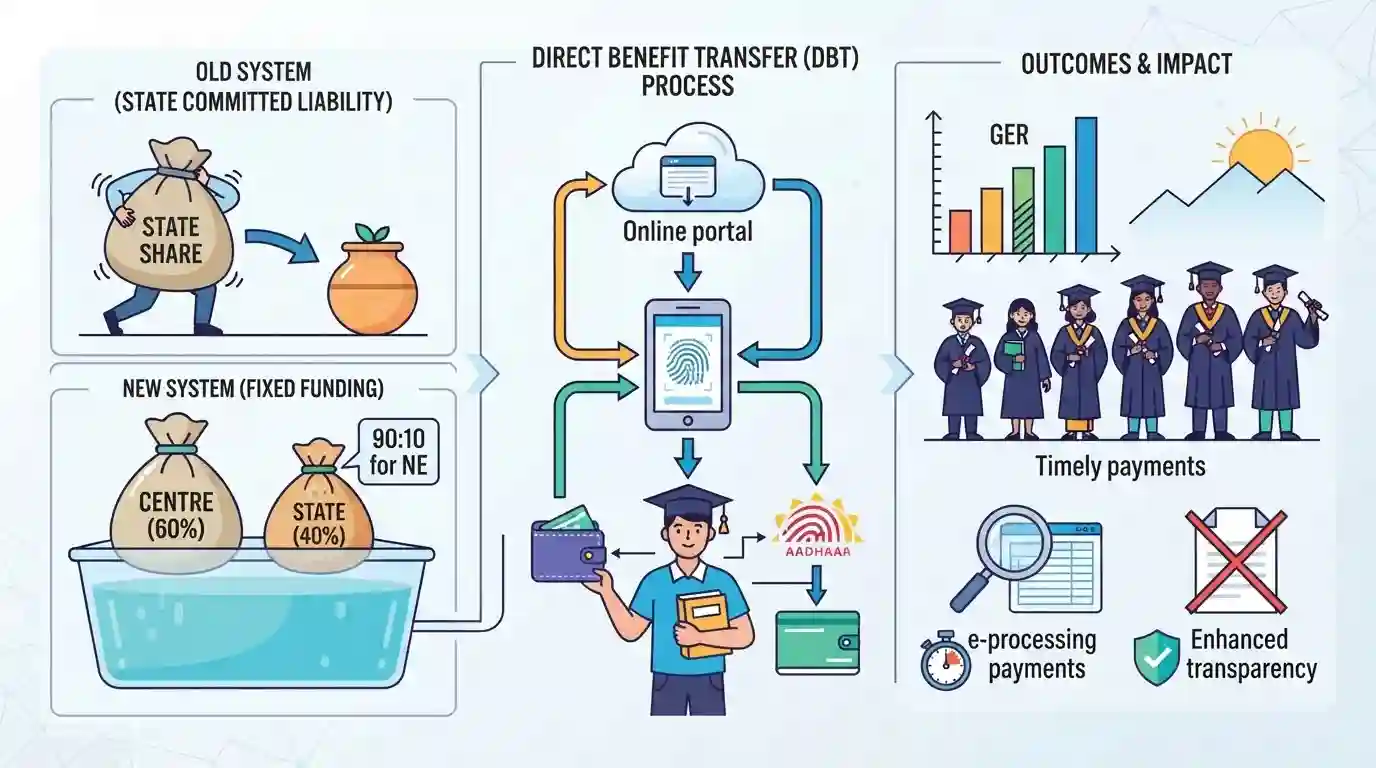
The Government of India has revamped the Post-Matric Scholarship Scheme for Scheduled Caste (SC) students to boost their Gross Enrolment Ratio (GER) in higher education. A major reform in 2020-21 replaced the 'State Committed Liability' with a fixed Centre-State funding ratio of 60:40 (90:10 for North-Eastern states), easing fiscal constraints for states. Furthermore, from 2021-22, the scheme adopted Direct Benefit Transfer (DBT), remitting funds directly into students' Aadhaar-seeded bank accounts once states release their share. The shift to end-to-end online processing has enhanced transparency, ensured timely payments, and minimized duplication.
মূল বিষয়
- The Post-Matric Scholarship Scheme aims to significantly raise the Gross Enrolment Ratio (GER) of Scheduled Caste students in higher education.
- In 2020-21, the funding pattern was reformed from a State Committed Liability system to a fixed 60:40 Centre-State ratio (90:10 for North-Eastern states), reducing the financial burden on states.
- Since 2021-22, funds are disbursed via Direct Benefit Transfer (DBT) directly into the Aadhaar-seeded bank accounts of students.
- The Central share is released to students only after the respective State Government transfers its matching share, ensuring financial accountability.
- End-to-end online processing and linkage with available databases ensure transparency, timely payment, and eliminate duplication.
গুরুত্বপূর্ণ শব্দ
Post-Matric Scholarship Scheme for SC students

A Centrally Sponsored Scheme enabling Scheduled Caste students to pursue post-matric/higher education. It covers tuition fees, academic allowances, and targets students with a parental income ceiling of ₹2.5 lakh per annum.
UPSC context
GS Paper II: Welfare schemes for vulnerable sections; social sector education. Tests knowledge of social justice initiatives and federal funding models.
Direct Benefit Transfer (DBT)
A government mechanism launched in 2013 to transfer subsidies, scholarships, pensions, and welfare benefits directly into beneficiaries' Aadhaar-seeded bank accounts, eliminating intermediaries and reducing leakages.
UPSC context
GS Paper II: Governance, transparency, accountability, and e-governance. Tests understanding of digital governance and welfare delivery.
State Committed Liability
The financial obligation borne by state governments under previous CSS funding models, equivalent to their expenditure level in the terminal year of the preceding Finance Commission cycle, before receiving central assistance.
UPSC context
GS Paper II: Issues and challenges pertaining to the federal structure, and fiscal federalism.
Gross Enrolment Ratio (GER)
A metric representing the ratio of total enrolment in a specific educational level (regardless of age) to the official school-age population for that level, expressed as a percentage.
UPSC context
GS Paper II: Social sector issues relating to Education. Tests knowledge of human development indicators and policy targets.
Centrally Sponsored Scheme (CSS)
A scheme funded jointly by the Centre and States (usually in a 60:40 or 90:10 ratio) but implemented by State Governments to achieve national development goals.
UPSC context
GS Paper II: Functions and responsibilities of the Union and States, and federal structure challenges.
প্রিলিমস ফাঁদ
The Central government releases its share first to states to kickstart the disbursement process under the Post-Matric Scholarship Scheme.
Under the reformed guidelines, the Central share is only released *after* the State government has released its matching share. It does not flow automatically or in advance to the states.
সংযুক্ত স্থির ধারণা
What is the difference between Central Sector Schemes and Centrally Sponsored Schemes (CSS)?
- Funding & Agency: Central Sector Schemes are 100% funded and directly implemented by the Central Government.
- Co-sharing Model: CSS are jointly funded by the Centre and States (e.g., 60:40 or 90:10) and implemented by State administrations.
- Syllabus Alignment: CSS typically target subjects under the State or Concurrent Lists to achieve national development goals.
What was the 'State Committed Liability' system in Centrally Sponsored Schemes?
- Definition: It required states to fully take over the financial liability of a scheme's maintenance at the end of each Five-Year Plan.
- Central Share limitation: Only expenditure above this baseline 'committed' level was eligible for Central assistance in the next plan period.
- Impact on States: It created massive fiscal stress for poorer states, resulting in delayed payments and mounting student scholarship arrears.
আন্তঃবিষয় প্যাটার্ন
Fiscal Federalism + CSS Reform
The transition from 'committed liability' to fixed ratios illustrates how CSS design alterations can either relieve or strain state finances, impacting cooperative federalism.
Digital Welfare + Exclusion Risks
While Aadhaar-seeded DBT eliminates ghost beneficiaries, structural issues like bank-account mapping failures can inadvertently lead to exclusion errors among vulnerable demographics.

2026 exams will likely contrast Central Sector vs Centrally Sponsored Schemes, focusing on the mechanics of DBT and federal sharing ratios.
সংযুক্ত PYQ · 4
সংযুক্ত PYQ · 4
- 2019MainsGS2
Performance of welfare schemes that are implemented for vulnerable sections is not so effective due to absence of their awareness and active involvement at all stages of policy process. Discuss.
- 2024MainsGS2
e-governance is not just about the routine application of digital technology in service delivery process. It is as much about multifarious interactions for ensuring transparency and accountability. In this context evaluate the role of the 'Interactive Service Model' of e-governance.
- 2023MainsGS2
e-governance, as a critical tool of governance, has ushered in effectiveness, transparency and accountability in governments. What inadequacies hamper the enhancement of these features ?
- 2025MainsGS2
Examine the evolving pattern of Centre-State financial relations in the context of planned development in India. How far have the recent reforms impacted the fiscal federalism in India?
