Flex-Fuel Vehicles Policy Clarification and PLI Auto Scheme
Source:PIB ↗
આ શા માટે મહત્વનું છે
This article is highly relevant to the GS Paper 3 syllabus, covering critical intersections of manufacturing/industrial policy (PLI scheme), energy transition (ethanol blending, flex-fuel vehicles), and environmental sustainability (water conservation in agriculture, Zero Liquid Discharge in distilleries). It directly relates to core UPSC concepts like localization (Domestic Value Addition), the National Policy on Biofuels, and micro-irrigation (PMKSY).
સારાંશ
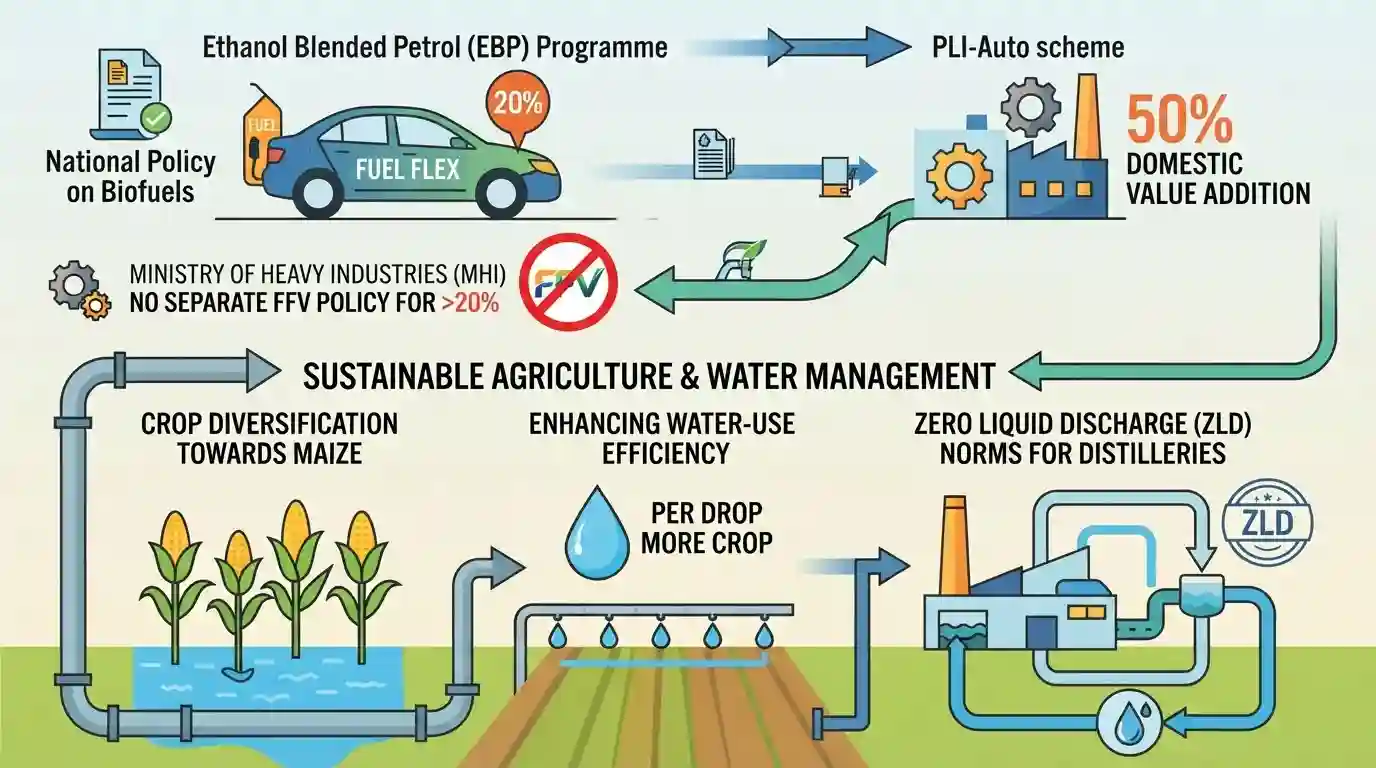
The Ministry of Heavy Industries (MHI) has clarified that there is no separate phased national policy or study for incentivizing flex-fuel vehicles (FFVs) running on >20% ethanol blends. Instead, the government is focusing on the PLI-Auto scheme (which mandates 50% Domestic Value Addition for incentives) and a balanced execution of the Ethanol Blended Petrol (EBP) Programme. To align biofuel goals with water and food security, the government is utilizing diverse feedstocks under the National Policy on Biofuels, promoting crop diversification towards maize, enhancing water-use efficiency through the 'Per Drop More Crop' initiative of the Pradhan Mantri Krishi Sinchayee Yojana, and enforcing Zero Liquid Discharge norms for distilleries.
મુખ્ય મુદ્દા
- The Ministry of Heavy Industries (MHI) clarified that it has not formulated any separate phased national policy or conducted any study to incentivize flex-fuel vehicles (FFVs) running on blends with more than 20% ethanol (E20).
- Under the PLI-Auto scheme, cumulative achievements as of March 31, 2026, include Rs. 44,326 crore in investments, Rs. 52,414 crore in incremental sales, and 67,820 jobs generated, with Rs. 2,386.36 crore in incentives disbursed.
- To qualify for PLI-Auto incentives, a minimum Domestic Value Addition (DVA) of 50% is mandated to promote localization, with 18 applicants having received DVA certificates for 155 Advanced Automotive Technology (AAT) products/variants as of July 2026.
- The government is balancing the Ethanol Blended Petrol (EBP) Programme with food security, water sustainability, and farmers' interests, producing ethanol from approved feedstocks like maize, sugarcane, and damaged foodgrains.
- Under the National Policy on Biofuels, crop diversification towards water-efficient crops (like maize) is encouraged. Water conservation is further promoted via micro-irrigation under the Per Drop More Crop (PDMC) component of PMKSY.
- To prevent environmental degradation, molasses-based distilleries utilizing incineration boilers and grain-based distilleries are legally mandated to function as Zero Liquid Discharge (ZLD) units to recycle and reuse process water.
મહત્વપૂર્ણ શબ્દો
PLI-Auto scheme

A financial incentive program by the Ministry of Heavy Industries to boost domestic manufacturing of advanced automotive technologies (like EVs), mandating at least 50% Domestic Value Addition.
UPSC context
GS-3 (Economy/Industry). Tests knowledge of the 'Make in India' initiative, industrial policy, and automotive supply chain resilience.
National Policy on Biofuels
A framework promoting domestic biofuel production from diverse feedstocks (sugarcane, maize, damaged grains). Amended in 2022, it advanced India's 20% ethanol blending target to 2025.
UPSC context
GS-3 (Environment/Energy). Crucial for questions on the sustainable energy transition, climate change targets, and national energy security.
Ethanol Blended Petrol (EBP) Programme
An initiative launched to blend ethanol into motor fuel, reducing fossil fuel reliance, cutting vehicle emissions, and boosting farmer incomes. It mandates E20 (20% ethanol) nationwide.
UPSC context
GS-3 (Environment/Agriculture). Evaluates understanding of the circular economy, renewable energy mandates, and agricultural feedstock diversification.
Pradhan Mantri Krishi Sinchayee Yojana (PMKSY)
A centrally sponsored umbrella scheme launched in 2015 focusing on expanding cultivable land under assured irrigation ('Har Khet Ko Pani') and improving agricultural water-use efficiency.
UPSC context
GS-3 (Agriculture). Important for topics on agricultural productivity, large-scale water conservation, and climate-resilient farming infrastructure.
Per Drop More Crop
A micro-irrigation initiative focusing on water-use efficiency through drip and sprinkler systems. Originally under PMKSY, it optimizes water consumption and enhances crop yields per drop.
UPSC context
GS-3 (Agriculture). Relevant for precision farming, sustainable water management, and mitigating drought impacts in Indian agriculture.
National Biofuel Coordination Committee
A central committee that oversees the implementation of biofuel programs. It holds the authority to approve the diversion of surplus food grains for ethanol production.
UPSC context
GS-2/3 (Governance/Energy). Highlights institutional mechanisms managing the 'food vs. fuel' debate and strategic energy planning.
પ્રિલિમ્સ ટ્રેપ
"The government has launched a dedicated national policy to incentivize Flex-Fuel Vehicles running on >20% ethanol blends."
The Ministry of Heavy Industries explicitly clarified that no such separate policy exists for blends above E20; incentives currently rely on the broader PLI-Auto scheme.
સંલગ્ન સ્થિર ખ્યાલો
What are the permitted feedstocks for 1G ethanol in India?
- Primary Crops: Sugarcane juice, sugar beet, sweet sorghum, and maize/corn.
- Damaged Grains: Broken rice, wheat, and rotten potatoes that are declared unfit for human consumption.
- Surplus Grains: Surplus rice with the Food Corporation of India, requiring National Biofuel Coordination Committee approval.
What is Zero Liquid Discharge (ZLD) in industrial pollution control?
- Complete Recycling: An engineering approach to water treatment where all wastewater is purified and recycled, leaving zero effluent.
- Mandatory Sectors: Legally mandated for highly polluting sectors in India, including molasses-based and grain-based distilleries, tanneries, and textiles.
- Resource Recovery: Recovers valuable resources (like salts) from wastewater while entirely eliminating the release of liquid pollutants.
આંતર-વિષય પેટર્ન
Biofuels shifting cropping patterns
The transition from water-guzzling sugarcane to maize for ethanol connects India's renewable energy targets with PMKSY water conservation and crop diversification goals.
50% DVA in PLI Schemes
The strict 50% Domestic Value Addition (DVA) requirement in the PLI-Auto scheme highlights India's shift from assembly-based manufacturing to deep supply-chain localization.

Expect a multi-statement question interlinking the 2025-26 E20 target, ZLD norms for distilleries, and the shift toward maize feedstock.
સંલગ્ન PYQ · 3
સંલગ્ન PYQ · 3
- 2025MainsGS3
Discuss the rationale of the Production Linked Incentive (PLI) scheme. What are its achievements? In what way can the functioning and outcomes of the scheme be improved?
- 2020PrelimsGS1
According to India's National Policy on Biofuels, which of the following can be used as raw materials for the production of biofuels ? 1. Cassava 2. Damaged wheat grains 3. Groundnut seeds 4. Horse gram 5. Rotten potatoes 6. Sugar beet Select the correct answer using the code given below:
- 2021MainsGS3
How and to what extent would micro-irrigation help in solving India's water crisis?
