TRAI Evaluates Railway Route Mobile Network Quality
Source:PIB ↗
Why It Matters
Demonstrates the practical enforcement of Quality of Service (QoS) standards by statutory bodies like TRAI. It connects to broader themes of digital infrastructure development, consumer protection, and regulatory governance in the telecommunications sector.
Summary
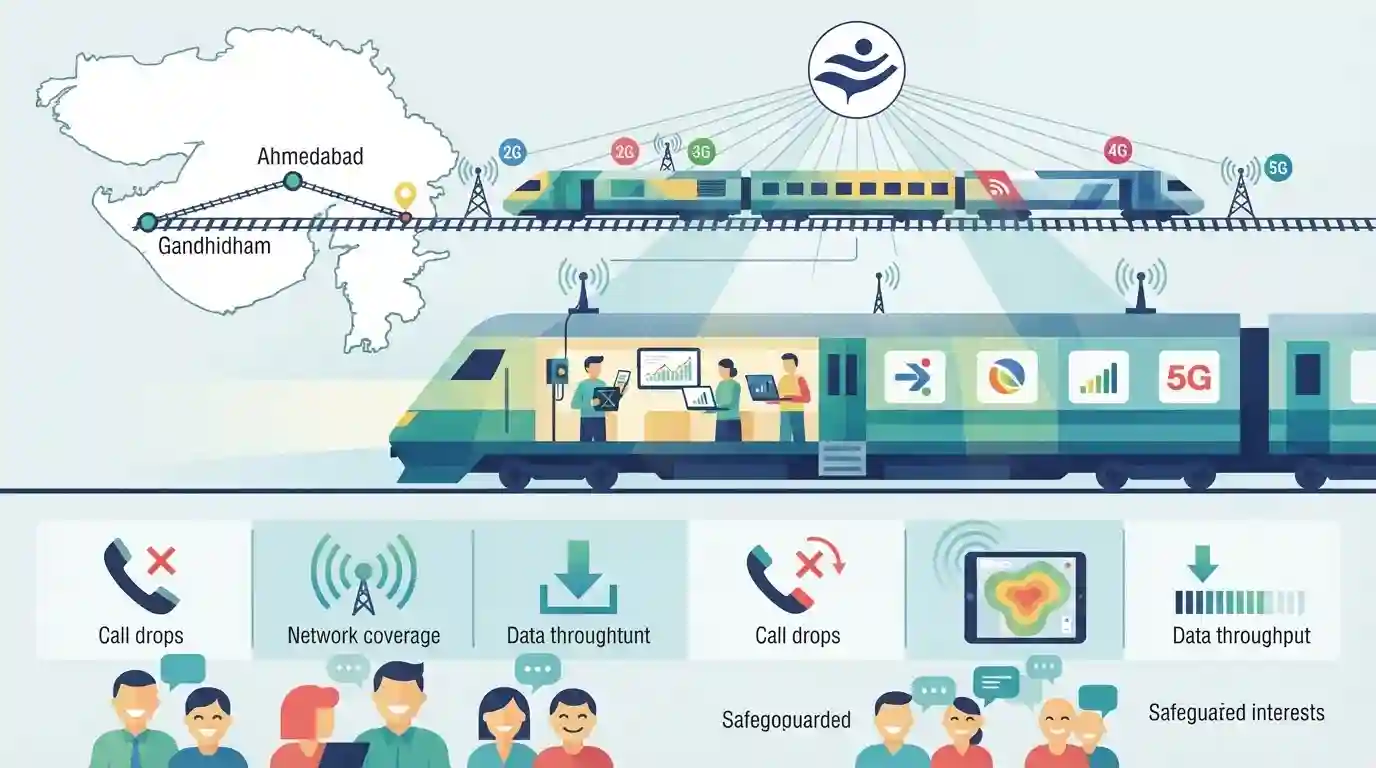
The Telecom Regulatory Authority of India (TRAI) conducted targeted Drive Tests along the Ahmedabad to Gandhidham railway route in Gujarat to evaluate the mobile network performance of major telecom operators. Assessing 2G, 3G, 4G, and 5G networks, the tests measured crucial Quality of Service (QoS) parameters such as call drop rates, network coverage, and data speeds. This initiative highlights TRAI's active regulatory role in ensuring that telecom service providers maintain high infrastructure standards and safeguard consumer interests.
Key Points
- The Telecom Regulatory Authority of India (TRAI) conducted extensive Drive Tests along the 300+ km Ahmedabad to Gandhidham railway route to assess real-time mobile network quality.
- The assessment evaluated the performance of major Telecom Service Providers (Airtel, BSNL, RJIL, VIL) across multiple network generations including 2G, 3G, 4G, and 5G.
- Key Performance Indicators (KPIs) monitored included network coverage, Call Drop Rate, Call Setup Success Rate, and data download/upload speeds.
- This exercise aligns with TRAI's statutory mandate to protect consumer interests and enforce prescribed Quality of Service (QoS) standards in the telecommunications sector.
Important Terms
TRAI (Telecom Regulatory Authority of India)

An independent statutory body established in 1997 to regulate telecom services, manage tariffs, and protect consumer interests, ensuring a level playing field and healthy growth of India's communication sector.
UPSC context
GS Paper II (Statutory & Regulatory Bodies) & GS Paper III (Infrastructure). Tests governance, telecom reforms, and regulatory architecture.
Telecom Regulatory Authority of India Act, 1997
The parliamentary legislation that established TRAI and was later amended in 2000 to set up the Telecom Disputes Settlement and Appellate Tribunal (TDSAT), separating adjudicatory and regulatory functions.
UPSC context
GS Paper II (Government Policies & Interventions). Tests legislative frameworks governing communication networks and digital platforms.
Quality of Service (QoS) Regulations
Regulatory benchmarks set by TRAI—updated strictly in 2024 to encompass 4G, 5G, and fiber broadband—prescribing standards for parameters like call drop rates, latency, packet drop, and network availability.
UPSC context
GS Paper III (Infrastructure/IT & Communication). Tests regulatory mechanisms to safeguard digital infrastructure standards and consumer rights.
BSNL (Bharat Sanchar Nigam Limited)
A 100% government-owned central public sector undertaking (CPSU) incorporated in 2000 to provide nationwide wireline, wireless, and broadband services, crucial for bridging India's rural-urban digital divide.
UPSC context
GS Paper III (Indian Economy & Infrastructure). Tests the role of state-owned enterprises, digital inclusion, and telecom sector revival plans.
Prelims Trap
TRAI has the sole statutory authority to adjudicate disputes between telecom service providers and consumers.
The 2000 amendment to the TRAI Act stripped TRAI of its judicial powers, transferring them to the newly created Telecom Disputes Settlement and Appellate Tribunal (TDSAT).
Static Concepts Connected
What is the statutory role and structure of TRAI?
- Mandate: Established under the TRAI Act, 1997, to regulate telecom services, protect consumer interests, and ensure fair tariff structures.
- Structural Reform: A landmark amendment in 2000 established TDSAT, separating adjudicatory powers from TRAI's regulatory functions.
- Powers: Recommends terms/conditions for service providers, though its recommendations are recommendatory and not binding on the Central Government.
How does telecom corridor connectivity support national infrastructure?
- Digital Inclusion: Robust corridor networks ensure continuous data access for passengers transiting rural and semi-urban divides.
- Logistics Integration: High-reliability networks along transport pathways support emerging logistics tracking and real-time transit telemetry.
Cross-Topic Patterns
Telecom QoS + Railway Modernization
Seamless corridor connectivity is vital for Indian Railways' modern signaling, real-time tracking, and safety systems like Kavach.
Regulatory Autonomy vs Executive Control
The Telecommunications Act, 2023 highlights the ongoing debate on balancing TRAI's independent regulatory powers with the Ministry's administrative authority.

TRAI's structural evolution post-2000 amendment and its division of powers with TDSAT is a high-probability source for 2026 Polity questions.
Linked PYQs · 2
Linked PYQs · 2
- 2024GPSC_PRELIMSGS1
From the following bodies, which is not a statutory body in India ?
- 2026GPSC_PRELIMSGS1
What is the primary objective of the BharatNet project?
