Glaw Lake Designation as Arunachal Pradesh First Ramsar Site
Source:PIB ↗
આ શા માટે મહત્વનું છે
UPSC frequently tests knowledge on Ramsar sites, wetlands conservation, and specific protected areas. The addition of a new state's first Ramsar site within a Tiger Reserve in a biodiversity hotspot (Eastern Himalayas) makes Glaw Lake highly probable for Prelims map-based questions and Mains questions on wetland ecosystems.
સારાંશ
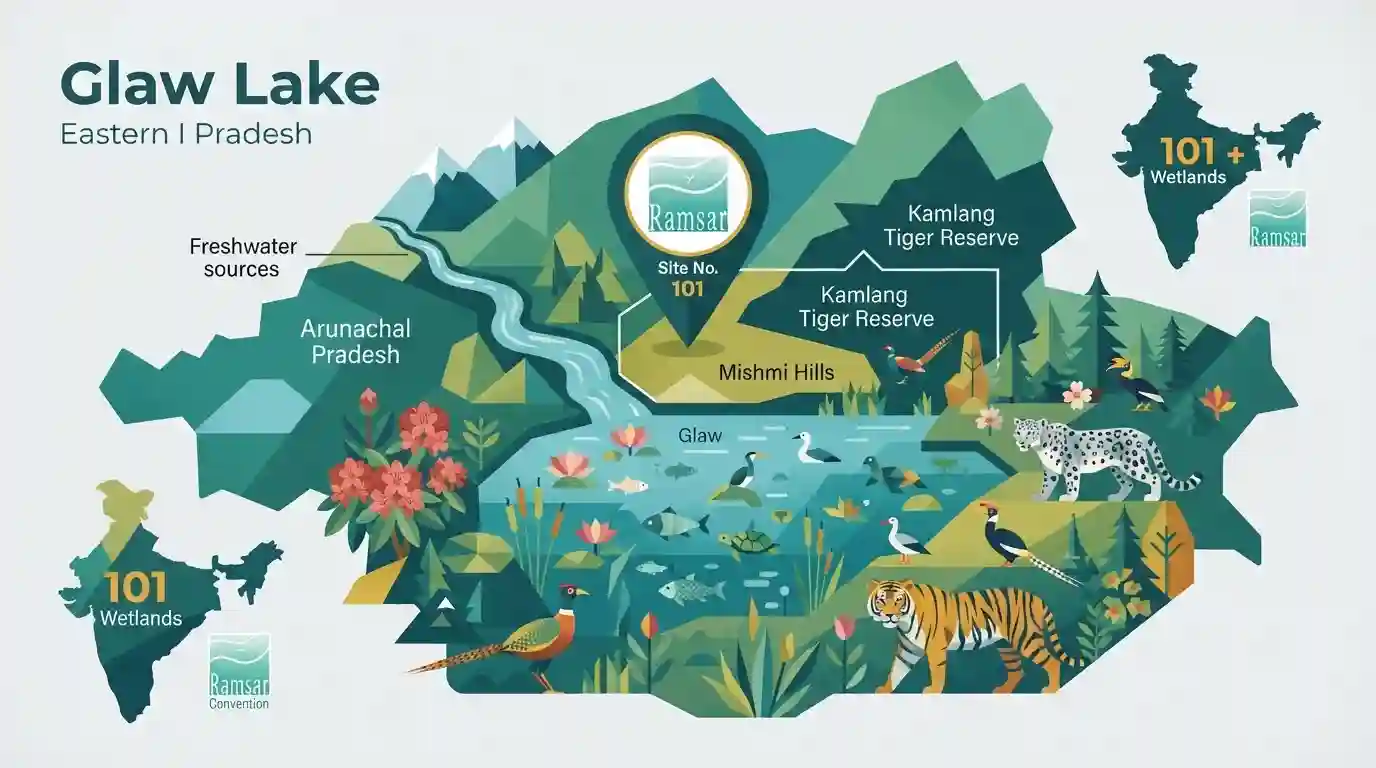
Glaw Lake, situated in the Kamlang Tiger Reserve of Arunachal Pradesh's Mishmi Hills, has been officially designated as the state's first Ramsar Site. This milestone elevates India's total number of Wetlands of International Importance under the Ramsar Convention to 101. The lake is a vital freshwater ecosystem fed by mountain streams and supports diverse Eastern Himalayan flora and fauna, highlighting India's expanding network of protected wetlands.
મુખ્ય મુદ્દા
- Glaw Lake has been designated as Arunachal Pradesh’s first-ever Ramsar Site.
- With this addition, India's total number of recognized Ramsar Sites has reached 101.
- Glaw Lake is a pristine freshwater ecosystem situated within the Kamlang Tiger Reserve and Wildlife Sanctuary in the Mishmi Hills of the Eastern Himalayas.
- The lake holds immense ecological significance, being fed by perennial streams and surrounded by rich biodiversity including species like Hoolock Gibbons and Mishmi Takin.
મહત્વપૂર્ણ શબ્દો
Glaw Lake

A pristine freshwater lake in Arunachal Pradesh's Kamlang Tiger Reserve, fed by mountain streams. Recently designated as the state's first Ramsar site, it is a biodiversity hotspot with rich Eastern Himalayan flora.
UPSC context
Important for GS-3 Environment and Prelims mapping. Questions often target newly added Ramsar Sites, their precise locations, and ecological features.
Ramsar Convention
An international treaty adopted in 1971 in Ramsar, Iran, dedicated to the conservation and "wise use" of wetlands to maintain their ecological character while supporting sustainable development.
UPSC context
Core GS-3 Environment topic. Tests knowledge of international environmental agreements, wetland protection criteria, and India's commitments and specific Ramsar Sites.
Kamlang Tiger Reserve
A protected area in the Eastern Himalayas of Arunachal Pradesh's Lohit district. Encompassing Glaw Lake, it is known for rugged terrain and hosting four big cat species: tiger, leopard, clouded leopard, and snow leopard.
UPSC context
Highly relevant for Prelims Environment. Tests knowledge of Tiger Reserves, their geographical locations, endemic species, and surrounding rivers or hills.
Mishmi Hills
A biodiversity-rich mountainous region in northeastern Arunachal Pradesh, located at the junction of the Northeastern Himalayas and Indo-Burma ranges. It features rugged terrain, heavy rainfall, and subtropical evergreen forests.
UPSC context
Vital for GS-1 Geography and Prelims mapping. Often tested on physical geography, transition zones, and specific hill ranges of Northeast India.
Ministry of Environment, Forest and Climate Change
The nodal agency in the central government responsible for planning, promoting, and overseeing the implementation of India's environmental, forestry, wildlife, and climate change policies, including Ramsar site recommendations.
UPSC context
Relevant for GS-2 and GS-3. Tests understanding of the institutional framework, statutory bodies, and government initiatives driving environmental conservation in India.
પ્રિલિમ્સ ટ્રેપ
"Glaw Lake is located in Namdapha National Park and is the first Ramsar site of Northeast India."
Glaw Lake is in Kamlang Tiger Reserve (which only borders Namdapha) and is Arunachal's first Ramsar site, not the Northeast's (Loktak and Deepor Beel are older).
સંલગ્ન સ્થિર ખ્યાલો
What is the Montreux Record under the Ramsar Convention?
- Definition: A principal register of wetland sites where changes in ecological character have occurred, are occurring, or are likely to occur due to human interference.
- Indian Sites: Currently, Keoladeo National Park (Rajasthan) and Loktak Lake (Manipur) are listed. Chilika Lake (Odisha) was historically listed but successfully removed in 2002.
What are the distinct characteristics of the Hoolock Gibbon?
- Only Ape: It is India's only native ape species (a lesser ape), making it phylogenetically distinct from other Indian primates like macaques and langurs.
- Canopy Habitat: Primarily found in the tropical and subtropical canopy forests of Northeast India. They are arboreal and highly dependent on contiguous forest covers.
- Conservation Status: Divided into Western (Endangered) and Eastern (Vulnerable) species, with their populations geographically separated by rivers like the Brahmaputra and Dibang.
આંતર-વિષય પેટર્ન
Wetlands overlapping with Tiger Reserves
UPSC increasingly targets wetlands embedded within larger protected areas. Glaw Lake’s location inside Kamlang Tiger Reserve parallels past questions focusing on water bodies within Corbett or Dudhwa.
Eastern Himalayas biogeographical endemism
The contiguous belt from Kamlang to Namdapha forms a critical biogeographical zone. Variations in altitude and terrain create isolated niches, driving endemism for species like the Mishmi Takin.

Expect a match-the-pair question linking Northeastern Ramsar sites (Glaw) or Tiger reserves with endemic fauna like the Mishmi Takin.
સંલગ્ન PYQ · 5
સંલગ્ન PYQ · 5
- 2019PrelimsGS1
Consider the following statements: 1. Under Ramsar Convention, it is mandatory on the part of the Government of India to protect and conserve all the wetlands in the territory of India. 2. The Wetlands (Conservation and Management) Rules, 2010 were framed by the Government of India based on the recommendations of Ramsar Convention. 3. The Wetlands (Conservation and Management) Rules, 2010 also encompass the drainage area or catchment regions of the wetlands as determined by the authority. Which of the statements given above is/are correct?
- 2021PrelimsGS1
'R2 Code of Practices' constitutes a tool available for promoting the adoption of
- 2014PrelimsGS1
With reference to a conservation organization called 'Wetlands International', which of the following statements is/are correct? 1. It is an intergovernmental organization formed by the countries which are signatories to Ramsar Convention. 2. It works at the field level to develop and mobilize knowledge, and use the practical experience to advocate for better policies. Select the correct answer using the code given below.
- 2023MainsGS3
Comment on the National Wetland Conservation Programme initiated by the Government of India and name a few India's wetlands of international importance included in the Ramsar Sites.
- 2018MainsGS3
What is wetland? Explain the Ramsar concept of 'wise use' in the context of wetland conservation. Cite two examples of Ramsar sites from India.
