Foreign Higher Educational Institutions Campuses Guidelines in India
Source:PIB ↗
Why It Matters
The entry of foreign universities is a landmark shift in India's higher education policy, directly addressing issues of quality, global competitiveness, and the internationalization of education. It is highly relevant for GS Paper 2 (Education and Social Sector Governance) and has been directly asked in past UPSC Mains examinations.
Summary
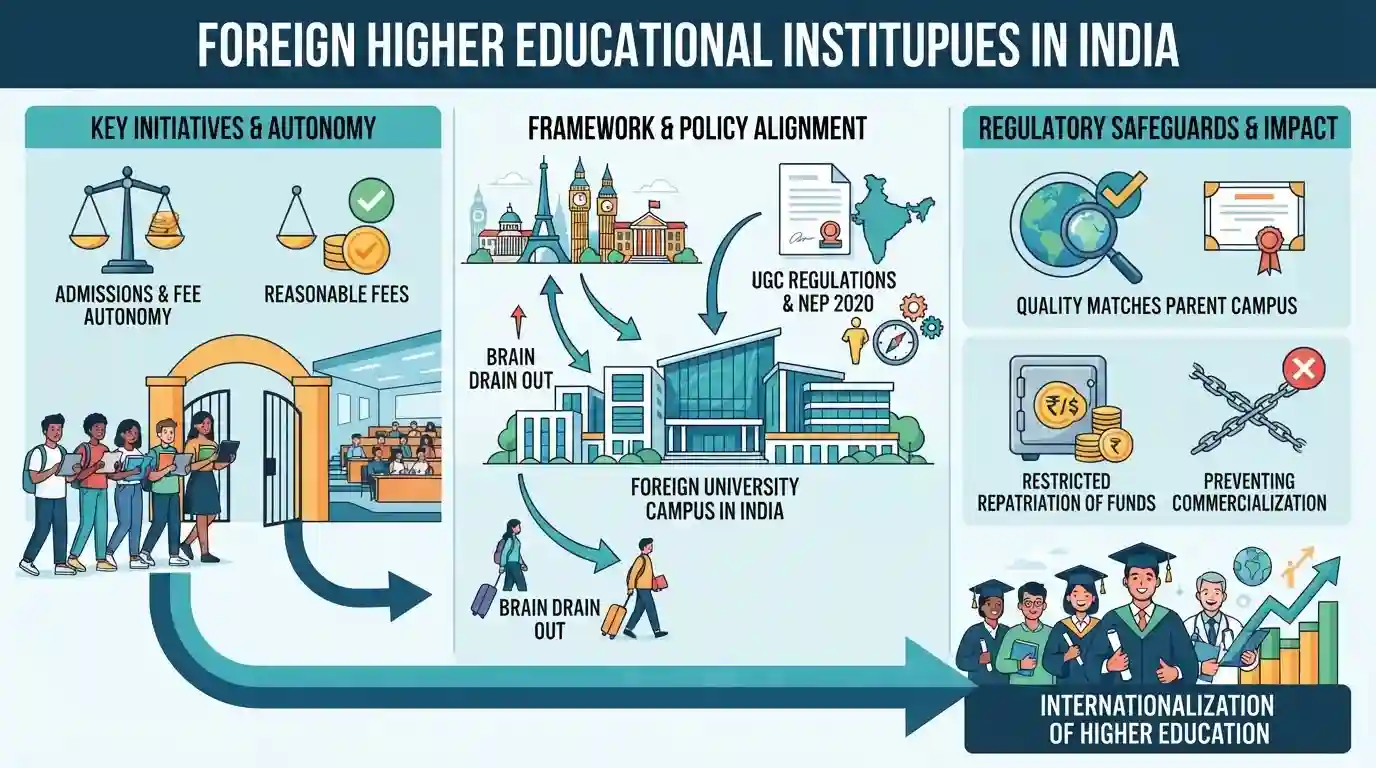
The article discusses the framework and implications of allowing Foreign Higher Educational Institutions (FHEIs) to establish campuses in India, a key reform aligned with the National Education Policy (NEP) 2020. Guided by the University Grants Commission (UGC) regulations, the initiative allows top globally ranked foreign universities to operate in India with autonomy over admissions and fee structures, provided the fees remain reasonable. The policy is designed to curb brain drain, stem the outflow of foreign exchange, and foster global academic standards domestically. It also includes strict regulatory safeguards, such as ensuring education quality matches the parent campus and restricting the repatriation of surplus funds to prevent commercialization. This represents a significant shift towards the internationalization of India's higher education sector.
Key Points
- The establishment of foreign university campuses in India is aimed at achieving the internationalization of higher education as envisioned under the National Education Policy (NEP) 2020.
- Under the UGC regulations, Foreign Higher Educational Institutions (FHEIs) ranked in the top 500 globally can apply to set up campuses in India.
- These institutions are granted autonomy to determine their own admission processes, fee structures (which must be reasonable and transparent), and faculty recruitment.
- The policy includes safeguards such as ensuring that the quality of education at the Indian campus is on par with the main campus, and provisions requiring surplus funds to be reinvested locally rather than repatriated as profit.
- The move is expected to reduce brain drain, save foreign exchange, and increase healthy competition, thereby elevating the overall quality of higher education in India.
Important Terms
National Education Policy (NEP) 2020

A comprehensive framework aiming to transform India's education system. It promotes multidisciplinary learning and envisions internationalizing higher education by allowing top global universities to establish physical campuses within India.
UPSC context
Crucial for GS Paper 2 (Education). Tests knowledge of government policies, social sector development, and reforms driving higher education internationalization.
UGC (Setting up and Operation of Campuses of Foreign Higher Educational Institutions in India) Regulations
A 2023 framework permitting global top-500 foreign universities to establish Indian branch campuses. It grants autonomy over admissions and fees while ensuring academic quality matches the parent campus and restricting commercial fund repatriation.
UPSC context
Vital for GS Paper 2 (Government Policies). Evaluates understanding of regulatory safeguards and norms concerning internationalization of India's higher education.
University Grants Commission (UGC)
A statutory body established in 1956 under the Ministry of Education. It is responsible for coordinating, determining, and maintaining the standards of higher education in India, including providing funding and recognition.
UPSC context
Important for GS Paper 2 (Statutory Bodies). Tests understanding of regulatory frameworks and oversight mechanisms in the education sector.
Ministry of Education
The Government of India ministry responsible for developing and regulating the nation's education sector. It oversees the implementation of the National Education Policy 2020 and manages statutory bodies like the UGC.
UPSC context
Relevant for GS Paper 2 (Governance). Covers the administrative hierarchy responsible for executing social sector schemes and broad educational reforms.
Foreign Higher Educational Institutions (FHEIs)
Globally ranked universities recognized in their home countries. Under recent reforms, elite FHEIs can set up Indian campuses to curb brain drain, stem foreign exchange outflow, and boost domestic academic standards.
UPSC context
Important for GS Paper 2 (Issues relating to Education). Focuses on internationalization, global exposure, and structural shifts in higher education.
Prelims Trap
FHEIs establishing campuses in India have the autonomy to freely repatriate surplus profits to their parent countries.
The UGC regulations prohibit repatriation of surplus funds; all profits generated must be reinvested locally in the Indian campus.
Static Concepts Connected
What is the constitutional and statutory framework governing education in India?
- Concurrent List: Education was shifted from the State List to the Concurrent List by the 42nd Amendment Act, 1976.
- UGC Mandate: Established under the UGC Act, 1956, it is the statutory apex body for coordinating and maintaining higher education standards.
What are the key higher education structural changes proposed by NEP 2020?
- GER Target: NEP 2020 aims to increase the Gross Enrolment Ratio in higher education to 50% by 2035.
- Single Regulator: Proposes the Higher Education Commission of India (HECI) as a single overarching regulator for all higher education.
Cross-Topic Patterns
Higher Education and Balance of Payments
Curbing outward student mobility directly improves India's current account balance by reducing foreign exchange outflows on tuition and living expenses.
Services Trade and GATS Mode 3
Allowing foreign campuses constitutes Commercial Presence under WTO's GATS, representing a strategic transition in India's service-sector trade commitments.

2026 Prelims may test regulatory details of UGC's FHEI guidelines, particularly the non-repatriation of surplus funds and ranking thresholds.
Linked PYQs · 2
Linked PYQs · 2
- 2015MainsGS2
The quality of higher education in India requires major improvements to make it internationally competitive. Do you think that the entry of foreign educational institutions would help improve the quality of higher and technical education in the country? Discuss.
- 2020MainsGS2
National Education Policy 2020 is in conformity with the Sustainable Development Goal-4 (2030). It intends to restructure and reorient education system in India. Critically examine the statement.
