Centre of Excellence for Handloom Technology Inauguration at IIT Delhi
Source:PIB ↗
কেন এটি গুরুত্বপূর্ণ
This development is a strong case study for UPSC aspirants on how traditional, employment-intensive sectors like MSMEs and artisan crafts can be modernized using emerging technologies (Industry 4.0, AI). It bridges GS1 (safeguarding art heritage) and GS3 (manufacturing, digitalisation, employment generation, and sustainable development).
সারসংক্ষেপ
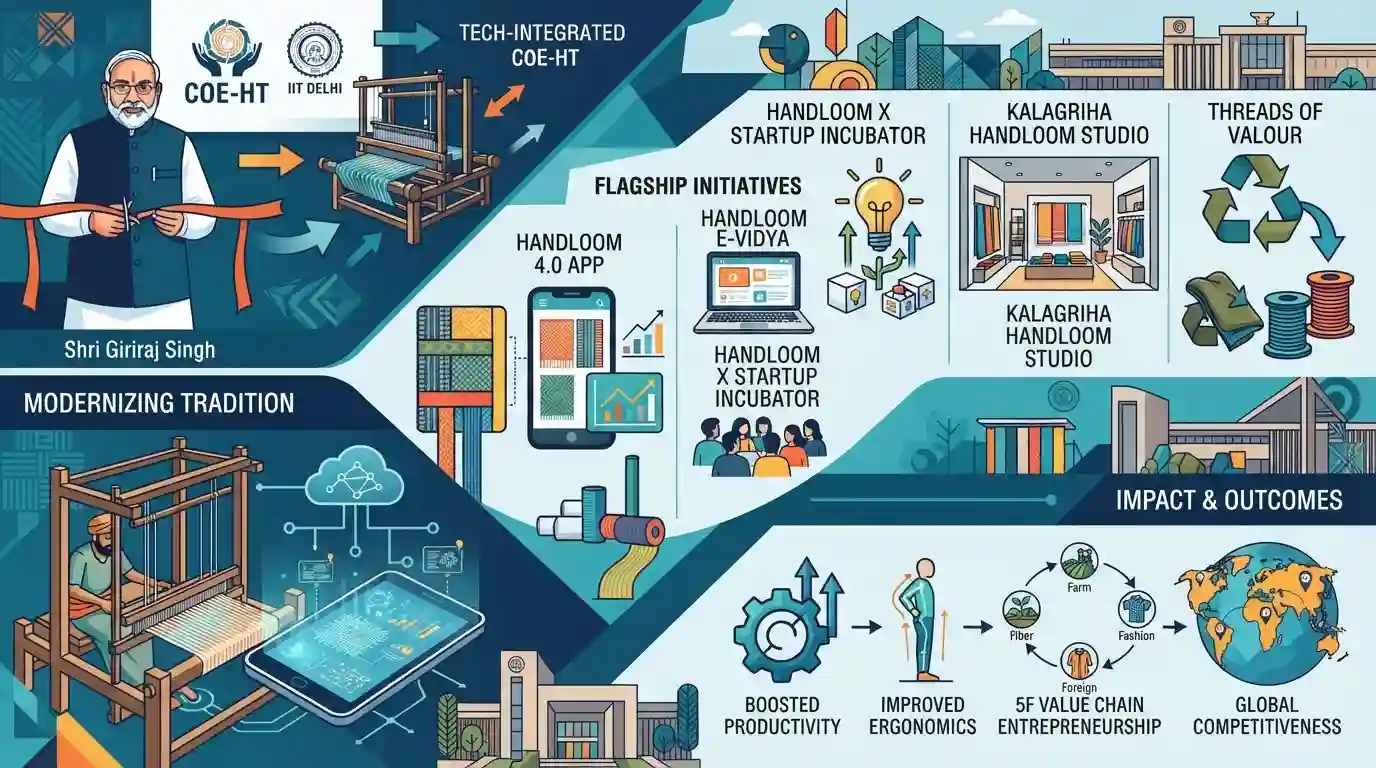
Union Minister of Textiles Shri Giriraj Singh inaugurated the Centre of Excellence for Handloom Technology (CoE-HT) at IIT Delhi. The facility aims to revitalize the traditional handloom sector by integrating it with modern technologies such as AI, digital monitoring, and e-learning. The launch included five flagship initiatives: Handloom 4.0 App, Handloom e-Vidya, HandloomX startup incubator, Kalagriha Handloom Studio for modern consumers, and the sustainable 'Threads of Valour' project recycling defence textiles. The CoE-HT is expected to boost weaver productivity, improve ergonomics, foster entrepreneurship across the 5F value chain, and elevate the global competitiveness of Indian handlooms.
মূল বিষয়
- The Ministry of Textiles inaugurated the Centre of Excellence for Handloom Technology (CoE-HT) at IIT Delhi to modernise the traditional handloom sector with Industry 4.0 technologies.
- Five major initiatives were launched, including the Handloom 4.0 App for digital loom monitoring, Handloom e-Vidya for online capacity building, and HandloomX, an incubator for startups across the 5F value chain.
- The 'Threads of Valour' initiative was introduced as a sustainability project, transforming recycled defence textiles into premium handloom fabrics.
- The Kalagriha Handloom Studio aims to connect traditional weavers with GenZ consumers through customization, visualization, and modern design interventions.
- The CoE-HT targets upskilling over 1,000 weavers, implementing AI-enabled tools for design, and improving ergonomics to make the Indian handloom sector globally competitive.
গুরুত্বপূর্ণ শব্দ
Centre of Excellence for Handloom Technology (CoE-HT)

A national knowledge and innovation hub established at IIT Delhi to modernize India's traditional handloom sector using advanced technologies like AI, IoT, ergonomics, and sustainable practices.
UPSC context
GS Paper III (Economic Development & MSME); tests technology adoption, livelihood security, and traditional industry modernization.
5F Value Chain
The Ministry of Textiles' integrated development vision representing "Farm to Fibre to Fabric to Fashion to Foreign," aimed at boosting vertical integration and global export competitiveness.
UPSC context
GS Paper III (Indian Economy); tests understanding of value addition, agricultural linkage, and export-oriented industrial growth.
Handloom 4.0 Mobile App
A digital application that enables real-time monitoring of loom productivity, quality, maintenance, and sustainability, bringing Fourth Industrial Revolution (Industry 4.0) tools to rural weavers.
UPSC context
GS Paper III (Technology & Digitization); tests digital inclusion, grassroots technology adoption, and manufacturing productivity.
HandloomX
An accelerator and incubator platform designed to support startups, innovators, and entrepreneurs creating technological solutions across the entire handloom and textile value chain.
UPSC context
GS Paper III (Employment & Innovation); tests startup incubation and modernization in labor-intensive decentralized sectors.
Threads of Valour
A circular economy initiative that scientifically recycles decommissioned and unused defence fabrics to produce high-quality, sustainable handloom textiles through skilled local craftsmanship.
UPSC context
GS Paper III (Environment & Circular Economy); tests waste-to-wealth programs and eco-friendly manufacturing models.
Kalagriha Handloom Studio
A digital visualization design studio that uses modern interactive technologies to connect younger consumers with authentic handloom products through design customization and visual authentication.
UPSC context
GS Paper III (Marketing & Technology Adoption); tests market integration and linking traditional sectors with modern consumers.
প্রিলিমস ফাঁদ
The 'Threads of Valour' recycling initiative is jointly administered and funded by the Ministry of Defence.
Though it recycles surplus defense textile waste, it is solely a sustainable handloom initiative under the Ministry of Textiles' CoE-HT at IIT Delhi.
সংযুক্ত স্থির ধারণা
What is the economic and demographic significance of India's handloom sector?
- Rural Employment: It is the second-largest provider of rural employment after agriculture, supporting over 35 lakh weavers.
- Gender Empowerment: Women constitute over 72% of the workforce, making it a critical driver of rural female labor force participation.
- Export and GI: It preserves traditional knowledge, representing a significant share of India’s Geographical Indication (GI) protected crafts.
What is the '5F' vision for India's textile sector?
- Value Chain: Stands for Farm to Fibre to Factory to Fashion to Foreign, representing an end-to-end integrated textile supply chain.
- Policy Integration: Aims to minimize logistics bottlenecks, scale up domestic manufacturing, and make Indian apparel globally competitive.
আন্তঃবিষয় প্যাটার্ন
Circular economy + Defense logistics
Using defense textile waste for premium handlooms shows how public sector waste streams can feed MSMEs, modeling GS3 circular economy goals.
AI integration + Traditional art
Applying AI design tools to handlooms tests the balance between GS1 cultural preservation and GS3 technology-driven productivity enhancements.

2026 GS3 may ask how Industry 4.0 interventions in traditional cottage sectors can boost rural incomes without displacing labor.
সংযুক্ত PYQ · 4
সংযুক্ত PYQ · 4
- 2023MainsGS3
Faster economic growth requires increased share of the manufacturing sector in GDP, particularly of MSMEs. Comment on the present policies of the Government in this regard.
- 2018MainsGS1
Safeguarding the Indian art heritage is the need of the moment. Discuss.
- 2017MainsGS1
Examine how the decline of traditional artisanal industry in colonial India crippled the rural economy.
- 2023MainsGS3
What is the status of digitalization in the Indian economy? Examine the problems faced in this regard and suggest improvements.
