PM POSHAN Scheme Nutrition Norms and Localized Sourcing
Source:PIB ↗
ఇది ఎందుకు ముఖ్యం
Understanding the PM POSHAN scheme's mechanics is critical for UPSC GS2 (Social Justice/Vulnerable Sections) and GS3 (Food Security). It exemplifies cooperative federalism, given education's placement on the Concurrent List, and highlights the practical application of the National Food Security Act, 2013 in combating childhood malnutrition through decentralized food procurement.
సారాంశం
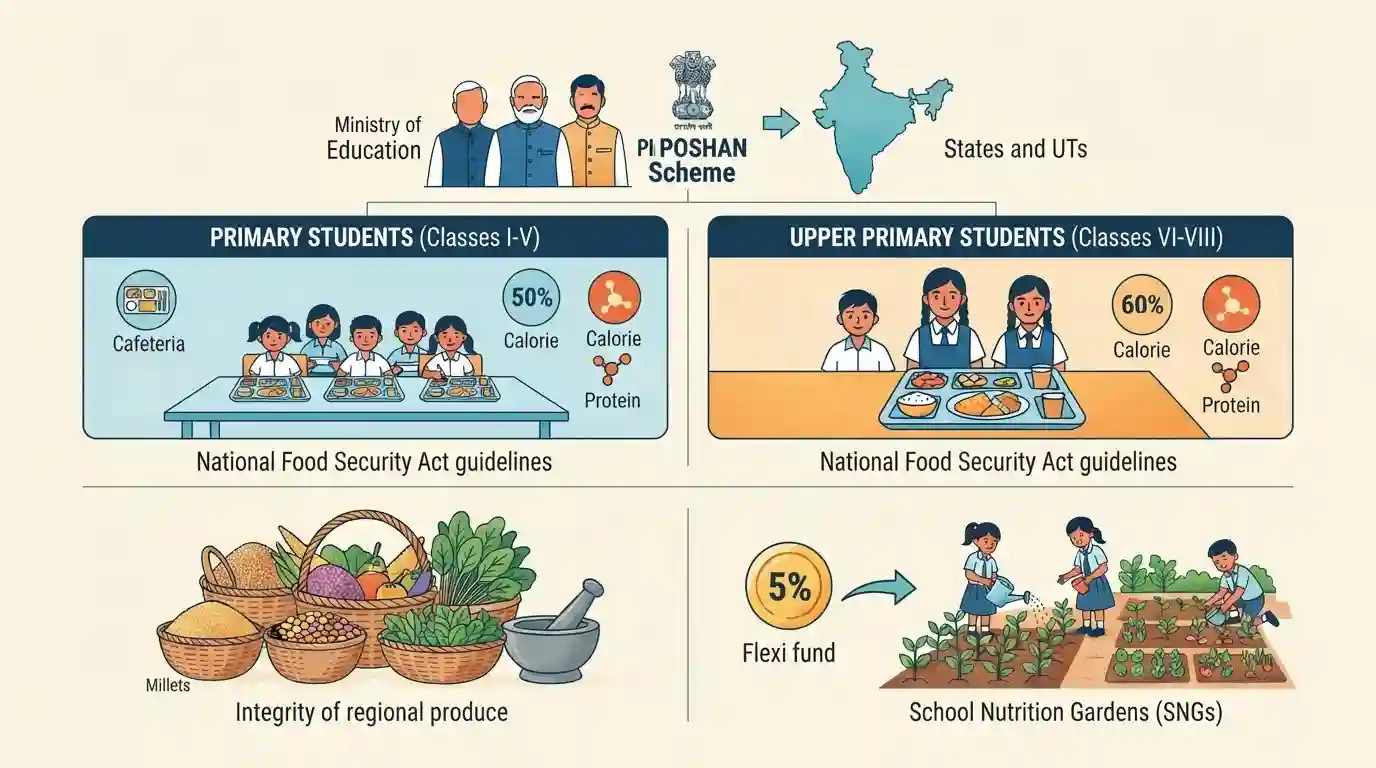
The Ministry of Education highlighted the framework for nutrition equivalence and substitutions under the PM POSHAN Scheme, which is implemented in partnership with States and UTs. Adhering to the National Food Security Act, 2013, the scheme mandates specific daily calorie and protein intakes for Primary and Upper Primary students. To support local dietary practices and agriculture, States are encouraged to incorporate local items like millets. Additionally, a 5% flexi fund is allowed for School Nutrition Gardens (SNGs) and supplementary localized interventions, reflecting the decentralized approach to education and child health.
ముఖ్య అంశాలు
- The PM POSHAN Scheme, targeting students from Bal Vatika to Class VIII, is implemented by State/UT Governments as Education falls under the Concurrent List.
- Nutritional norms strictly follow the National Food Security Act (NFSA), 2013, mandating 450 calories/12g protein for primary students and 700 calories/20g protein for upper primary.
- States are encouraged to design local menus and procure locally grown foods like millets, ensuring nutritional equivalence.
- A 5% flexi-component of the recurring budget is designated for School Nutrition Gardens (SNGs) and supplementary nutrition interventions in specific districts.
ముఖ్యమైన పదాలు
PM POSHAN Scheme

A centrally sponsored scheme providing one hot-cooked meal daily to children in government and government-aided schools (Balvatika to Class VIII) to improve nutritional levels, school enrolment, and attendance.
UPSC context
GS Paper II (Social Justice/Governance); tests welfare schemes for vulnerable populations, childhood malnutrition, and institutional health policies.
National Food Security Act, 2013
A landmark legislation providing statutory backing to food security by offering highly subsidized foodgrains to up to 75% of rural and 50% of urban populations.
UPSC context
GS Paper II (Social Justice/Governance) and GS III (Food Security); tests statutory frameworks for hunger alleviation.
Constitution (Concurrent List)
List III in the Seventh Schedule under Article 246 of the Indian Constitution, containing subjects where both the Parliament and State Legislatures have power to make laws.
UPSC context
GS Paper II (Polity/Federalism); tests legislative relations, division of powers, and cooperative federalism.
Ministry of Education
The Union executive ministry responsible for implementing national policies on education, overseeing literacy programs, and administering the PM POSHAN Scheme through its school education department.
UPSC context
GS Paper II (Governance/Polity); tests the organizational structure of executive ministries and policy implementation.
State Governments
The constitutional executive and legislative bodies of India's states that share power with the Centre and are primary implementers of welfare schemes locally.
UPSC context
GS Paper II (Polity/Federalism); tests Union-state administrative relations and local implementation of national policies.
ప్రిలిమ్స్ ఉచ్చు
PM POSHAN operates as a non-statutory welfare policy directive, independent of the justiciable rights under the National Food Security Act (NFSA), 2013.
Section 5 of NFSA 2013 provides explicit statutory backing to PM POSHAN, translating the hot cooked school meal into a legally binding, justiciable right.
అనుసంధానమైన స్థిర భావనలు
What is the statutory role of the National Food Security Act (NFSA), 2013 in school nutrition?
- Statutory Entitlement: Section 5 mandates free hot cooked meals daily for children in government and government-aided schools, making nutrition a justiciable legal right.
- Nutritional Standards: Schedule II of the Act legally codifies calorie and protein norms, preventing administrative dilution of dietary standards.
- Disruption Compensation: Mandates the payment of a Food Security Allowance to beneficiaries if the cooked meal cannot be provided due to non-availability of foodgrains.
How is CPI-RL utilized in central welfare policy administration?
- Compilation: Compiled monthly by the Labour Bureau (Ministry of Labour & Employment) to measure inflation targeting the consumption patterns of rural laborers.
- Cost Indexation: Used to index material and cooking costs under PM POSHAN to shield school nutrition budgets from food price inflation.
అంతర-అంశ నమూనాలు
Cooperative Federalism & Concurrent List
Education falls under the Concurrent List, making PM POSHAN’s implementation a test of cooperative federalism, balancing central financial guidelines with flexible state-level localized menus.
Agro-ecology & School Gardens
School Nutrition Gardens (SNGs) link environmental science with nutritional security, encouraging localized farming, dietary diversity, and lower transport footprints under the PM POSHAN framework.

PM POSHAN's statutory NFSA 2013 backing, indexation to CPI-RL, and state-level flexi-funds are highly likely 2026 Prelims statement targets.
అనుసంధాన PYQలు · 5
అనుసంధాన PYQలు · 5
- 2021MainsGS2
“Earn while you learn' scheme needs to be strengthened to make vocational education and skill training meaningful.” Comment.
- 2016MainsGS2
Professor Amartya Sen has advocated important reforms in the realms of primary education and primary health care. What are your suggestions to improve their status and performance?
- 2021MainsGS3
What are the salient features of the National Food Security Act, 2013? How has the Food Security Bill helped in eliminating hunger and malnutrition in India?
- 2025MainsGS3
Examine the scope of the food processing industries in India. Elaborate the measures taken by the government in the food processing industries for generating employment opportunities.
- 2018PrelimsGS1
With reference to the provisions made under the National Food Security Act, 2013, consider the following statements : 1. The families coming under the category of 'below poverty line (BPL)' only are eligible to receive subsidised food grains. 2. The eldest woman in a household, of age 18 years or above, shall be the head of the household for the purpose of issuance of a ration card. 3. Pregnant women and lactating mothers are entitled to a 'take-home ration' of 1600 calories per day during pregnancy and for six months thereafter. Which of the statements given above is/are correct?
