Teacher Eligibility Test Mandate under RTE Act and Supreme Court
Source:PIB ↗
কেন এটি গুরুত্বপূর্ণ
The quality of education directly relies on the qualifications of teachers. Understanding the statutory mandates of the RTE Act, 2009, Supreme Court judgements enforcing these mandates, and the federal dynamics in education administration (Concurrent List) is essential for governance and social justice topics in UPSC.
সারসংক্ষেপ
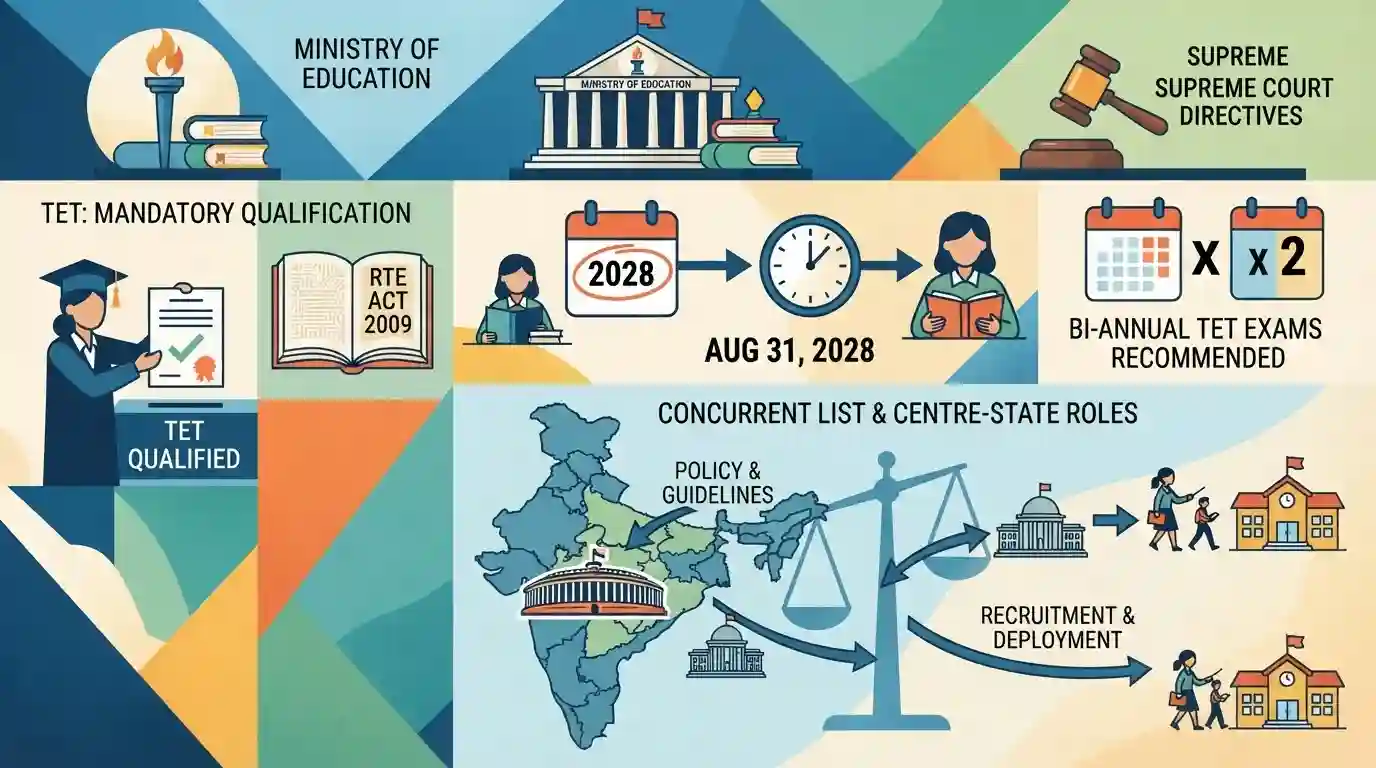
The Ministry of Education highlighted the Supreme Court's directives concerning the Teacher Eligibility Test (TET). The Court reaffirmed that TET is a mandatory minimum qualification under Section 23 of the Right of Children to Free and Compulsory Education (RTE) Act, 2009. A recent judgment extended the deadline for teachers to acquire this qualification to August 31, 2028, and recommended that TET exams be conducted twice a year. The statement also noted that since education is on the Concurrent List, teacher recruitment and deployment remain under the administrative domain of State and Union Territory governments.
মূল বিষয়
- Education is a subject under the Concurrent List, giving State Governments and Union Territories the administrative domain over teacher recruitment and service conditions.
- The Supreme Court reaffirmed that the Teacher Eligibility Test (TET) is a mandatory minimum qualification for teachers under Section 23 of the RTE Act, 2009.
- The Supreme Court extended the deadline for teachers to acquire the mandatory TET qualification to August 31, 2028.
- The Court also advised that the TET should be conducted periodically, ideally twice a year at six-month intervals, to provide eligible candidates a fair opportunity to qualify.
গুরুত্বপূর্ণ শব্দ
Right of Children to Free and Compulsory Education (RTE) Act, 2009

A 2009 law guaranteeing free and compulsory education for children aged 6–14. Section 23 of the Act mandates minimum qualifications, such as the Teacher Eligibility Test (TET), for the appointment of elementary teachers.
UPSC context
Crucial for GS Paper 2 (Social Justice/Education). Tests knowledge of statutory provisions securing the fundamental right to education (Article 21A).
Supreme Court of India
India's highest judicial authority. It recently reaffirmed that TET is a compulsory qualification for all teachers under the RTE Act, extending the compliance deadline for in-service educators to August 31, 2028.
UPSC context
Key for GS Paper 2 (Polity). Demonstrates the judiciary's role in enforcing educational standards and balancing statutory mandates with practical constraints.
Ministry of Education
The central ministry responsible for national educational policies. It clarified that while the Centre sets standards like TET, teacher recruitment and deployment remain under the administrative domain of State and Union Territory governments.
UPSC context
GS Paper 2 (Governance/Social Justice). Tests understanding of institutional roles and the Centre-State administrative division in subjects on the Concurrent List.
Lok Sabha
The lower house of India's bicameral Parliament. The Union Education Minister recently informed the Lok Sabha about the Supreme Court's directives extending the TET compliance deadline during a reply to a Starred Question.
UPSC context
GS Paper 2 (Polity). Relevant to parliamentary proceedings and the accountability of the executive branch in reporting policy enforcement.
প্রিলিমস ফাঁদ
State governments can relax the mandatory Teacher Eligibility Test (TET) qualifications for recruitment in local-body schools.
Under Section 23(1) of the RTE Act, only the NCTE (the central academic authority) sets qualifications. States cannot unilaterally relax these standards.
সংযুক্ত স্থির ধারণা
What are the roles of NCTE and NCERT under the RTE Act?
- NCTE mandate: Under Section 23(1), NCTE is the sole central authority laying down minimum academic qualifications for teacher eligibility.
- NCERT mandate: Under Section 29(1), NCERT is the designated academic authority for laying down the elementary curriculum and evaluation procedures.
How does the Concurrent List entry for Education operate?
- 42nd Amendment: The 42nd Constitutional Amendment Act of 1976 shifted Education from the State List to the Concurrent List (Entry 25).
- Shared authority: Parliament and State assemblies hold joint legislative power, but Central laws prevail in cases of conflict under Article 254.
- Administrative execution: Day-to-day administrative execution, including teacher recruitment and school funding, is managed primarily by State/UT governments.
আন্তঃবিষয় প্যাটার্ন
Federalism vs Central Educational Standards
Balancing Central uniform standards (like NCTE's TET) with the administrative autonomy of States who bear the financial and logistical burden of teacher recruitment.
Regulatory capture in private education
With over 90% of Teacher Education Institutions being private, strict TET enforcement exposes the gap between degree commercialization and actual learning outcomes.

Expect statements distinguishing NCTE (Sec 23) and NCERT (Sec 29) mandates under RTE in upcoming civil services prelims.
সংযুক্ত PYQ · 2
সংযুক্ত PYQ · 2
- 2018PrelimsGS1
Consider the following statements: 1. As per the Right to Education (RTE) Act, to be eligible for appointment as a teacher in a State, a person would be required to possess the minimum qualification laid down by the concerned State Council of Teacher Education. 2. As per the RTE Act, for teaching primary classes, a candidate is required to pass a Teacher Eligibility Test conducted in accordance with the National Council of Teacher Education guidelines. 3. In India, more than 90% of teacher education institutions are directly under the State Governments. Which of the statements given above is/are correct?
- 2022MainsGS2
The Right of Children to Free and Compulsory Education Act, 2009 remains inadequate in promoting incentive-based system for children's education without generating awareness about the importance of schooling. Analyse.
