Nasha Mukt Bharat Abhiyaan Implementation in Jammu and Kashmir
Source:PIB ↗
কেন এটি গুরুত্বপূর্ণ
UPSC frequently tests candidates on both the social implications of drug abuse (vulnerable sections, health) and its internal security dimensions (linkages to border trafficking and organized crime). The programmatic details of NMBA provide excellent factual fodder for Mains answers on demand-side solutions to drug addiction.
সারসংক্ষেপ
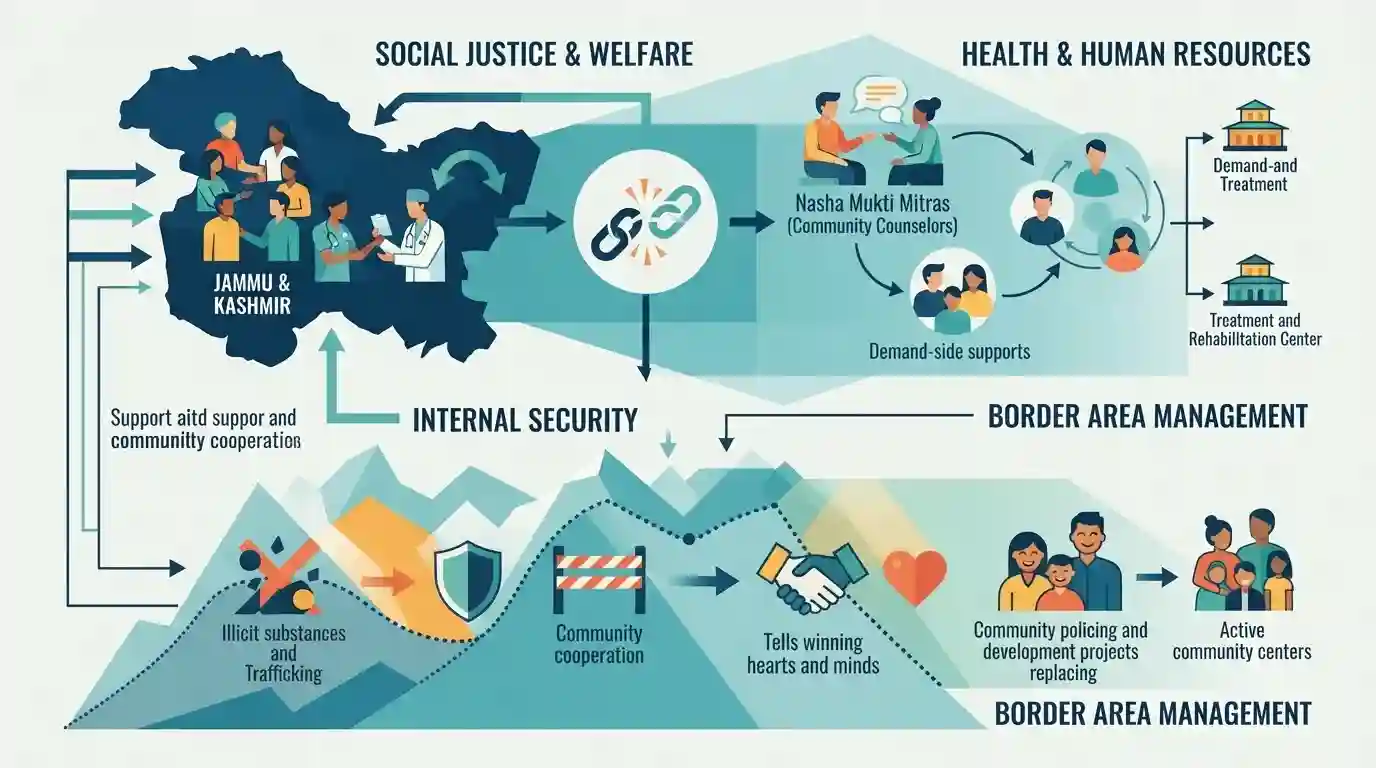
This article is highly relevant for GS-2 (Social Justice) and GS-3 (Internal Security). It details the implementation of the Nasha Mukt Bharat Abhiyaan (NMBA) under the National Action Plan for Drug Demand Reduction (NAPDDR), emphasizing demand-side interventions for substance abuse. The specific focus on Jammu & Kashmir highlights how social welfare and rehabilitation schemes (using 'Nasha Mukti Mitras' and tiered treatment centers) serve a dual purpose: addressing public health crises and aiding internal security by winning 'hearts and minds' in a border region vulnerable to cross-border drug trafficking from the Golden Crescent.
মূল বিষয়
- The Nasha Mukt Bharat Abhiyaan (NMBA) was launched on August 15, 2020, by the Ministry of Social Justice & Empowerment to combat substance abuse through mass awareness and rehabilitation.
- Under the National Action Plan for Drug Demand Reduction (NAPDDR), a structured network of de-addiction facilities including IRCAs, ODICs, CPLIs, DDACs, and ATFs are supported across states.
- In the sensitive border region of Jammu & Kashmir, the initiative has sensitized over 1.20 crore individuals, mobilizing 8,565 community volunteers known as 'Nasha Mukti Mitras'.
- A National Toll-Free De-addiction Helpline (14446) provides tele-counseling and primary support to those seeking help.
গুরুত্বপূর্ণ শব্দ
National Action Plan for Drug Demand Reduction (NAPDDR)

An umbrella scheme of the Ministry of Social Justice & Empowerment that funds and implements preventive education, awareness generation, identification, counselling, treatment, and rehabilitation for individuals dependent on substances.
UPSC context
GS Paper II (Social Justice) & GS Paper III (Internal Security); tests policies for vulnerable populations and countering cross-border drug menace.
Nasha Mukt Bharat Abhiyaan (NMBA)
The flagship mass-awareness and community-mobilization campaign launched in 2020 by the Ministry of Social Justice and Empowerment to eliminate substance abuse across all districts of India.
UPSC context
GS Paper II (Social Justice - Government Schemes); tests initiatives tackling social vulnerabilities and public health crises in India.
Integrated Rehabilitation Centre for Addicts (IRCA)
Supported facilities providing free in-patient treatment, detoxification, counseling, whole-person recovery, and reintegration into the social mainstream for individuals with substance dependence.
UPSC context
GS Paper II (Social Justice - Health & Welfare); tests institutional frameworks for rehabilitation and societal integration of vulnerable groups.
Community based Peer led Intervention (CPLI)
A localized outreach mechanism targeting vulnerable children and adolescents, utilizing peer educators to raise awareness, build life skills, and facilitate early prevention of substance use.
UPSC context
GS Paper II (Social Justice - Child Welfare); tests target-specific developmental interventions and grassroots social-security mechanisms.
Outreach and Drop In Centres (ODICs)
Community-based facilities providing a safe space for substance users to receive screening, assessment, motivational counseling, basic first aid, and structured referral links for medical treatment.
UPSC context
GS Paper II (Social Justice - Health Care); tests local-level health outreach, stigma reduction, and primary de-addiction access networks.
District De-addiction Centres (DDACs)
Comprehensive, single-roof institutions that consolidate the services of IRCAs, ODICs, and CPLIs to provide uniform treatment and rehabilitation in districts lacking individual facilities.
UPSC context
GS Paper II (Social Justice - Decentralized Governance); tests district-level implementation of welfare programs and administrative convergence in social sectors.
Addiction Treatment Facilities (ATFs)
Specialized de-addiction wards established in government hospitals (coordinated by AIIMS, New Delhi) to integrate clinical substance-use treatment directly into the state public health infrastructure.
UPSC context
GS Paper II (Social Justice - Health Issues); tests healthcare infrastructure integration and clinical mechanisms for addressing substance dependence.
প্রিলিমস ফাঁদ
The National Action Plan for Drug Demand Reduction (NAPDDR) is administered by the Ministry of Home Affairs to arrest drug traffickers.
The NAPDDR and NMBA are executed by the Ministry of Social Justice and Empowerment for demand reduction, not by the Ministry of Home Affairs or Health.
সংযুক্ত স্থির ধারণা
What are the Golden Crescent and Golden Triangle, and how do they impact India's security?
- Golden Crescent: Comprises Afghanistan, Iran, and Pakistan, leaking illicit opiates through India's western border states like Punjab and Jammu & Kashmir.
- Golden Triangle: Comprises Myanmar, Laos, and Thailand, channeling synthetic drugs and heroin primarily into India's northeastern border states.
- Narco-Terrorism Link: Drug trade proceeds directly fund proxy wars, purchase illegal weapons, and sustain insurgent modules across India's sensitive borders.
Which constitutional and legislative provisions guide drug control in India?
- Article 47: A Directive Principle of State Policy directing the State to bring about prohibition of consumption of intoxicating drinks and drugs.
- Seventh Schedule: Provides public health as a State subject, but control of narcotic drugs and international treaty implementation belongs to the Union.
- NDPS Act: Enacted in 1985, it is the primary legislative framework imposing strict penalties for illicit drug manufacturing, sale, and trafficking.
আন্তঃবিষয় প্যাটার্ন
Narco-Terrorism & Border Management
Illicit drug channels from the Golden Crescent fund proxy terrorism in Kashmir, making demand-reduction programs key components of border-area security.
Soft Security in Counter-Insurgency
Community-led initiatives like 'Nasha Mukti Mitras' build local social capital, denying hostile actors the vulnerable youth networks needed for radicalization.

Mains 2026 may link demand-side rehabilitation (MoSJE) with supply-side policing (MHA) as a dual defense against border narco-terrorism.
সংযুক্ত PYQ · 3
সংযুক্ত PYQ · 3
- 2018MainsGS3
India's proximity to two of the world's biggest illicit opium-growing states has enhanced her internal security concerns. Explain the linkages between drug trafficking and other illicit activities such as gunrunning, money laundering and human trafficking. What counter-measures should be taken to prevent the same?
- 2026PrelimsGS1
Which of the following statements with regard to the persons with disabilities in India is/are correct ? 1. The Rights of Persons with Disabilities Act, an Act passed by the Parliament of India in 2018, mandates reservation in education and employment, places a legal duty on Governments to ensure accessibility and non-discrimination. 2. The Sugamya Bharat Abhiyan focuses on achieving universal accessibility for Persons with Disabilities across three key domains — built infrastructure, transport systems and information and communication technology. 3. The National Divyangjan Finance and Development Corporation (NDFDC) is a public sector organisation set up by the Ministry of Corporate Affairs as a not-for-profit company to promote entrepreneurship among Persons with Disabilities (PwDs). Select the answer using the code given below :
- 2023MainsGS3
Winning of 'Hearts and Minds' in terrorism-affected areas is an essential step in restoring the trust of the population. Discuss the measures adopted by the Government in this respect as part of the conflict resolution in Jammu and Kashmir.
