PM-AJAY Adarsh Gram Component and Village Convergence Strategy
Source:PIB ↗
ఇది ఎందుకు ముఖ్యం
Understanding PM-AJAY is crucial for addressing questions on the welfare of Scheduled Castes, rural development, and the governance strategy of 'convergence' of schemes to optimize resource utilization and ensure socio-economic upliftment.
సారాంశం
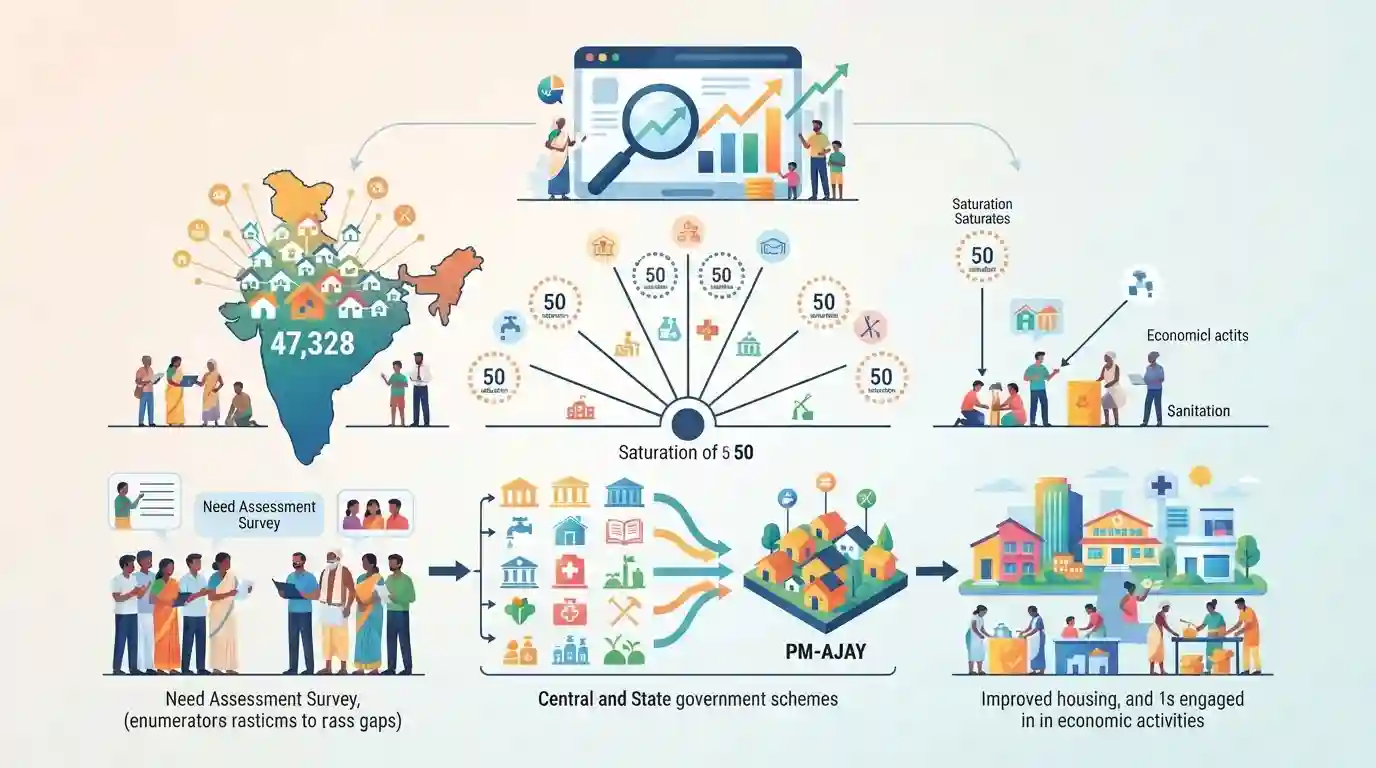
The Union Government has selected 47,328 villages under the Adarsh Gram Component of the Pradhan Mantri Anusuchit Jaati Abhyuday Yojana (PM-AJAY) to ensure their integrated development. The initiative aims to uplift the socio-economic status of Scheduled Caste communities by achieving saturation across 50 monitorable indicators in 10 development sectors. By identifying gaps through a Need Assessment Survey, the scheme relies on the convergence of various Central and State schemes to bring comprehensive infrastructure and service improvements to these villages. Tracking and monitoring are conducted via the PMAGY portal.
ముఖ్య అంశాలు
- The Adarsh Gram Component of PM-AJAY focuses on the integrated development of villages with a significant Scheduled Caste (SC) population.
- A total of 47,328 villages have been selected across India, with 435 villages in Telangana (122 from Karimnagar district alone).
- The scheme aims for saturation of 50 monitorable socio-economic indicators across 10 key development sectors, including education and health.
- Development gaps are identified through a Need Assessment Survey and addressed via convergence with existing Central and State government schemes.
- Progress is tracked and updated on the dedicated PMAGY Portal to ensure transparency and accountability.
ముఖ్యమైన పదాలు
Pradhan Mantri Anusuchit Jaati Abhyuday Yojana (PM-AJAY)

A 100% Centrally Sponsored Scheme launched in FY 2021-22 by merging three erstwhile welfare schemes to ensure socio-economic upliftment, poverty reduction, and infrastructure development in Scheduled Caste dominated areas.
UPSC context
GS Paper II: Welfare schemes; tests understanding of interventions for Scheduled Castes and rural development strategies.
Adarsh Gram Component
A major component of PM-AJAY targeting the integrated development of Scheduled Caste-dominated villages to ensure saturation across 50 monitorable indicators through convergence of central and state schemes.
UPSC context
GS Paper II: Rural development & welfare schemes; tests knowledge of targeted schemes and cross-sectoral convergence mechanisms.
Pradhan Mantri Adarsh Gram Yojana (PMAGY)
A Centrally Sponsored Scheme launched in 2009-10 to develop Scheduled Caste-dominated villages, which was merged into PM-AJAY in 2021-22 to optimize public resources and convergence.
UPSC context
GS Paper II: Welfare schemes; tests knowledge of policy evolution and institutional consolidation for vulnerable sections.
Ministry of Social Justice & Empowerment
The nodal Union Ministry responsible for policy formulation, welfare, and empowerment of marginalized groups, including Scheduled Castes, Backward Classes, and persons with disabilities.
UPSC context
GS Paper II: Ministries and departments; tests administrative framework governing the protection and betterment of vulnerable populations.
ప్రిలిమ్స్ ఉచ్చు
PM-AJAY and its Adarsh Gram component are implemented under the aegis of the Ministry of Rural Development.
The scheme is administered by the Ministry of Social Justice and Empowerment, not the Ministry of Rural Development, despite its core focus on village infrastructure.
అనుసంధానమైన స్థిర భావనలు
What are the key Constitutional provisions protecting and uplifting Scheduled Castes (SCs) in India?
- Article 46: Directs the State to promote educational and economic interests of SCs/STs to shield them from social injustice.
- Article 15(4): Empowers the State to make special provisions for the advancement of Scheduled Castes and Scheduled Tribes.
- Article 338: Establishes the National Commission for Scheduled Castes (NCSC) to safeguard and investigate SC-related matters.
What is the difference between Centrally Sponsored Schemes (CSS) and Central Sector Schemes?
- Funding model: CSS are jointly funded by Centre and States (typically 60:40), while Central Sector Schemes are 100% federally funded.
- Implementation agency: CSS are executed by State/UT administrations, whereas Central Sector Schemes are implemented directly by Central ministries.
అంతర-అంశ నమూనాలు
Fiscal federalism and welfare convergence
Relying on leveraging state funds and MPLADS alongside Central gap-funding highlights how cooperative federalism dictates the success of grassroots Scheduled Caste development.
Data-driven governance in social justice
The use of the PMAGY portal and Need Assessment Surveys shows a transition toward objective, indicator-based targeting instead of arbitrary, discretionary fund allocations.

Expect a multi-statement Prelims question testing the revised 40% SC threshold, the merged constituent schemes, and the host Ministry.
అనుసంధాన PYQలు · 2
అనుసంధాన PYQలు · 2
- 2023MainsGS2
“Development and welfare schemes for the vulnerable, by its nature, are discriminatory in approach.” Do you agree? Give reasons for your answer.
- 2019MainsGS2
Performance of welfare schemes that are implemented for vulnerable sections is not so effective due to absence of their awareness and active involvement at all stages of policy process. Discuss.
