Government Survey Reports Zero Manual Scavengers Under Statutory Act
Source:PIB ↗
কেন এটি গুরুত্বপূর্ণ
The eradication of manual scavenging is a critical issue under GS2 (Social Justice). Aspirants must understand the intersection of statutory frameworks (MS Act, 2013) with ongoing schemes (NAMASTE and SBM-U) to address the persistent challenges regarding the safety and dignity of sanitation workers.
সারসংক্ষেপ
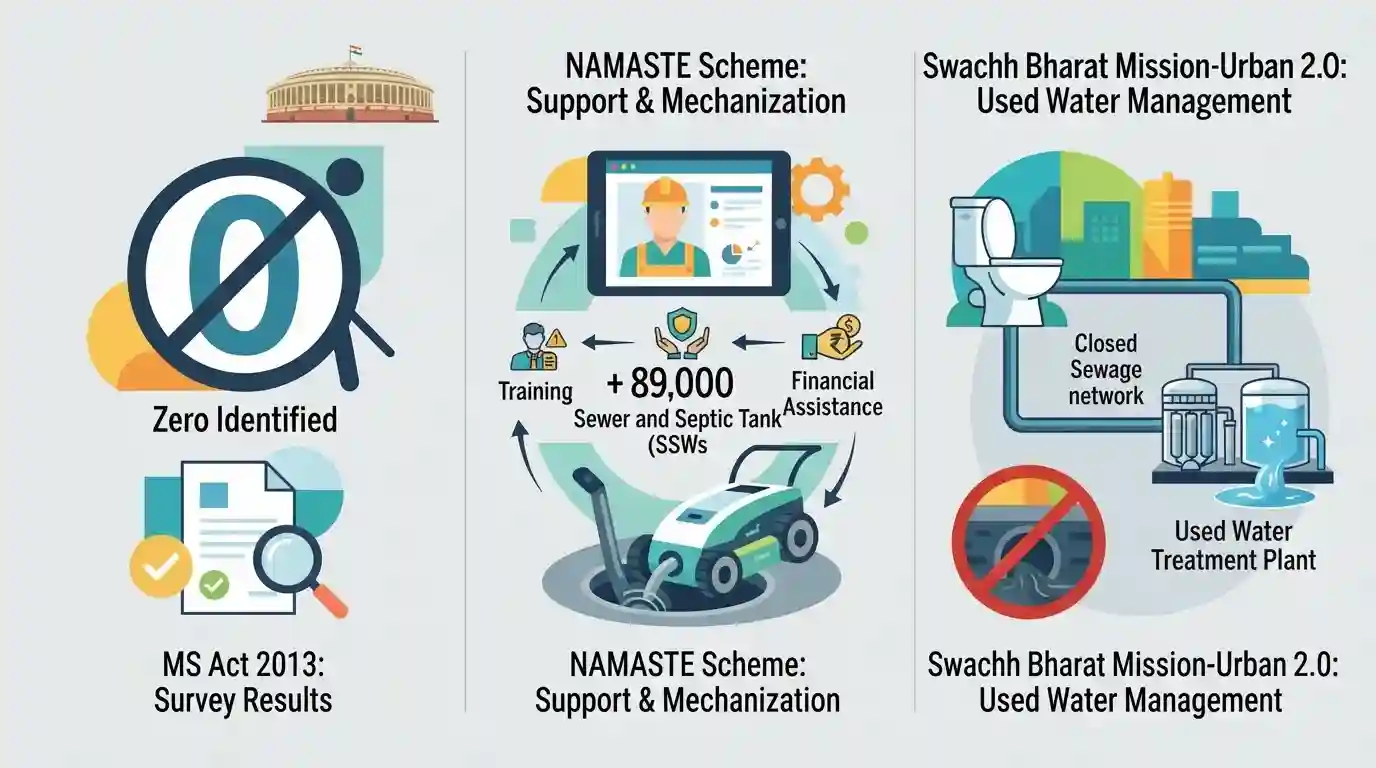
The Government reported in the Rajya Sabha that a recent survey conducted under the MS Act, 2013 identified no manual scavengers. Concurrently, the NAMASTE scheme is actively profiling and supporting over 89,000 Sewer and Septic Tank Workers (SSWs) to promote mechanised cleaning. Furthermore, Swachh Bharat Mission-Urban 2.0 has integrated Used Water Management (UWM) frameworks to enforce the prohibition of hazardous entry into sewers.
মূল বিষয়
- A fresh survey across 3,235 camps found zero manual scavengers as defined under the MS Act, 2013.
- The NAMASTE scheme validated 89,915 Sewer and Septic Tank Workers (SSWs) to ensure their safety and dignity through mechanised cleaning.
- Swachh Bharat Mission-Urban (SBM-U) 2.0 mandates strict conditions against hazardous manual entry into sewers as a prerequisite for accessing Used Water Management (UWM) funds.
- The MS Act, 2013 strictly prohibits both the construction of insanitary latrines and hazardous manual cleaning of sewers and septic tanks.
গুরুত্বপূর্ণ শব্দ
Prohibition of Employment as Manual Scavengers and their Rehabilitation Act, 2013 (MS Act)

A 2013 statute that criminalises manual scavenging and hazardous sewer cleaning. It mandates the demolition of insanitary latrines and comprehensive socio-economic rehabilitation for affected workers.
UPSC context
GS Paper 2 (Social Justice). Tests knowledge of legislative safeguards and statutory mechanisms protecting vulnerable and marginalised communities.
NAMASTE Scheme
The National Action for Mechanised Sanitation Ecosystem is a joint MoSJE and MoHUA scheme. It provides skill training, capital subsidies, and PPE to Sewer and Septic Tank Workers to eliminate hazardous manual cleaning and ensure zero sanitation fatalities.
UPSC context
GS Paper 2 (Welfare Schemes). Evaluates understanding of government interventions promoting occupational safety, formalisation, and dignified livelihoods for sanitation workers.
Swachh Bharat Mission-Urban (SBM-U) 2.0
Launched in 2021 by MoHUA to create "Garbage Free Cities" by 2026. It emphasises scientific waste processing, sustaining Open Defecation Free statuses, and introduces Used Water Management to ensure safe containment and treatment of faecal sludge.
UPSC context
GS Paper 2 (Government Policies). Important for understanding sustainable urban sanitation frameworks, circular economy applications, and municipal waste management goals.
Ministry of Social Justice and Empowerment
The nodal Union ministry tasked with ensuring social equity and welfare for marginalised groups, including Scheduled Castes and sanitation workers. It implements rehabilitation schemes and tracks the elimination of manual scavenging.
UPSC context
GS Paper 2 (Institutions/Bodies). Tests awareness of the institutional frameworks driving social inclusion, minority welfare, and policy implementation.
প্রিলিমস ফাঁদ
The MS Act, 2013 legally defines manual scavenging and hazardous cleaning of sewers as the same activity.
The Act differentiates 'manual scavenging' (handling excreta from dry latrines) from 'hazardous cleaning' (sewer entry without gear). Zero scavengers doesn't mean zero hazardous cleaning.
সংযুক্ত স্থির ধারণা
What is the constitutional and legal basis of the MS Act, 2013?
- Constitutional Roots: Draws authority from Article 17 (untouchability), Article 21 (right to life with dignity), and Article 23 (forced labour).
- Legal Nuance: Explicitly differentiates handling excreta in dry latrines ('manual scavenging') from 'hazardous cleaning' of sewers and septic tanks.
- Strict Penalties: Hazardous cleaning of sewers is punishable by up to 5 years imprisonment, a ₹5 lakh fine, or both.
What are the core features of the NAMASTE Scheme?
- Joint Initiative: A Central Sector Scheme run jointly by the Ministry of Social Justice (MoSJE) and Ministry of Housing (MoHUA).
- Core Objective: Aims to achieve 100% mechanised sewer cleaning and formalise Sewer and Septic Tank Workers (SSWs).
- Expanded Scope: Recently expanded in 2024 to include waste pickers in its social protection and mechanisation mandate.
আন্তঃবিষয় প্যাটার্ন
Fiscal Federalism & Welfare Mandates
Tying SBM-U 2.0 Used Water Management funds to the eradication of hazardous entry showcases conditional central transfers enforcing fundamental rights at the municipal level.
Rights vs. Urban Realities
Supreme Court directives to metro heads highlight the governance gap between constitutional untouchability abolition (Article 17) and municipal enforcement failures regarding worker safety.

Expect a 2026 Prelims statement confusing 'manual scavenging' with 'hazardous cleaning' or misattributing the NAMASTE scheme's ministries.
সংযুক্ত PYQ · 2
সংযুক্ত PYQ · 2
- 2016PrelimsGS1
'Rashtriya Garima Abhiyaan' is a national campaign to
- 2017MainsGS2
To ensure effective implementation of policies addressing water, sanitation and hygiene needs the identification of the beneficiary segments is to be synchronized with the anticipated outcomes." Examine the statement in the context of the WASH scheme.
