VCF-SC Scheme and Rubber Recycling Entrepreneurship for SC Women
Source:PIB ↗
ఇది ఎందుకు ముఖ్యం
This article provides a compelling real-world case study for Mains answers on social justice (GS2) and economic/environmental sustainability (GS3). It demonstrates the tangible impact of targeted government funding (VCF-SC and SIDBI) on empowering marginalized communities and women, while simultaneously addressing environmental challenges through a circular economy (waste-to-wealth) approach.
సారాంశం
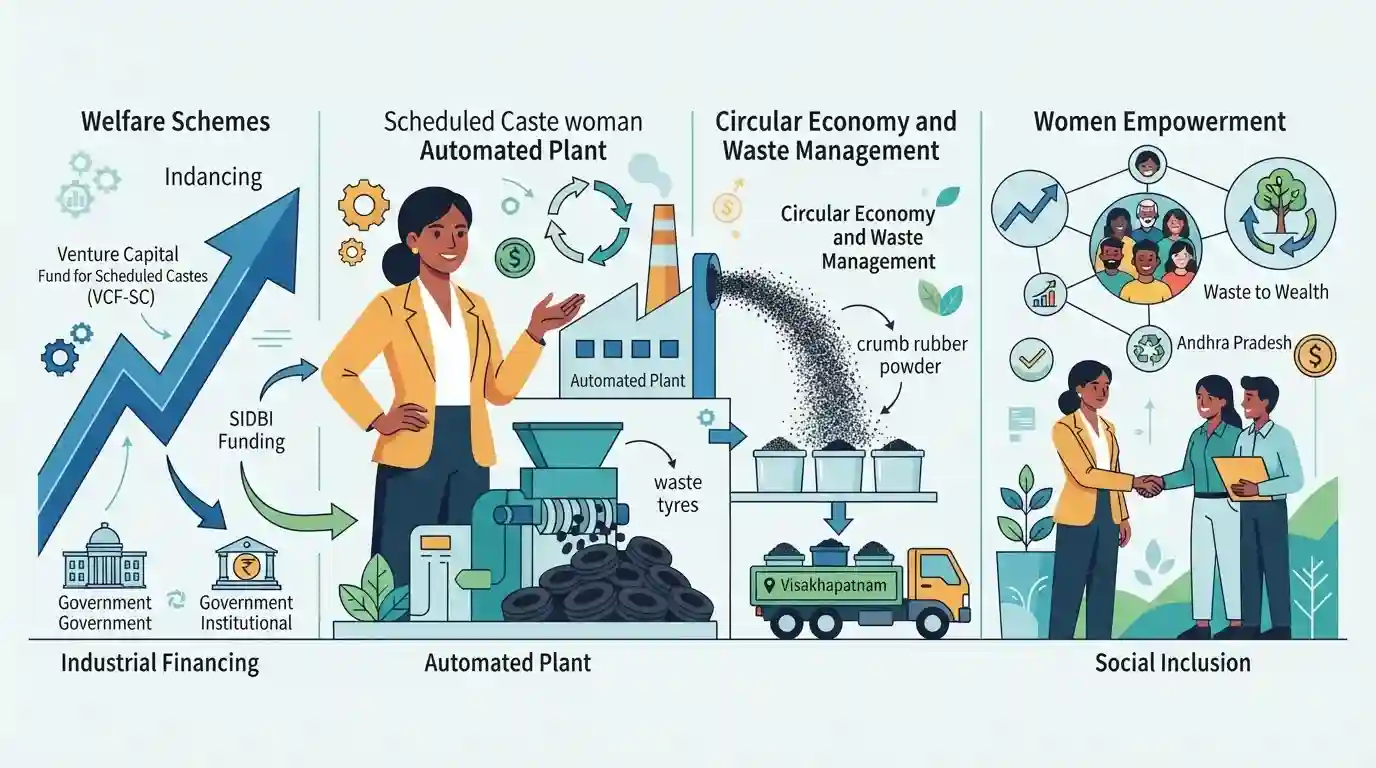
The Venture Capital Fund for Scheduled Castes (VCF-SC), a scheme by the Ministry of Social Justice and Empowerment, successfully enabled a Scheduled Caste woman entrepreneur to build a sustainable rubber recycling enterprise in Visakhapatnam, Andhra Pradesh. Supported by a Rs. 5 crore sanction from VCF-SC and additional funding from SIDBI, the automated plant converts waste tyres into valuable crumb rubber powder. This project serves as a practical model combining social inclusion, women's empowerment, and the 'Waste to Wealth' circular economy framework.
ముఖ్య అంశాలు
- Mrs. Swarnalatha Nethipudi, a first-generation Scheduled Caste woman entrepreneur, established an automated rubber recycling plant in Visakhapatnam to convert end-of-life tyres into crumb rubber powder.
- Her enterprise received a crucial Rs. 5 crore financial assistance in 2023 from the Venture Capital Fund for Scheduled Castes (VCF-SC) under the Ministry of Social Justice and Empowerment.
- The total project cost was Rs. 7.91 crore, with additional funding support coming from the Small Industries Development Bank of India (SIDBI) and the promoter's own contribution.
- The initiative embodies the 'Waste to Wealth' and circular economy models by providing an environmentally sustainable solution for waste tyre management.
- The project promotes social inclusion and economic empowerment by generating direct and indirect employment opportunities for marginalized communities.
ముఖ్యమైన పదాలు
Venture Capital Fund for Scheduled Castes (VCF-SC)

A social-sector fund under the Ministry of Social Justice and Empowerment that provides concessional finance to promote entrepreneurship and economic growth among Scheduled Castes.
UPSC context
GS Paper II (Welfare Schemes) & GS Paper III (Inclusive Growth); tests mechanisms for financial inclusion of vulnerable sections.
Small Industries Development Bank of India (SIDBI)
The principal statutory financial institution in India established to coordinate, promote, finance, and develop the Micro, Small, and Medium Enterprises (MSME) sector.
UPSC context
GS Paper III (Indian Economy); tests knowledge of institutional financing mechanisms and developmental banks supporting small enterprises.
Circular Economy
An economic model designed to minimize waste and maximize resources by keeping materials in use through recycling, reuse, and sustainable product design.
UPSC context
GS Paper III (Environment & Economy); tests concepts of sustainable development, waste-to-wealth conversion, and resource management.
Waste to Wealth Mission
A national mission under the PM-STIAC that identifies, develops, and deploys technologies for resource recovery, waste recycling, and energy generation.
UPSC context
GS Paper III (Science & Tech); tests national missions promoting clean technology, resource recovery, and environmental sustainability.
Ministry of Social Justice and Empowerment
The nodal ministry of the Government of India responsible for welfare, social justice, and empowerment of marginalized sections, including Scheduled Castes.
UPSC context
GS Paper II (Welfare Schemes & Institutions); tests administration of social welfare policies and government empowerment initiatives.
Swarnakaruna Princeton Rubber Industries Private Limited
A private rubber recycling enterprise based in Visakhapatnam that successfully utilized VCF-SC and SIDBI assistance to process waste tyres into crumb rubber powder.
UPSC context
GS Paper III (Growth & Employment); serves as a case study for women/marginalized-led green business startups in circular economy frameworks.
ప్రిలిమ్స్ ఉచ్చు
"VCF-SC is a venture scheme administered by SIDBI under the Ministry of Micro, Small and Medium Enterprises."
VCF-SC operates under the Ministry of Social Justice & Empowerment (MoSJE), and its implementing asset management agency is IFCI Ltd., not SIDBI.
అనుసంధానమైన స్థిర భావనలు
What are the core criteria for the Stand-Up India Scheme?
- Target Beneficiaries: Loans must be provided to at least one SC/ST borrower and at least one woman borrower per bank branch.
- Greenfield Only: Loans are exclusively for setting up new greenfield enterprises in manufacturing, services, agri-allied, or trading sectors.
- Loan Limits: Provides composite loans (inclusive of term loan and working capital) between ₹10 lakh and ₹100 lakh.
How is waste tyre management regulated in India?
- EPR Framework: Governed by a mandatory Extended Producer Responsibility (EPR) regime under the Hazardous and Other Wastes Amendment Rules, 2022.
- Digital Certificates: Tyre producers must meet recycling targets by purchasing digital EPR certificates online from registered recyclers.
- End Products: Recognized recycling outputs include Crumb Rubber, Reclaimed Rubber, Recovered Carbon Black, and Pyrolysis Oil/Char.
అంతర-అంశ నమూనాలు
Social Welfare + Circular Economy
The convergence of marginalized empowerment funds (VCF-SC) backing sustainable business models (tyre recycling) serves as a perfect GS-2/GS-3 case study for inclusive green growth.
Expanding EPR mandates
Extended Producer Responsibility (EPR) historically focused on E-waste and Plastics. Its 2022 expansion into waste tyres and batteries reflects India's rapidly evolving environmental compliance landscape.

Expect a Prelims multi-statement question contrasting VCF-SC (MoSJE) with Stand-Up India, or a query on the 2022 tyre EPR framework.
అనుసంధాన PYQలు · 2
అనుసంధాన PYQలు · 2
- 2019MainsGS2
Performance of welfare schemes that are implemented for vulnerable sections is not so effective due to absence of their awareness and active involvement at all stages of policy process. Discuss.
- 2016PrelimsGS1
With reference to 'Stand Up India Scheme', which of the following statements is/are correct? 1. Its purpose is to promote entrepreneurship among SC/ST and women entrepreneurs. 2. It provides for refinance through SIDBI. Select the correct answer using the code given below.
