Venture Capital Fund Empowers SC Startup in Defense Electronics
Source:PIB ↗
Why It Matters
It provides an excellent case study for GS2 (welfare schemes/social justice) and GS3 (inclusive growth/defense indigenization) on how targeted government venture capital can simultaneously bridge social inequalities and achieve strategic technological self-reliance.
Summary
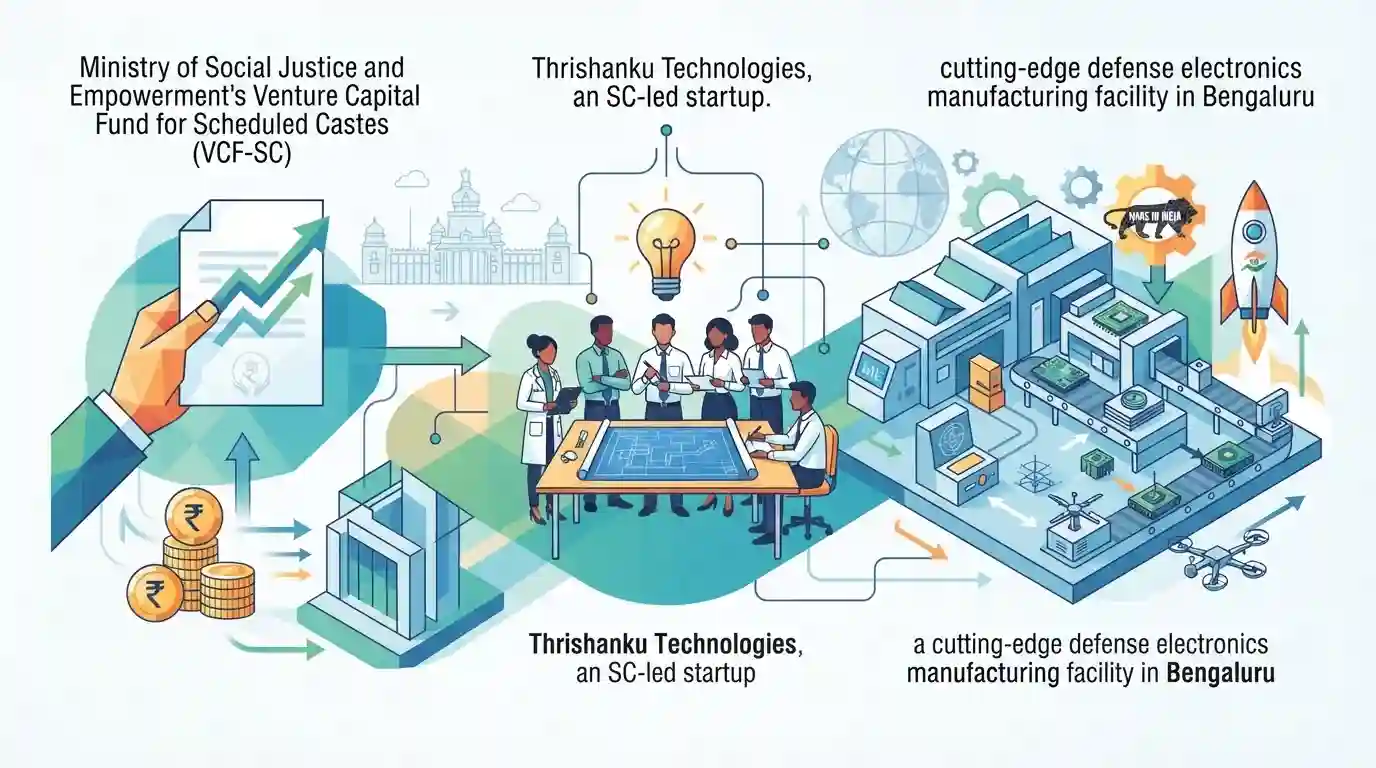
The Ministry of Social Justice and Empowerment's Venture Capital Fund for Scheduled Castes (VCF-SC) has successfully enabled Thrishanku Technologies, an SC-led startup, to establish a cutting-edge defense electronics manufacturing facility in Bengaluru. By providing ₹4.47 crore in financial assistance, the scheme not only promoted inclusive entrepreneurship and job creation for marginalized communities but also strengthened India's indigenous defense supply chain, directly contributing to the 'Make in India' and 'Atmanirbhar Bharat' initiatives.
Key Points
- The Venture Capital Fund for Scheduled Castes (VCF-SC), under the Ministry of Social Justice and Empowerment, provided ₹4.47 crore in financial assistance (via equity and Optionally Convertible Debentures) to Thrishanku Technologies.
- Thrishanku Technologies is an SC-led startup specializing in defense electronics, including printed circuit boards (PCBs), radar systems, and EDGE AI devices.
- The funding enabled the company to set up a state-of-the-art manufacturing facility in Bengaluru and provide critical electronic manufacturing services to major defense and tech entities like DRDO, BEL, and L&T.
- The initiative successfully merges social empowerment with strategic national interests, fostering inclusive entrepreneurship while advancing 'Atmanirbhar Bharat' and 'Make in India' in the defense sector.
Important Terms
Venture Capital Fund for Scheduled Castes (VCF-SC)

A social sector initiative launched in 2014-15 to provide concessional risk capital and venture finance to Scheduled Caste (SC) entrepreneurs, promoting innovation, growth, and economic inclusion.
UPSC context
GS Paper II: Government Schemes; GS Paper III: Inclusive Growth. Tests knowledge of state-led interventions for vulnerable sections.
Atmanirbhar Bharat
A flagship national vision launched in 2020 aiming to make India self-reliant across key sectors, emphasizing economic growth, infrastructure, technology-driven systems, and robust domestic demand.
UPSC context
GS Paper III: Indian Economy, Indigenization of Technology. Tests strategic vision of national self-reliance and manufacturing capabilities.
Make in India
A major national initiative launched in 2014 designed to facilitate investment, foster innovation, enhance skill development, protect intellectual property, and build best-in-class manufacturing infrastructure within India.
UPSC context
GS Paper III: Indian Economy, Industrial Policy. Tests understanding of manufacturing growth and economic self-sufficiency strategies.
Defence Research and Development Organisation (DRDO)
The premier military research and development agency under the Ministry of Defence, established in 1958, tasked with designing and developing indigenous defense technologies and weapon systems.
UPSC context
GS Paper III: Science and Technology, Security. Tests knowledge of defense indigenization and public sector technological advancements.
Bharat Electronics Limited (BEL)
A Navratna Public Sector Undertaking under the Ministry of Defence, established in 1954, specializing in manufacturing advanced electronic systems, communication equipment, and radar devices for the Indian military.
UPSC context
GS Paper III: Security, Indigenization of Technology. Tests understanding of defense manufacturing PSUs and state-supported security technology.
Ministry of Social Justice and Empowerment
The central ministry responsible for welfare, social justice, and empowerment of marginalized groups, including Scheduled Castes, Scheduled Tribes, Other Backward Classes, senior citizens, and persons with disabilities.
UPSC context
GS Paper II: Welfare Schemes for Vulnerable Sections. Tests knowledge of institutional frameworks for social equity and inclusion.
Thrishanku Technologies Private Limited
A Bengaluru-based, SC-led startup specializing in defense electronics, radar systems, and Edge AI, illustrating the success of government-supported venture capital in strengthening indigenous defense manufacturing.
UPSC context
GS Paper III: Inclusive Growth, Security. Tests real-world case studies of technology indigenization and inclusive entrepreneurship.
Prelims Trap
The Venture Capital Fund for Scheduled Castes (VCF-SC) is administered by the Ministry of Finance or Ministry of Commerce.
Though VCF-SC operates as a financial venture fund managed by IFCI, it is administered by the Ministry of Social Justice and Empowerment, not Finance or Commerce.
Static Concepts Connected
What are SEBI's Alternative Investment Fund (AIF) categories?
- Category I AIFs: Invest in start-ups, early-stage ventures, social ventures, and infrastructure (e.g., venture capital or angel funds).
- Category II AIFs: Do not fall under Cat I or III and do not undertake leverage (e.g., private equity, real estate, or debt funds like VCF-SC).
- Category III AIFs: Employ diverse/complex trading strategies, including short-selling and leverage, to make short-term returns (e.g., hedge funds).
What is the Ambedkar Social Innovation and Incubation Mission?
- Nodal scheme: Launched in September 2020 as a sub-scheme under the Venture Capital Fund for Scheduled Castes (VCF-SC).
- Core objective: Aims to promote innovation and enterprise among SC youth working in Technology Business Incubators (TBIs) across India.
- Financial limit: Offers equity funding support of up to ₹30 lakh over a three-year period to eligible start-ups.
Cross-Topic Patterns
Social justice meets strategic defense
Shifts affirmative action from traditional welfare grants to venture equity, integrating marginalized entrepreneurs directly into critical defense-tech indigenization.
AIFs as development tools
Demonstrates how formal capital market structures (SEBI Category II AIFs) are deployed to meet target socio-economic empowerment goals of minority groups.

Prelims 2026 may target the structural classification of VCF-SC as a Category II AIF under the Ministry of Social Justice, not Finance.
Linked PYQs · 3
Linked PYQs · 3
- 2016PrelimsGS1
With reference to 'Stand Up India Scheme', which of the following statements is/are correct? 1. Its purpose is to promote entrepreneurship among SC/ST and women entrepreneurs. 2. It provides for refinance through SIDBI. Select the correct answer using the code given below.
- 2025PrelimsGS1
With reference to investments, consider the following: I. Bonds II. Hedge Funds III. Stocks IV. Venture Capital How many of the above are treated as Alternative Investment Funds?
- 2023MainsGS2
“Development and welfare schemes for the vulnerable, by its nature, are discriminatory in approach.” Do you agree? Give reasons for your answer.
