PM-AJAY Adarsh Gram Component Targets Holistic Village Development
Source:PIB ↗
কেন এটি গুরুত্বপূর্ণ
Understanding targeted welfare programs like PM-AJAY is crucial for answering questions on governance and social justice in GS Paper 2. It highlights the mechanism of scheme convergence for effective rural development and the systemic efforts directed toward the socio-economic empowerment of marginalized groups (Scheduled Castes).
সারসংক্ষেপ
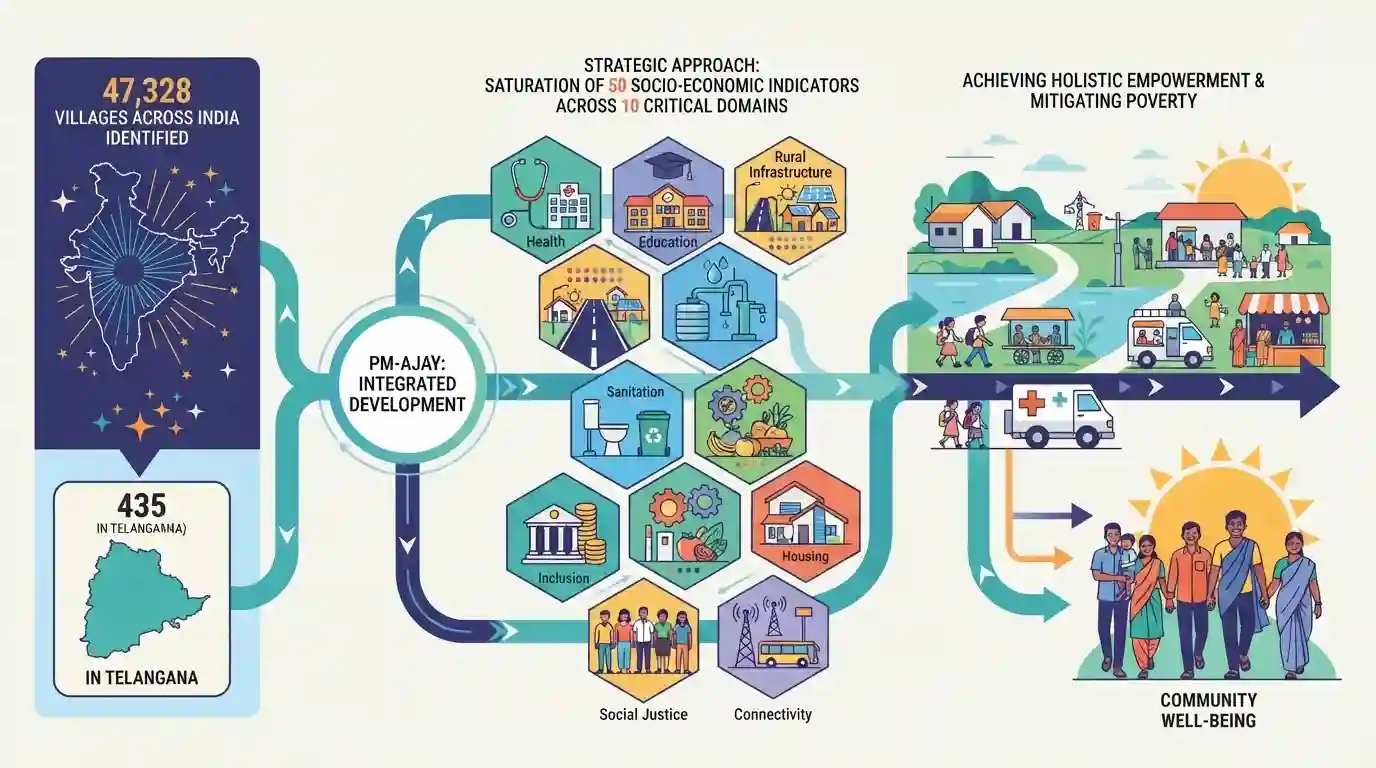
The Ministry of Social Justice and Empowerment has identified 47,328 villages across India, including 435 in Telangana, for integrated development under the Adarsh Gram Component of the Pradhan Mantri Anusuchit Jaati Abhyuday Yojana (PM-AJAY). This initiative seeks to transform Scheduled Caste (SC) majority villages into 'Adarsh Grams' (Model Villages) by ensuring the saturation of 50 monitorable socio-economic indicators across 10 critical domains, including health, education, and rural infrastructure. The component achieves this by leveraging the convergence of existing Central and State Government schemes, thereby fostering holistic socio-economic empowerment and mitigating poverty among vulnerable communities.
মূল বিষয়
- A total of 47,328 villages nationwide, including 435 in Telangana, have been selected under the Adarsh Gram Component of PM-AJAY.
- The initiative aims to transform Scheduled Caste (SC) majority villages into model villages (Adarsh Grams) through integrated socio-economic development.
- Implementation is driven by the convergence of existing Central and State Government schemes to avoid duplication and maximize resource utilization.
- The scheme targets the saturation of 50 monitorable socio-economic indicators spanning 10 domains, such as education, healthcare, sanitation, and rural infrastructure.
- PM-AJAY operates as an umbrella scheme under the Ministry of Social Justice and Empowerment to reduce poverty and generate employment for SC communities.
গুরুত্বপূর্ণ শব্দ
Pradhan Mantri Anusuchit Jaati Abhyuday Yojana (PM-AJAY)

A 100% Centrally Sponsored umbrella scheme launched in 2021-22 by the Ministry of Social Justice and Empowerment for the socio-economic upliftment, poverty reduction, and skill development of Scheduled Caste communities.
UPSC context
Crucial for GS Paper II (Welfare Schemes). Tests understanding of umbrella initiatives for vulnerable sections and outcome-oriented digital governance.
Adarsh Gram Component
A key pillar of PM-AJAY targeting the integrated development of villages with over 50% SC population. It ensures adequate infrastructure and saturates 50 monitorable socio-economic indicators across 10 developmental domains.
UPSC context
Relevant to GS Paper II (Governance) and GS III (Inclusive Growth). Evaluates knowledge of targeted grassroots interventions and rural indicators.
Pradhan Mantri Adarsh Gram Yojana (PMAGY)
An erstwhile rural development scheme launched in 2009-10 to provide integrated infrastructure to SC-majority villages. In 2021-22, it was consolidated into the PM-AJAY scheme as its Adarsh Gram component.
UPSC context
Important for GS Paper II (Government Policies). Often tested in prelims regarding the timeline and consolidation of major social welfare schemes.
Ministry of Social Justice and Empowerment
The nodal central ministry responsible for ensuring equitable treatment and socio-economic empowerment of marginalized communities, including Scheduled Castes, backward classes, senior citizens, and persons with disabilities.
UPSC context
Key for GS Paper II (Polity and Governance). Questions frequently test matching specific welfare programs and targeted interventions to their correct nodal ministries.
প্রিলিমস ফাঁদ
PM-AJAY's Adarsh Gram component is implemented by the Ministry of Rural Development and targets villages with more than 50% SC population.
It is implemented by the Ministry of Social Justice and Empowerment, and the criteria requires a minimum SC population threshold of 40%, not 50%.
সংযুক্ত স্থির ধারণা
What distinguishes Centrally Sponsored Schemes (CSS) from Central Sector Schemes?
- Funding structure: Central Sector Schemes are 100% funded by the Union; CSS usually involve cost-sharing ratios like 60:40 or 90:10 with states.
- Implementation agency: Central Sector Schemes are executed by Union ministries; CSS are primarily implemented by state government machinery.
- PM-AJAY hybridity: PM-AJAY is classified as a CSS but unique because the core components are 100% funded by the Central Government.
What are the key constitutional safeguards for Scheduled Castes in India?
- Article 46: Directs the State to promote the educational and economic interests of Scheduled Castes with special care.
- Article 338: Mandates the creation of the National Commission for Scheduled Castes (NCSC) to monitor safeguard implementation.
- Article 17: Abolishes the practice of untouchability, establishing the foundational legal framework for social equality.
আন্তঃবিষয় প্যাটার্ন
Scheme Convergence and Governance Efficiency
Merging three separate schemes into PM-AJAY highlights a transition toward programmatic convergence, reducing fiscal leakage and administrative duplication across Union and State machineries.
Spatial Justice in Rural Planning
Targeting villages with >40% SC population addresses spatial discrimination, linking rural development indicators directly to localized social-vulnerability indices rather than broad geographic parameters.

Questions on PM-AJAY are likely to test its specific demographic thresholds (>40% SC), merged parent schemes, and gap-filling funding.
সংযুক্ত PYQ · 2
সংযুক্ত PYQ · 2
- 2023MainsGS2
“Development and welfare schemes for the vulnerable, by its nature, are discriminatory in approach.” Do you agree? Give reasons for your answer.
- 2024MainsGS2
Analyse the role of local bodies in providing good governance at local level and bring out the pros and cons merging the rural local bodies with the urban local bodies.
