Tri-Services Future Warfare Course and Jointness in Armed Forces
Source:PIB ↗
কেন এটি গুরুত্বপূর্ণ
Reflects India's shift toward jointness in the armed forces (tri-services integration) and highlights the increasing focus on modernizing military preparedness against non-traditional, multidimensional, and technology-driven warfare threats.
সারসংক্ষেপ
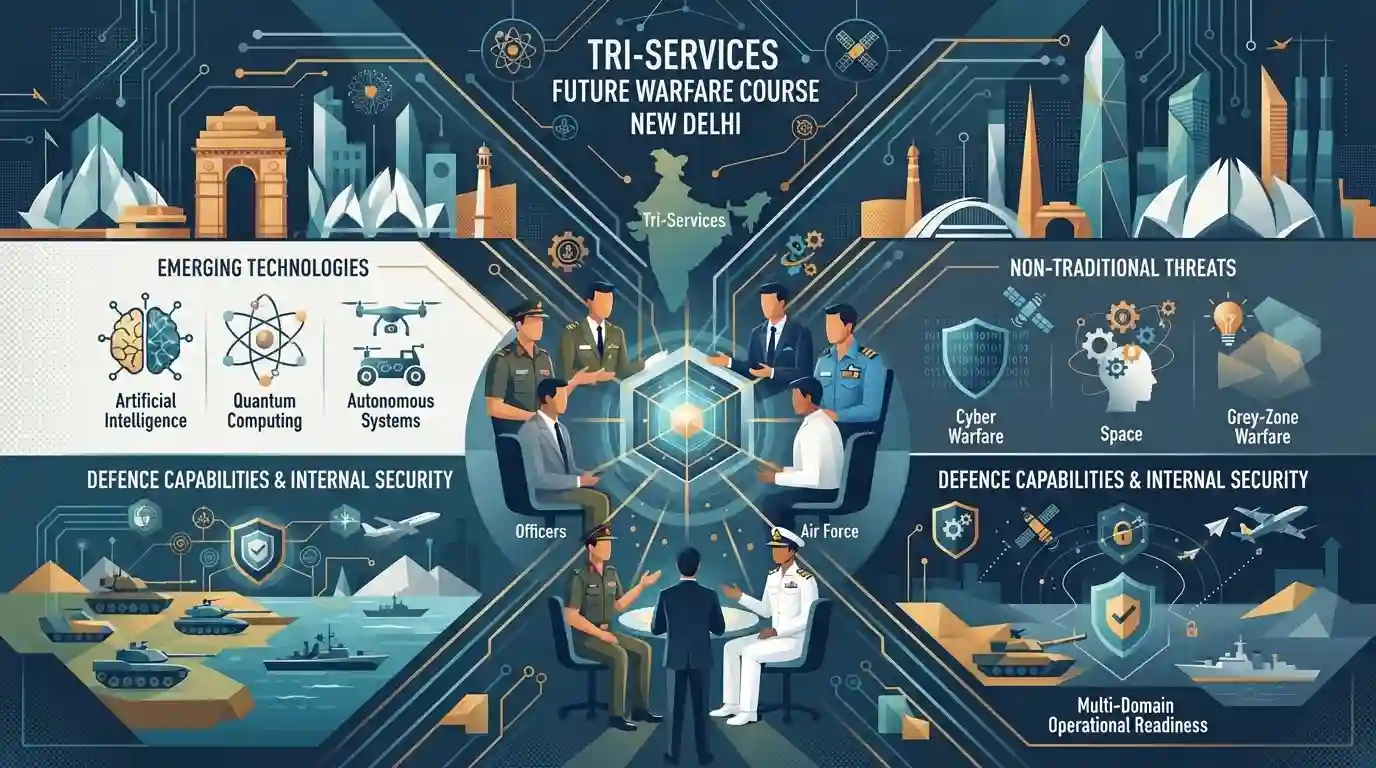
The fourth edition of the Tri-Services Future Warfare Course begins in New Delhi to prepare India's armed forces for evolving combat scenarios. Conducted by the Headquarters Integrated Defence Staff (HQ IDS) and coordinated by the Centre for Joint Warfare Studies (CENJOWS), the four-week course unites tri-service officers, policymakers, and industry experts. The curriculum emphasizes emerging technologies like AI, quantum computing, and autonomous systems, alongside non-traditional threats such as cyber, space, cognitive, and grey-zone warfare, aiming to enhance multi-domain operational readiness.
মূল বিষয়
- The 4th edition of the Tri-Services Future Warfare Course is set to begin on August 3, 2026, in New Delhi.
- The four-week course is conducted under the aegis of the Headquarters Integrated Defence Staff (HQ IDS) and coordinated by CENJOWS.
- The curriculum focuses on modern and emerging battlefields, including artificial intelligence, quantum technologies, cyber, space and cognitive warfare, and multi-domain operations.
- It aims to foster a joint understanding among military officers, policymakers, industry leaders, and scientists regarding future operational and multidimensional challenges.
গুরুত্বপূর্ণ শব্দ
Tri-Services Future Warfare Course

A four-week program uniting Army, Navy, Air Force officers, and civilian experts to build joint operational readiness against evolving threats like cyber, space warfare, AI, and multi-domain operations.
UPSC context
Crucial for GS-3 (Internal Security). Highlights India's strategic push for armed forces integration and modernization against non-traditional, technology-enabled threats.
Headquarters Integrated Defence Staff (HQ IDS)
A tri-service military organization established in 2001 following the Kargil Review Committee. It functions under the Ministry of Defence to foster coordination, jointness, and integrated capability development across India's armed forces.
UPSC context
Vital for GS-3 (Security Architecture). Tests knowledge of structural defence reforms, theatre command integration, and multi-domain military synergy.
Centre for Joint Warfare Studies (CENJOWS)
An autonomous tri-services think tank set up by the Ministry of Defence in 2007. It promotes strategic innovation, policy discourse, and joint warfighting concepts across the Indian military establishment.
UPSC context
Relevant to GS-3 (Security). Demonstrates institutional efforts to cultivate intellectual capital and evidence-based research for integrated national security strategies.
প্রিলিমস ফাঁদ
The Headquarters Integrated Defence Staff (HQ IDS) is a constitutional body vested with direct combat command over individual service operational branches.
HQ IDS is an executive organization created post-Kargil (2001) to foster jointness, synergy, and coordination, not a constitutional body exercising direct operational combat command.
সংযুক্ত স্থির ধারণা
What is the mandate and origin of the Headquarters Integrated Defence Staff (HQ IDS)?
- Post-Kargil Origin: Established in 2001 following Kargil Review Committee recommendations to institutionalize jointness and synergy among India's Army, Navy, and Air Force.
- Advisory & Integration: It coordinates joint doctrine development, intelligence sharing, common procurement prioritization, and prepares the armed forces for multi-domain integrated combat operations.
- Leadership Structure: Operates under the Chief of Defence Staff (CDS) to ensure unified military advice and seamless transition to integrated theater commands.
What is the distinction between Grey-Zone Warfare and Cognitive Warfare?
- Grey-Zone Warfare: Activities operating below the threshold of open, conventional war—such as cyber harassment, maritime militia operations, and economic coercion—ensuring plausible deniability.
- Cognitive Warfare: A specialized dimension targeting the human mind as a domain of war, leveraging psychological manipulation, deepfakes, and disinformation to alter cognitive processing and decision-making.
আন্তঃবিষয় প্যাটার্ন
Defense Reforms + Shekatkar Committee
Tri-service training in emerging technologies advances the Shekatkar Committee’s goals of restructuring civil-military relations, optimizing defense spending, and enhancing joint combat readiness.
Dual-use Tech + Critical Infrastructure Protection
Military integration of quantum and cyber systems mirrors civilian efforts by agencies like NCIIPC to protect India's Critical Information Infrastructure from state-sponsored threats.

UPSC is likely to test conceptual differences between grey-zone, cognitive, and cyber warfare in a multi-statement internal security question.
সংযুক্ত PYQ · 3
সংযুক্ত PYQ · 3
- 2021MainsGS3
Analyse the multidimensional challenges posed by external state and non-state actors, to the internal security of India. Also discuss measures required to be taken to combat these threats.
- 2022PrelimsGS1
Which one of the following is the context in which the term "qubit" is mentioned ?
- 2021MainsGS3
Keeping in view India's internal security, analyse the impact of cross-border cyber attacks. Also discuss defensive measures against these sophisticated attacks.
