BRICS Statistical Heads Meeting Focuses on Quality Data for Governance
Source:PIB ↗
ఇది ఎందుకు ముఖ్యం
The article is relevant for GS Paper 2 (International Relations and Governance). It highlights India's leadership in the expanded BRICS framework during its 2026 Chairship. Furthermore, the focus on 'Quality Statistics', AI in data ecosystems, and evidence-based governance aligns with UPSC syllabus themes on e-governance, transparency, and the role of data in developmental policy-making.
సారాంశం
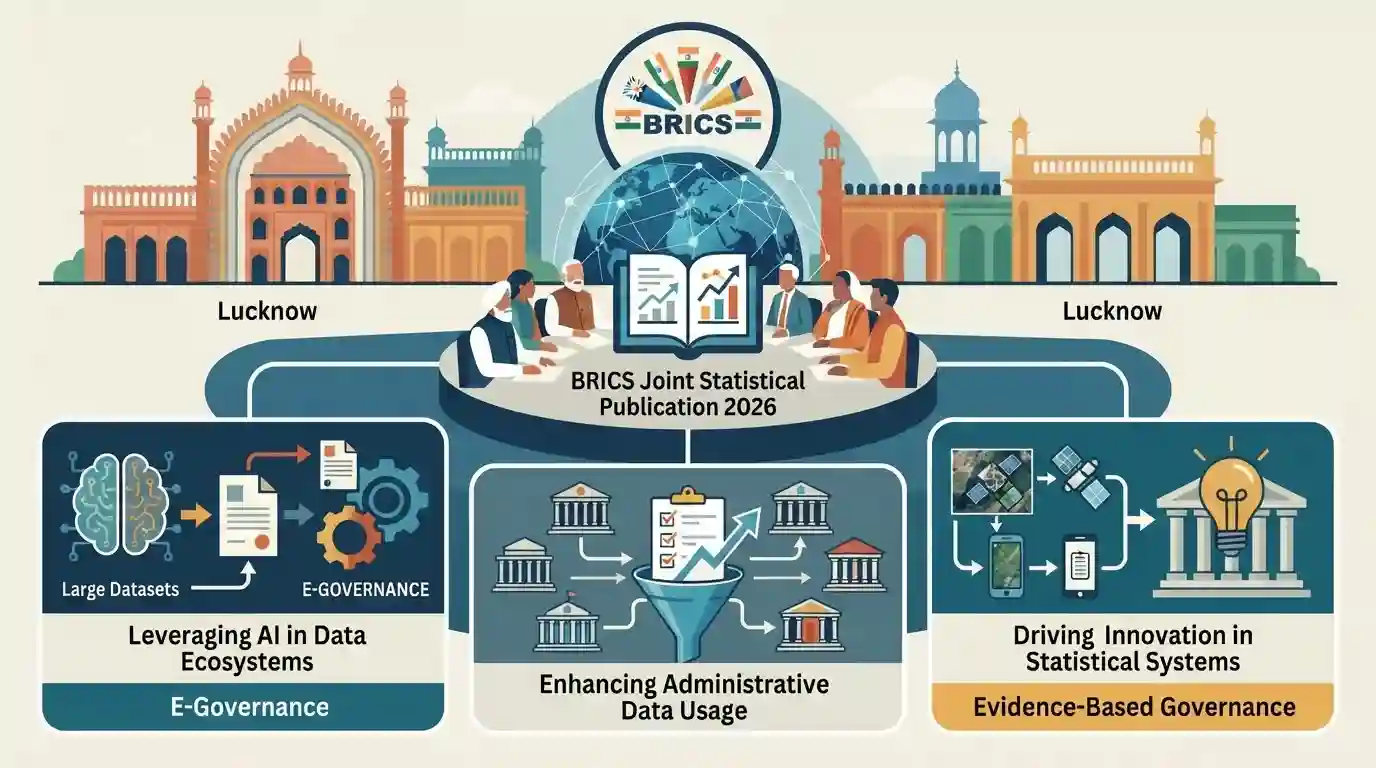
The Ministry of Statistics and Programme Implementation (MoSPI) hosted the 16th meeting of the Heads of National Statistical Offices (NSO) of BRICS Countries in Lucknow, Uttar Pradesh, under India's 2026 BRICS Chairship. The gathering, themed 'Quality Statistics as Driver of Change', highlighted the expanded BRICS membership with participation from 11 nations. Key deliverables included the release of the BRICS Joint Statistical Publication 2026. Critical discussions revolved around leveraging AI in data ecosystems, enhancing administrative data usage, and driving innovation in statistical systems to support evidence-based governance across member states.
ముఖ్య అంశాలు
- The 16th meeting of Heads of National Statistical Offices (NSO) of BRICS Countries was held on August 3-4, 2026, in Lucknow, Uttar Pradesh.
- The event was organized by the Ministry of Statistics and Programme Implementation (MoSPI) under India's BRICS Chairship in 2026.
- India's BRICS Chairship theme is 'Building for Resilience, Innovation, Cooperation and Sustainability (BRICS)', while the statistics track theme was 'Quality Statistics as Driver of Change'.
- The meeting saw participation from the expanded BRICS grouping, including representatives from Brazil, Russia, India, China, South Africa, Egypt, Ethiopia, Indonesia, Iran, Saudi Arabia, and the UAE.
- The BRICS Joint Statistical Publication (JSP) 2026 and Snapshot BRICS JSP 2026 were released, showcasing comprehensive socio-economic indicators.
- Discussions focused on integrating Administrative Data, AI Readiness in Data Ecosystems, and Innovations in Statistical Systems to bolster policy-making.
ముఖ్యమైన పదాలు
BRICS Joint Statistical Publication (JSP)

An annual report jointly published by BRICS National Statistical Offices since 2010, offering comprehensive, comparable socioeconomic and macroeconomic indicators of member countries.
UPSC context
GS Paper II (International Relations) & GS Paper III (Economic Development); tests knowledge of multilateral governance data and indices.
Snapshot BRICS JSP
A condensed, user-friendly version of the main BRICS Joint Statistical Publication introduced in 2020 to provide easily accessible, harmonised statistics for a wider audience.
UPSC context
GS Paper II (International Institutions) & GS Paper III (E-governance); tests awareness of policy communication and accessibility in international cooperation.
BRICS
An influential grouping of emerging economies, originally comprising Brazil, Russia, India, China, and South Africa, which recently expanded to include several other countries.
UPSC context
GS Paper II (Bilateral & Groupings); crucial for questions on global governance reform, geopolitics, and emerging multipolar world order.
National Statistical Office (NSO)
The nodal statistical wing under India's Ministry of Statistics and Programme Implementation, formed by merging CSO and NSSO in 2019 to conduct national surveys and compile macroeconomic indicators like GDP.
UPSC context
GS Paper III (Indian Economy & Planning); essential for understanding statistical machinery, national indicators, and evidence-based policy.
Ministry of Statistics and Programme Implementation (MoSPI)
The apex Indian ministry responsible for coordinating official statistics, conducting large-scale national surveys, and monitoring the implementation of major infrastructure projects and schemes.
UPSC context
GS Paper II (Governance) & GS Paper III (Planning/Development); tests understanding of institutions supporting development administration and data-driven policymaking.
ప్రిలిమ్స్ ఉచ్చు
The National Statistical Office (NSO) is a statutory body established under an Act of Parliament to ensure data independence.
The NSO is an attached office of MoSPI created via an executive merger (CSO and NSSO) in 2019; it is not established under any statute.
అనుసంధానమైన స్థిర భావనలు
What is the structure and origin of India's National Statistical Office (NSO)?
- Establishment: Created in May 2019 by merging the Central Statistics Office (CSO) and the National Sample Survey Office (NSSO).
- Nodal Agency: Functions as the statistical wing of the Ministry of Statistics and Programme Implementation (MoSPI).
- Key Indicators: Responsible for compiling and releasing key macroeconomic indicators including GDP, CPI, and the Index of Industrial Production (IIP).
What are the key institutional mechanisms of the BRICS grouping?
- New Development Bank: Established to mobilize resources for infrastructure and sustainable development projects in BRICS and other emerging economies.
- Contingent Reserve Arrangement: A framework for providing protection against global liquidity pressures and currency instability.
- Statistical Track: Collaborative platform of member NSOs to produce the annual Joint Statistical Publication for comparative socio-economic analysis.
అంతర-అంశ నమూనాలు
Data Sovereignty + Global South Cooperation
Harmonizing statistical tools among BRICS+ nations challenges Western-dominated data architectures, establishing developmental metrics tailored to Global South realities.
AI in Governance + Predictive Policy
Integrating AI into national statistical databases transitions public service delivery from reactive reporting to predictive, evidence-based e-governance models.

BRICS expansion dynamics combined with MoSPI's statistical reforms (CSO-NSSO merger) will likely feature as a multi-statement MCQ in 2026.
అనుసంధాన PYQలు · 3
అనుసంధాన PYQలు · 3
- 2012MainsGS2
Compare the significance of IBSA and BRICS in the context of India's multilateral diplomacy.
- 2024MainsGS2
e-governance is not just about the routine application of digital technology in service delivery process. It is as much about multifarious interactions for ensuring transparency and accountability. In this context evaluate the role of the 'Interactive Service Model' of e-governance.
- 2025MainsGS2
"In contemporary development models, decision-making and problem-solving responsibilities are not located close to the source of information and execution defeating the objectives of development." Critically evaluate.
