Commercial Coal Mining Reforms Drive India Toward Energy Self-Reliance
Source:PIB ↗
Why It Matters
This article provides a concrete example of a major structural reform in a core sector, marking the transition from the nationalization and captive-use eras to open-market commercial mining. It is highly relevant for GS3 questions addressing resource allocation, FDI liberalization, and strategies for national energy self-reliance.
Summary
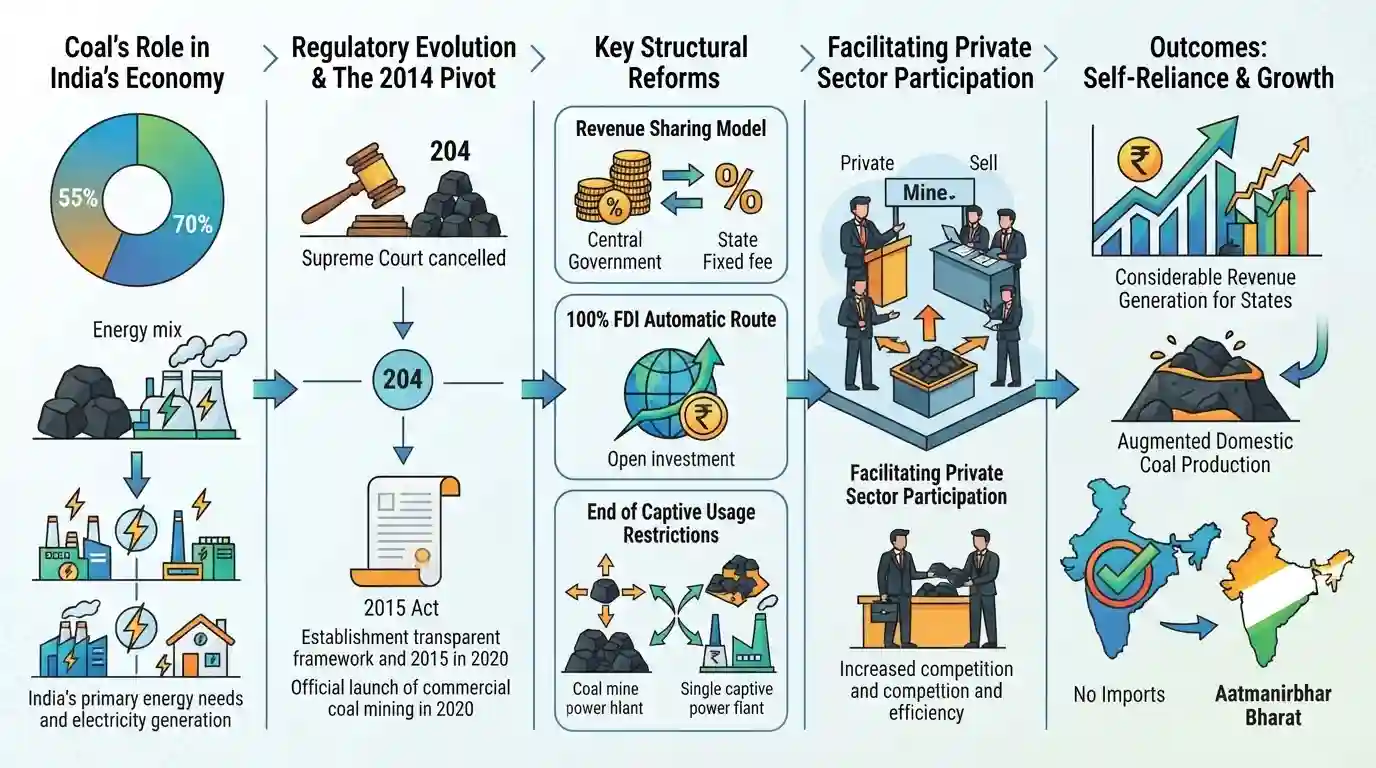
The article outlines India's structural reforms in the coal sector, specifically the transition to commercial coal mining, which is aimed at ensuring energy security and achieving "Aatmanirbhar Bharat" (self-reliance). Highlighting coal's central role in the economy—meeting 55% of primary energy needs and 70% of electricity generation—the piece traces the sector's regulatory evolution following the Supreme Court's 2014 cancellation of 204 coal blocks. To establish a transparent system, the government enacted the Coal Mines (Special Provisions) Act, 2015, and officially launched commercial coal mining in June 2020. Key reforms include shifting from fixed charges to a revenue-sharing model based on the National Coal Index, allowing 100% FDI via the automatic route, and removing restrictions on captive usage, thus empowering private entities to sell coal on the open market. These policy interventions have facilitated the successful auction of 141 mines, generating considerable revenue for states and augmenting domestic coal production to curtail import reliance.
Key Points
- Coal remains fundamental to India's energy landscape, fulfilling approximately 55% of primary energy demand and fueling about 70% of the nation's electricity generation.
- The cancellation of 204 captive coal block allocations by the Supreme Court in 2014 triggered a paradigm shift, prompting the enactment of the Coal Mines (Special Provisions) Act, 2015.
- Commercial coal mining was officially launched in June 2020 under the Aatmanirbhar Bharat initiative, permitting the sale of coal on the open market without any captive-use restrictions.
- The allocation framework shifted from a fixed-charge per tonne mechanism to a dynamic revenue-sharing model pegged to the National Coal Index.
- The sector has been completely liberalized for foreign capital, with 100% FDI now permitted under the automatic route for coal mining and associated infrastructure.
Important Terms
Commercial Coal Mining

A market-driven policy framework introduced in 2020 allowing private entities to mine and sell coal on the open market, removing captive-use restrictions to enhance competition and energy security.
UPSC context
GS Paper III (Infrastructure: Energy & Economic Reforms). Tests understanding of private sector participation, ease of doing business, and mineral sector development.
National Coal Index
A monthly price index compiled by the Ministry of Coal with FY18 as the base year, combining prices from all sales channels to determine revenue sharing for auctioned commercial coal mines.
UPSC context
GS Paper III (Energy and Economic Reforms). Tests knowledge of pricing mechanisms, resource governance, and revenue-sharing models in the minerals sector.
Coal Mines (Special Provisions) Act, 2015
A statutory framework enacted to manage the reallocation of 204 coal blocks cancelled by the Supreme Court in 2014, establishing transparent auction-based processes and legal certainty for coal mining in India.
UPSC context
GS Paper III (Infrastructure and Resource Mobilisation). Tests understanding of legislative responses to judicial decisions and mineral rights allocation.
Revenue-Sharing Model
An allocation mechanism where successful bidders pay a percentage of their revenue, linked to the National Coal Index, to the government, replacing the older fixed per-tonne payment structure.
UPSC context
GS Paper III (Investment Models & Resource Mobilisation). Tests comprehension of fiscal regimes, public-private partnerships, and market-linked natural resource auctions.
Aatmanirbhar Bharat
India's national vision and policy initiative aiming for self-reliance across critical economic sectors, emphasizing domestic production, infrastructure development, and reduced reliance on imports, including in energy and mining.
UPSC context
GS Paper III (Indian Economy). Tests appreciation of macroeconomic policies, domestic manufacturing strategies, and import substitution across key core sectors.
Prelims Trap
All revenue and auction proceeds generated from commercial coal mining auctions accrue directly to the Consolidated Fund of India.
Under the 2015 Act, all auction proceeds and royalties accrue entirely to the respective state governments where the mines are located, not the Centre.
Static Concepts Connected
What is the National Coal Index (NCI)?
- Developer & Publisher: Developed by the Indian Statistical Institute (ISI) Kolkata and published monthly by the Ministry of Coal.
- Base Year: It uses FY 2017-18 as the fixed base year to measure monthly price variations of coal.
- Composition: It aggregates coal prices from all sales channels, including notified prices, auction prices, and import prices.
How is mineral wealth regulated under the Indian Constitution?
- State Ownership: State governments own onshore minerals within their boundaries and receive all royalties and auction revenues.
- Central Control: The Union government regulates major minerals (like coal) under the Mines and Minerals (Development and Regulation) Act.
- Offshore Minerals: Minerals found within the Exclusive Economic Zone (EEZ) and continental shelf vest solely with the Union government.
Cross-Topic Patterns
Energy transition vs. Fiscal federalism
Phasing down coal threatens the fiscal health of mineral-rich states like Jharkhand and Chhattisgarh that depend heavily on coal royalties for public spending.
Clean coal vs. Climate goals
Coal gasification and clean-coal technologies bridge India's short-term domestic energy security with its long-term net-zero commitments under the Paris Agreement.

National Coal Index composition, MMDR 2021 captive-sale limits, and the federal distribution of mining revenues will likely feature in 2026.
Linked PYQs · 3
Linked PYQs · 3
- 2019PrelimsGS1
Consider the following statements: 1. Coal sector was nationalized by the Government of India under Indira Gandhi. 2. Now, coal blocks are allocated on lottery basis. 3. Till recently, India imported coal to meet the shortages of domestic supply, but now India is self-sufficient in coal production. Which of the statements given above is/are correct?
- 2022PrelimsGS1
In India, what is the role of the Coal Controller's Organization (CCO)? 1. CCO is the major source of Coal Statistics in Government of India. 2. It monitors progress of development of Captive Coal/Lignite blocks. 3. It hears any objection to the Government's notification relating to acquisition of coal-bearing areas. 4. It ensures that coal mining companies deliver the coal to end users in the prescribed time. Select the correct answer using the code given below:
- 2025MainsGS3
Mineral resources are fundamental to the country's economy and these are exploited by mining. Why is mining considered an environmental hazard? Explain the remedial measures required to reduce the environmental hazard due to mining.
