Central Bureau of Narcotics Counterfeit Drug Bust in Bihar
Source:PIB ↗
Why It Matters
This operation provides a practical case study of how inter-state organized crime syndicates operate within India's borders, exploiting systemic loopholes like undocumented rentals and cash transactions. It is highly relevant for GS3 Internal Security topics focusing on drug trafficking, organized crime linkages, and the operational responses required (like multi-agency coordination) to counter such threats.
Summary
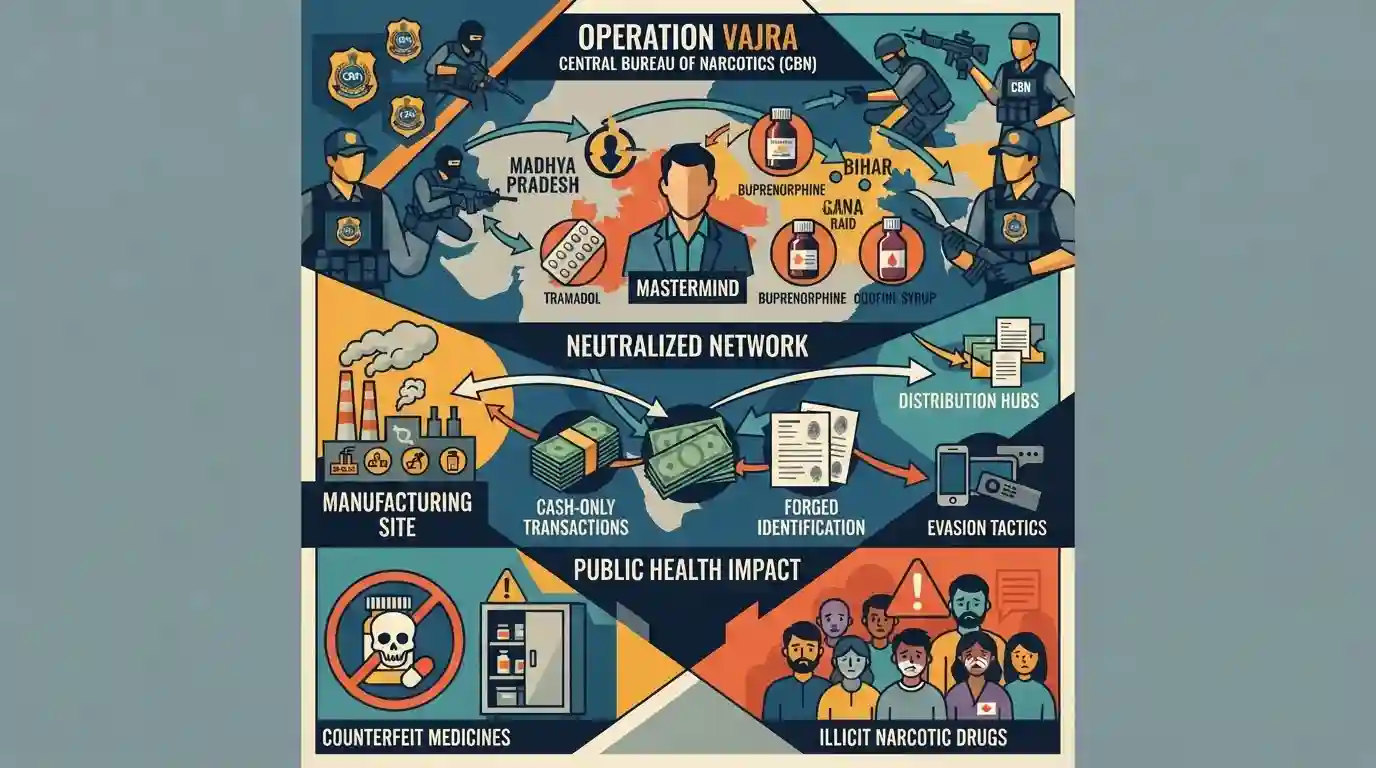
The Central Bureau of Narcotics (CBN), Madhya Pradesh Unit, successfully conducted 'Operation Vajra', neutralizing a sophisticated inter-state network involved in manufacturing and distributing counterfeit medicines and illicit narcotic drugs in Bihar. Raids across Gaya and Patna led to the arrest of a prime mastermind and massive seizures of spurious drugs like Tramadol, Buprenorphine, and Codeine syrup. The operation highlighted the evolving tactics of organized crime syndicates, who evaded law enforcement by renting facilities without paperwork, operating strictly in cash, and utilizing forged identification for communication channels.
Key Points
- The Central Bureau of Narcotics (CBN), Madhya Pradesh Unit, executed Operation Vajra, successfully dismantling an inter-state illicit drug and counterfeit medicine manufacturing network in Bihar.
- Raids in Gaya and Patna (Masaurhi) resulted in the seizure of huge caches of counterfeit/spurious medicines and narcotics, including Tramadol, Buprenorphine, and Codeine syrup.
- The criminal syndicate utilized a sophisticated modus operandi: renting premises without formal agreements, avoiding electronic payment trails by dealing entirely in cash, and using forged IDs for mobile connections.
- The bust demonstrates effective multi-agency cooperation, involving the local police, State Drug Department, and Food Department.
Important Terms
Narcotic Drugs and Psychotropic Substances (NDPS) Act

Enacted in 1985, this comprehensive Indian law strictly prohibits the cultivation, production, possession, sale, and consumption of narcotic drugs and psychotropic substances, except for authorized medical and scientific purposes.
UPSC context
Crucial for GS Papers 2 & 3. Tests knowledge of India's primary statutory framework combating illicit drug trafficking and drug abuse.
Central Bureau of Narcotics (CBN)
A central law enforcement agency under the Department of Revenue, Ministry of Finance. It regulates the licit cultivation of opium and enforces the NDPS Act against illicit drug trafficking.
UPSC context
Relevant for GS Paper 3 (Security Agencies). Tests the distinction between CBN (Ministry of Finance) and NCB (Ministry of Home Affairs).
State Drug Administration
State-level regulatory bodies operating under the Drugs and Cosmetics Act. They work alongside the Central Drugs Standard Control Organisation (CDSCO) to license pharmaceutical manufacturing and curb counterfeit medicines locally.
UPSC context
Important for GS Paper 2 (Health & Governance). Highlights the federal structure of pharmaceutical regulation and public health safeguarding.
Operation Vajra
A coordinated enforcement initiative led by the Central Bureau of Narcotics (CBN) to dismantle sophisticated inter-state and international syndicates involved in trafficking massive quantities of illicit narcotic medicines.
UPSC context
A key contemporary example for GS Paper 3 (Internal Security) illustrating state action against modern organized crime and drug syndicates.
Psychotropic Substances
Natural or synthetic chemical compounds—such as Tramadol and Buprenorphine—that alter brain function and consciousness. Their production and distribution are stringently regulated domestically and globally to prevent abuse.
UPSC context
Relevant to GS Paper 3 (Science/Security). Tests understanding of the evolving nature of pharmaceutical drug diversion and synthetic opioid abuse.
Prelims Trap
The Central Bureau of Narcotics (CBN) operates under the administrative control of the Ministry of Home Affairs.
CBN operates under the Department of Revenue, Ministry of Finance. Aspirants often confuse it with the Narcotics Control Bureau (NCB), which is under the Ministry of Home Affairs.
Static Concepts Connected
What is the functional and administrative difference between NCB and CBN?
- Nodal Ministry: CBN is under the Ministry of Finance, while the Narcotics Control Bureau (NCB) falls under the Ministry of Home Affairs.
- Core Mandate: CBN oversees licit opium/poppy cultivation and synthetic drug licenses. NCB acts as the primary national nodal agency for intelligence and enforcement against illicit drug trafficking.
How does India align its domestic drug laws with global commitments?
- NDPS Classification: The NDPS Act strictly distinguishes plant-based 'Narcotic Drugs' (opium, cannabis) from chemical/synthetic 'Psychotropic Substances' (Tramadol, Buprenorphine).
- Treaty Obligations: The Act fulfills India's obligations under the UN Single Convention (1961), Convention on Psychotropic Substances (1971), and the UN Convention Against Illicit Traffic (1988).
Cross-Topic Patterns
Narco-terrorism and 'Fighter Drugs'
Tramadol's abuse in global conflict zones (e.g., by ISIS) links pharmaceutical diversion in India directly to the financing and physiological sustaining of transnational terrorism.
Cash Economy in Organized Crime
Syndicates avoiding electronic trails highlight how the shadow economy and forged KYC norms subvert digital law enforcement tools, exposing critical money laundering vulnerabilities.

Expect a Prelims question testing the difference between CBN (Finance) and NCB (Home) alongside Tramadol's status under the NDPS Act.
Linked PYQs · 3
Linked PYQs · 3
- 2024MainsGS3
Explain how narco-terrorism has emerged as a serious threat across the country. Suggest suitable measures to counter narco-terrorism.
- 2018MainsGS3
India's proximity to two of the world's biggest illicit opium-growing states has enhanced her internal security concerns. Explain the linkages between drug trafficking and other illicit activities such as gunrunning, money laundering and human trafficking. What counter-measures should be taken to prevent the same?
- 2022MainsGS3
Discuss the types of organised crimes. Describe the linkages between terrorists and organised crime that exist at the national and transnational levels.
