CAQM Enforcement Task Force Review for Air Pollution in NCR
Source:PIB ↗
কেন এটি গুরুত্বপূর্ণ
It highlights the institutional mechanisms (CAQM, ETF) and enforcement strategies used to tackle the persistent air pollution crisis in Delhi-NCR, which is highly relevant for GS3 Environmental Conservation and GS2 Governance topics.
সারসংক্ষেপ
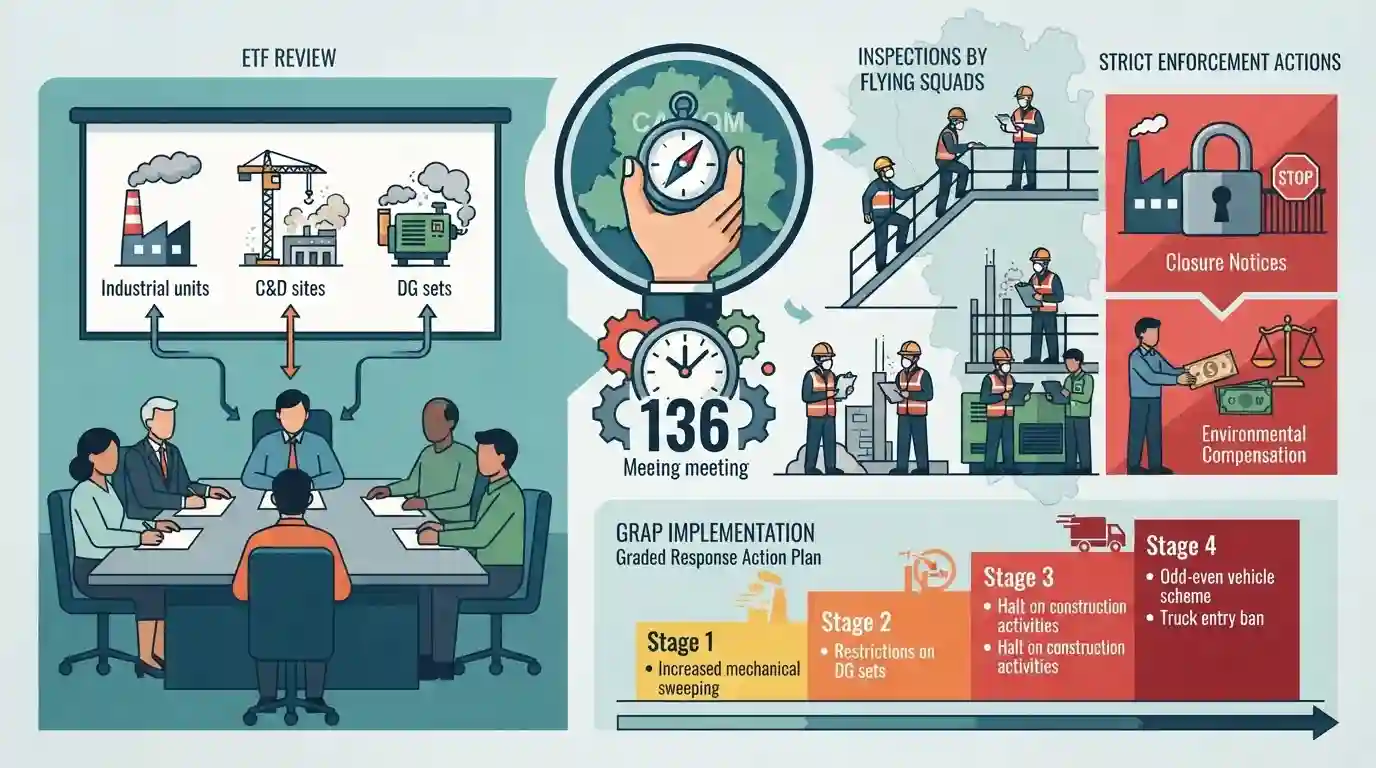
The 136th meeting of the Enforcement Task Force (ETF) under the Commission for Air Quality Management (CAQM) reviewed the enforcement of anti-pollution measures across the National Capital Region (NCR). The ETF evaluated sector-specific compliance based on inspections by flying squads, particularly targeting major emission sources like industrial units, construction and demolition (C&D) sites, and diesel generator (DG) sets. Strict actions, including closure notices and environmental compensation, are being taken against violators. The meeting also reiterated the need for stringent implementation of the Graded Response Action Plan (GRAP) to combat air pollution effectively.
মূল বিষয়
- The Enforcement Task Force (ETF) of the CAQM convened its 136th meeting to review the compliance and enforcement of pollution control directives across the NCR.
- The review focused on sector-specific inspections conducted by flying squads, targeting industrial units, Construction and Demolition (C&D) sites, and diesel generator (DG) sets.
- Non-compliant entities face strict actions, including closure directions and the levying of environmental compensation, to deter violations.
- The meeting emphasized the importance of rigorous implementation of the Graded Response Action Plan (GRAP) by state agencies to mitigate seasonal air quality deterioration.
গুরুত্বপূর্ণ শব্দ
Commission for Air Quality Management in NCR and Adjoining Areas Act, 2021

A 2021 Act establishing the CAQM as an overarching statutory body to coordinate, research, and resolve air pollution problems in Delhi-NCR and adjoining states, replacing the erstwhile EPCA.
UPSC context
GS III (Environment). Highlights legislative frameworks replacing ad-hoc bodies with permanent statutory authorities for pollution control.
Graded Response Action Plan (GRAP)
An emergency response framework that implements increasingly stringent, pre-defined anti-pollution measures in Delhi-NCR based on the severity of the Air Quality Index (AQI). It is currently enforced by the CAQM.
UPSC context
Highly relevant for GS III (Environment). Tests knowledge of emergency governance protocols and tiered policy responses to urban air pollution.
Commission for Air Quality Management (CAQM)
A statutory body responsible for monitoring, coordinating, and issuing binding directions to combat air pollution across the Delhi-NCR region and adjoining states of Punjab, Haryana, Rajasthan, and UP.
UPSC context
Crucial for GS III. Tests institutional solutions to NCR’s persistent pollution crisis and the consolidation of environmental governance.
Enforcement Task Force (ETF)
A specialized functional unit under the CAQM that utilizes flying squads to actively inspect and enforce compliance with anti-pollution norms across industrial, vehicular, and construction sectors in the NCR.
UPSC context
Relevant for GS III (Environmental Governance), demonstrating the ground-level compliance and enforcement mechanisms of the CAQM.
State Pollution Control Boards (SPCBs)
Statutory state-level agencies established under the Water Act (1974) and Air Act (1981). They regulate local pollution, issue environmental clearances, and enforce environmental laws within their respective states.
UPSC context
Important for GS II and III. Highlights decentralized implementation of environmental laws and inter-agency coordination challenges.
প্রিলিমস ফাঁদ
CAQM directives are advisory to State Pollution Control Boards and apply only within Delhi.
CAQM is a statutory body under a 2021 Act. Its orders are legally binding across the entire NCR and supersede state government or SPCB decisions.
সংযুক্ত স্থির ধারণা
What are the statutory powers and jurisdiction of the CAQM?
- Statutory Backing: Established under the CAQM in NCR and Adjoining Areas Act, 2021, replacing the EPCA.
- Jurisdiction: Covers Delhi, Haryana, Punjab, Rajasthan, and UP specifically for matters relating to air quality.
- Superseding Authority: In case of conflict, CAQM orders prevail over those of State Governments, CPCB, and SPCBs.
How does the Graded Response Action Plan (GRAP) function in the NCR?
- AQI Trigger: GRAP restrictions are triggered by the National Air Quality Index (AQI), which monitors eight core pollutants.
- Four Stages: Actions are enforced progressively across four stages, from Stage I (Poor) to Stage IV (Severe+).
- Pre-emptive Implementation: CAQM now invokes GRAP measures pre-emptively based on AQI forecasts rather than waiting for deterioration.
আন্তঃবিষয় প্যাটার্ন
Polluter Pays Principle & Article 21
The CAQM’s mandate to levy environmental compensation is rooted in the Polluter Pays Principle, echoing NGT jurisprudence and linking statutory environmental law to Article 21 (right to a clean environment).
Environmental Federalism and Inter-state Externalities
CAQM superseding state boards highlights a shift in environmental federalism, centralizing power to address inter-state externalities like air pollution across the NCR and adjoining states (Punjab, Haryana, UP, Rajasthan).

Expect a multi-statement Prelims question contrasting the statutory powers, appellate mechanisms, and specific jurisdictions of CAQM vs CPCB.
সংযুক্ত PYQ · 4
সংযুক্ত PYQ · 4
- 2024MainsGS3
Industrial pollution of river water is a significant environmental issue in India. Discuss the various mitigation measures to deal with this problem and also the government's initiatives in this regard.
- 2021MainsGS3
Describe the key points of the revised Global Air Quality Guidelines (AQGs) recently released by the World Health Organisation (WHO). How are these different from its last update in 2005? What changes in India's National Clean Air Programme are required to achieve these revised standards?
- 2022PrelimsGS1
In the context of WHO Air Quality Guidelines, consider the following statements: 1. The 24-hour mean of PM2.5 should not exceed 15 µg/m³ and annual mean of PM2.5 should not exceed 5 µg/m³. 2. In a year, the highest levels of ozone pollution occur during the periods of inclement weather. 3. PM10 can penetrate the lung barrier and enter the bloodstream. 4. Excessive ozone in the air can trigger asthma. Which of the statements given above are correct?
- 2016PrelimsGS1
In the cities of our country, which among the following atmospheric gases are normally considered in calculating the value of Air Quality Index? 1. Carbon dioxide 2. Carbon monoxide 3. Nitrogen dioxide 4. Sulfur dioxide 5. Methane Select the correct answer using the code given below.
