NEET-PG Security Reforms and Public Examination Transparency Act
Source:PIB ↗
কেন এটি গুরুত্বপূর্ণ
Restoring public trust in high-stakes examinations is a high-priority administrative challenge in India. This article demonstrates how the government is operationalizing the Public Examination (Prevention of Unfair Means) Act, 2024, utilizing e-governance tools, biometrics, and cyber audits to tackle systemic leakages, making it a highly relevant case study for administrative reforms, e-governance, and education policy under GS Paper 2.
সারসংক্ষেপ
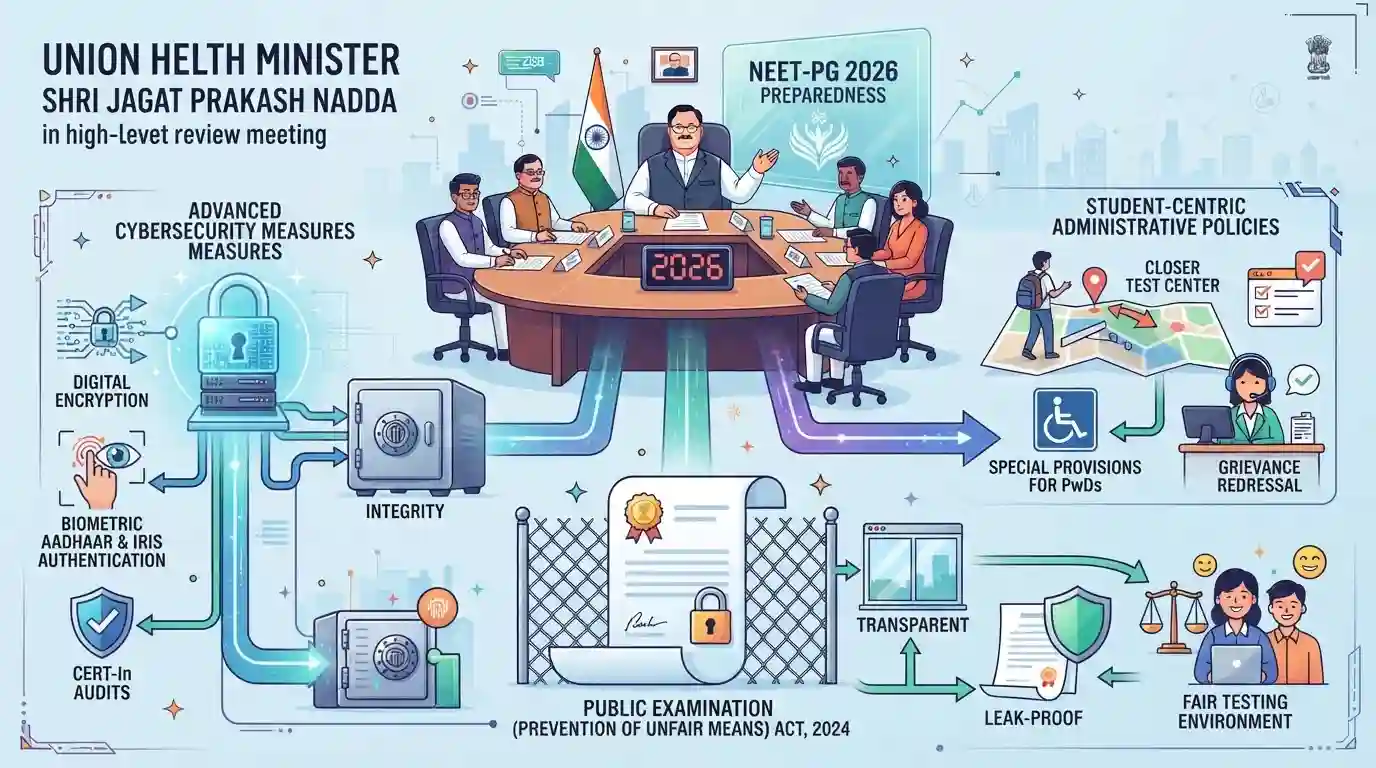
Union Health Minister Shri Jagat Prakash Nadda chaired a high-level review of the administrative and security preparedness for the NEET-PG 2026 exam. Focused on restoring and maintaining institutional integrity, the reviewed reforms combine advanced cybersecurity measures (digital encryption, biometric Aadhaar and iris authentication, CERT-In audits) with student-centric administrative policies (closer test center allocation, special provisions for PwDs/women, and robust grievance redressal). The measures actively implement the Public Examination (Prevention of Unfair Means) Act, 2024, to ensure a transparent, leak-proof, and fair testing environment.
মূল বিষয়
- Union Health Minister J.P. Nadda reviewed the operational preparedness of NBEMS and MoHFW for the NEET-PG 2026 examination to ensure a smooth, secure, and transparent process.
- To prevent paper leaks and malpractices, the government is utilizing advanced technological security measures, including end-to-end digital encryption of question papers, decryption keys released shortly before the exam, signal jammers, and central CCTV command monitoring.
- Robust biometric identification, including Aadhaar-based authentication, iris scanning, and facial recognition, will be deployed at test centers to completely eliminate candidate impersonation.
- Third-party cybersecurity audits are being conducted by agencies like CERT-In to ensure the resilience of the examination's digital infrastructure against cyber threats and manipulation.
- In a bid to make the exams student-centric, centers are prioritized to be allocated within the candidate's home state or close to their preferred cities, with special considerations for female candidates and Persons with Disabilities (PwD).
- The government will strictly enforce the Public Examination (Prevention of Unfair Means) Act, 2024, providing a strong legal deterrent against organized cheating and leak syndicates.
গুরুত্বপূর্ণ শব্দ
Public Examination (Prevention of Unfair Means) Act, 2024

A central law enacted to prevent paper leaks, cheating, and organized malpractices in major public and entrance examinations conducted by central authorities, imposing severe criminal and financial penalties.
UPSC context
GS Paper II: Government Policies and Interventions, testing legal frameworks for ensuring transparency and accountability in public examinations.
National Board of Examinations in Medical Sciences (NBEMS)
An autonomous body under the Ministry of Health and Family Welfare established to standardize postgraduate medical education and conduct crucial examinations like NEET-PG and DNB nationwide.
UPSC context
GS Paper II: Social Sector/Health, testing the governance of professional medical education and institutional standards in India.
Indian Computer Emergency Response Team (CERT-In)
The national nodal agency under the Ministry of Electronics and Information Technology responsible for cybersecurity incident response, forecasting, threat alerts, and securing India's digital ecosystem.
UPSC context
GS Paper III: Cyber Security, testing institutional frameworks that safeguard critical digital infrastructure and public sector networks.
National Medical Commission (NMC)
The statutory regulatory body that replaced the Medical Council of India in 2020 to oversee medical education, accredit institutions, register practitioners, and enforce professional ethics.
UPSC context
GS Paper II: Statutory Bodies, testing governance reforms in medical education and healthcare regulation in India.
National Eligibility cum Entrance Test for Postgraduates (NEET-PG)
A standardized national-level computer-based entrance examination conducted by NBEMS for MBBS graduates seeking admission to postgraduate medical courses, including MD and MS programs.
UPSC context
GS Paper II: Social Sector/Education, testing standardized systems of evaluation and merit-based admission in specialized healthcare.
Ministry of Health and Family Welfare (MoHFW)
The Union ministry responsible for formulating public health policies, implementing national healthcare programs, managing health infrastructure, and regulating medical education in India.
UPSC context
GS Paper II: Government Policies and Interventions, testing executive administration of health sector schemes and welfare programs.
প্রিলিমস ফাঁদ
"All investigations under the Public Examination Act, 2024 must be conducted by central agencies like the CBI."
The Act standardizes police investigation protocols by mandating an officer not below the rank of DSP or ACP; it does not automatically transfer jurisdiction to the CBI.
সংযুক্ত স্থির ধারণা
What are the key provisions of the Public Examination Act, 2024?
- Applicability: Targets Central public examination authorities (UPSC, SSC, NTA, RRB, etc.), criminalizing paper leaks, impersonation, and digital tampering.
- Penalties: Individual malpractices attract 3 to 5 years in prison. Organized syndicates face up to 10 years and a minimum fine of ₹1 crore.
- Investigation Rank: Must be led by an officer not below the rank of Deputy Superintendent of Police (DSP) or Assistant Commissioner of Police (ACP).
What is the statutory mandate of CERT-In?
- Statutory Backing: Established and operates under Section 70B of the Information Technology Act, 2000.
- Core Mandate: Acts as the national nodal agency for cybersecurity incident response, vulnerability prediction, and mandatory digital audits.
- Nodal Ministry: Functions directly under the Ministry of Electronics and Information Technology (MeitY).
আন্তঃবিষয় প্যাটার্ন
DPI & e-Governance linkages
Aadhaar's open APIs enabling real-time iris/biometric authentication in exams perfectly illustrates the application of Digital Public Infrastructure (DPI) to solve legacy governance issues.
Statutory vs Executive reform
The shift from executive guidelines to the Public Examination Act 2024 highlights a systemic push to provide explicit legal definitions (like 'computer network' tampering) for modern digital crimes.

Expect a 2026 multi-statement Prelims question combining the penalty tiers of the Public Exam Act 2024 with CERT-In's statutory mandate.
সংযুক্ত PYQ · 3
সংযুক্ত PYQ · 3
- 2024MainsGS2
What are the aims and objects of recently passed and enforced, The Public Examination (Prevention of Unfair Means) Act, 2024? Whether University/State Education Board examinations, too, are covered under the Act ?
- 2023MainsGS2
e-governance, as a critical tool of governance, has ushered in effectiveness, transparency and accountability in governments. What inadequacies hamper the enhancement of these features ?
- 2018PrelimsGS1
The identity platform 'Aadhaar' provides open "Application Programming Interfaces (APIs)". What does it imply? 1. It can be integrated into any electronic device. 2. Online authentication using iris is possible. Which of the statements given above is/are correct?
