Cotton Productivity Mission and Ecosystem Reforms for Agriculture
Source:PIB ↗
কেন এটি গুরুত্বপূর্ণ
Cotton is a vital commercial crop underpinning India's textile industry and rural economy. This development bridges agriculture with the manufacturing (textiles) and environmental sectors. Specifically, the introduction of 'Kapas Kanti', technological integration for traceability ('Kasturi Cotton Bharat'), and carbon credit mechanisms in farming reflect a paradigm shift towards sustainable, high-value agricultural exports, highly relevant to GS3's focus on agriculture, MSP, and environmental sustainability.
সারসংক্ষেপ
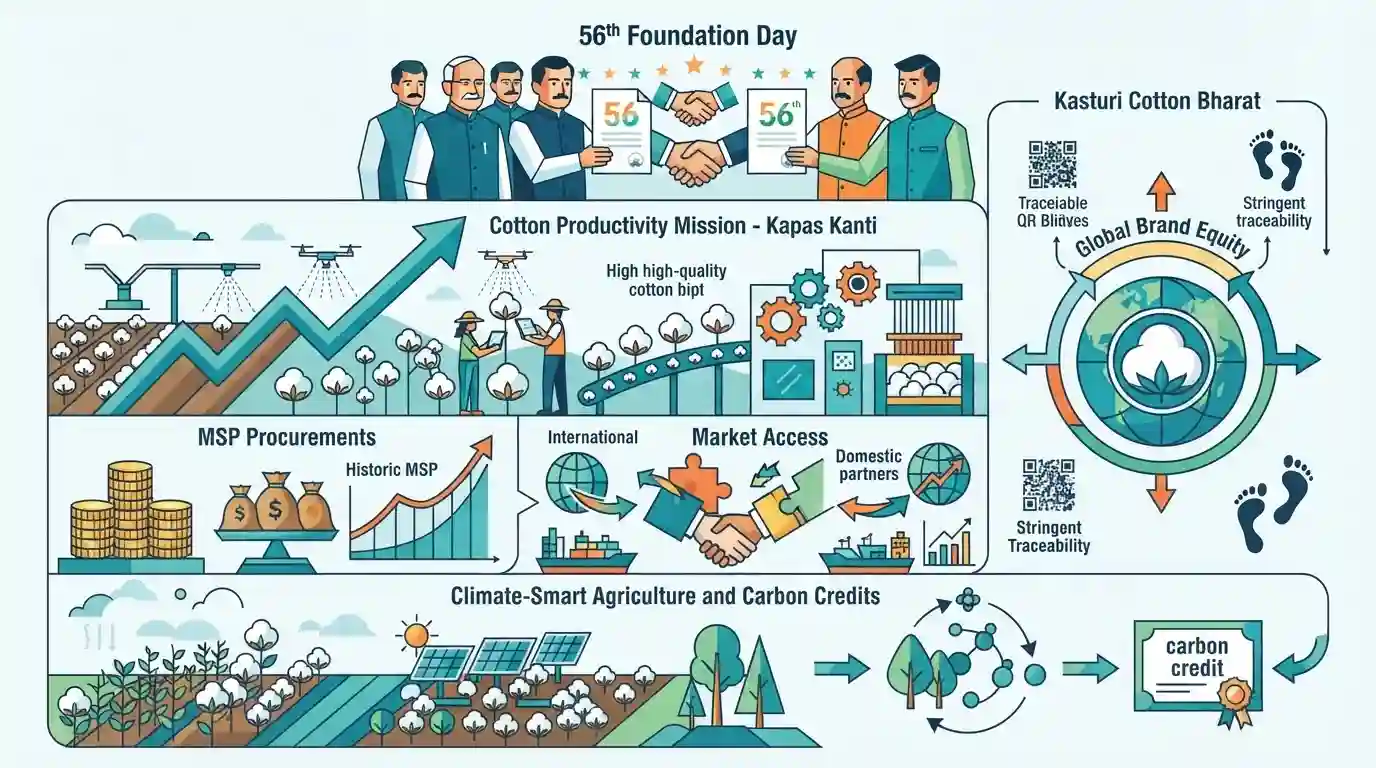
During the 56th Foundation Day of the Cotton Corporation of India (CCI), the Union government outlined significant steps to revamp India's cotton ecosystem. Highlighting historic MSP procurements in the 2025-26 season, the Ministry of Textiles detailed its ₹5,659-crore 'Cotton Productivity Mission - Kapas Kanti', aimed at enhancing yield, quality, and processing infrastructure over the next five years. Emphasis was also placed on the 'Kasturi Cotton Bharat' initiative to build global brand equity for Indian cotton through stringent traceability and sustainability standards. Addressing modern agricultural challenges, the CCI signed key MoUs with international and domestic partners to facilitate market access and promote carbon credit generation via climate-smart agricultural practices.
মূল বিষয়
- The Cotton Corporation of India (CCI) executed historic MSP procurement for the 2025-26 season, procuring 522 lakh quintals of seed cotton and transferring over ₹41,530 crore directly to farmers.
- The ₹5,659 crore Cotton Productivity Mission - Kapas Kanti was launched to improve cotton productivity, modernise processing, and promote climate-resilient cultivation over five years.
- The Kasturi Cotton Bharat initiative aims to build global brand value for premium Indian cotton by ensuring end-to-end traceability, certification, and sustainability from farm to fashion.
- Four pivotal MoUs were signed with organizations including GIZ, ICAR-CIRCOT, and CITI to enhance capacity building, ensure quality assurance, and pioneer carbon credit generation through climate-smart farming.
- Digital tools like the Kapas Darshan Bulletin and the Kapas Kisan Mobile App were introduced to offer timely advisories to farmers on weather, scientific cultivation, and market trends.
গুরুত্বপূর্ণ শব্দ
Cotton Productivity Mission - Kapas Kanti

A government initiative approved in 2026 with a ₹5,659.22 crore outlay (2026-27 to 2030-31) aimed at raising lint productivity, developing pest-resistant high-yielding varieties, and ensuring self-reliance in India's cotton sector.
UPSC context
GS Paper III (Agriculture & Cropping Patterns). Tests understanding of government interventions to improve crop yields and modernize the cotton value chain.
Kasturi Cotton Bharat
A joint branding, traceability, and certification initiative by the Ministry of Textiles, CCI, and TEXPROCIL to promote premium-quality, sustainably produced Indian cotton globally using blockchain and QR code-based tracking.
UPSC context
GS Paper III (Agriculture & Marketing/Textile Sector). Tests knowledge of quality standardization, export branding, and technological integration in agriculture.
Cotton Corporation of India Ltd. (CCI)
A central public sector undertaking established in 1970 under the Ministry of Textiles, serving as the nodal agency for cotton trading, export, and Minimum Support Price (MSP) operations.
UPSC context
GS Paper III (Agricultural Pricing/PSUs). Tests understanding of institutional mechanisms for price stabilization, public procurement, and market intervention in commercial crops.
TEXPROCIL
The Cotton Textiles Export Promotion Council, established in 1954 as an autonomous body under the Ministry of Textiles to promote Indian cotton yarn, fabric, and home textile exports globally.
UPSC context
GS Paper III (Industrial Policy & Trade). Tests knowledge of export promotion councils, trade facilitation, and global competitiveness of India's textile sector.
Confederation of Indian Textile Industry (CITI)
A major national apex industry chamber representing the entire spectrum of the Indian textile and clothing sector, acting as an interface between the industry and the government for policy formulation.
UPSC context
GS Paper III (Industrial Growth & Policies). Tests understanding of representative industry bodies, public-private partnerships, and structural challenges in the textile value chain.
প্রিলিমস ফাঁদ
The Cotton Corporation of India (CCI), which manages cotton MSP procurement, is an administrative body under the Ministry of Agriculture and Farmers Welfare.
CCI is a Public Sector Undertaking (PSU) operating under the Ministry of Textiles, not Agriculture, despite executing agricultural price support operations.
সংযুক্ত স্থির ধারণা
What are the ideal agro-climatic conditions required for cotton cultivation in India?
- Temperature profile: Requires a warm climate, ideally between 21°C and 30°C, with a minimum of 180 to 210 frost-free days.
- Soil and water: Performs best in deep, water-retentive black cotton soil (Regur) of the Deccan Plateau, with 50-100 cm rainfall.
How does the Minimum Support Price (MSP) mechanism operate for Cotton?
- Pricing recommendation: CACP recommends MSPs for two basic grades of cotton (Medium Staple and Long Staple) based on cost of cultivation metrics.
- Procurement agency: The Cotton Corporation of India (CCI) acts as the central nodal agency to undertake MSP operations when prices fall below support levels.
আন্তঃবিষয় প্যাটার্ন
Blockchain + Agri-traceability
The Kasturi Cotton initiative uses blockchain for export traceability, linking digital governance with trade competitiveness and supply-chain transparency.
Agrarian Carbon Credits
MoUs linking climate-smart cotton farming with carbon finance showcase the transition of India's farm policy toward environmental economics and global ESG compliance.

UPSC 2026 may pair cotton's static geographical requirements with blockchain-led traceability initiatives and textiles-led MSP mechanisms.
সংযুক্ত PYQ · 5
সংযুক্ত PYQ · 5
- 2021PrelimsGS1
The black cotton soil of India has been formed due to the weathering of
- 2020PrelimsGS1
Consider the following statements: 1. In the case of all cereals, pulses and oil-seeds, the procurement at Minimum Support Price (MSP) is unlimited in any State/UT of India. 2. In the case of cereals and pulses, the MSP is fixed in any State/UT at a level to which the market price will never rise. Which of the statements given above is/are correct?
- 2018PrelimsGS1
Consider the following: 1. Areca nut 2. Barley 3. Coffee 4. Finger millet 5. Groundnut 6. Sesamum 7. Turmeric The Cabinet Committee on Economic Affairs has announced the Minimum Support Price for which of the above?
- 2024PrelimsGS1
Which one of the following is the correct description of “100 Million Farmers”?
- 2021PrelimsGS1
In the context of India's preparation for Climate-Smart Agriculture, consider the following statements : 1. The 'Climate-Smart Village' approach in India is a part of a project led by the Climate Change, Agriculture and Food Security (CCAFS), an international research programme. 2. The project of CCAFS is carried out under Consultative Group on International Agricultural Research (CGIAR) headquartered in France. 3. The International Crops Research Institute for the Semi-Arid Tropics (ICRISAT) in India is one of the CGIAR's research centres. Which of the statements given above are correct?
