Coal India Post-Retirement Welfare Reforms and C-CARES Portal
Source:PIB ↗
ఇది ఎందుకు ముఖ్యం
This article showcases a practical application of e-governance (C-CARES portal) significantly improving public service delivery and grievance redressal for vulnerable demographics. It provides excellent case study material for GS2 questions on digital governance and welfare administration, and highlights the social responsibility dimensions of CPSEs critical to India's energy security (GS3).
సారాంశం
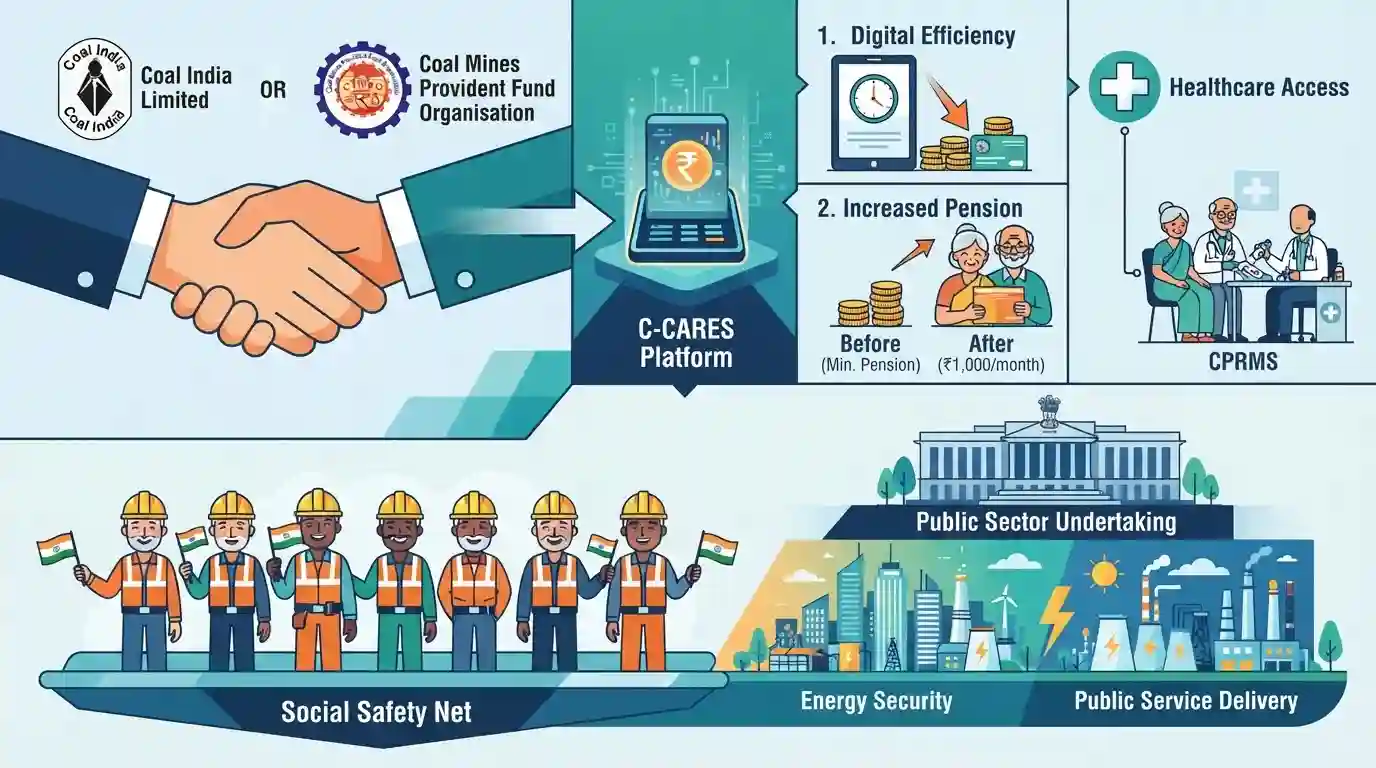
Coal India Limited (CIL), in collaboration with the Coal Mines Provident Fund Organisation (CMPFO), has enacted sweeping post-retirement welfare reforms to secure the livelihoods of its retired workers. Central to these reforms is the C-CARES digital platform, an e-governance initiative that expedites pension claim settlements and automates routine disbursements. Along with boosting the minimum pension to ₹1,000 per month, CIL expanded healthcare coverage through the Contributory Post Retirement Medicare Scheme (CPRMS). Such structural interventions bolster the social safety net for vulnerable mine workers while showcasing a model of effective, technology-driven public service delivery by a major Central Public Sector Enterprise (CPSE) responsible for India's energy security.
ముఖ్య అంశాలు
- Coal India Limited (CIL) has introduced comprehensive welfare and pension reforms benefiting over 4.5 lakh retired employees, reinforcing social security for coal sector workers.
- The C-CARES digital platform, developed with CMPFO, has slashed retirement claim settlement times from 30 days to 10 days and facilitates PPO issuance on the day of retirement.
- The minimum pension under the Coal Mines Pension Scheme has been raised to ₹1,000 per month (effective March 2024), improving financial support for roughly 40,000 pensioners.
- Healthcare access has been widened via the Contributory Post Retirement Medicare Scheme (CPRMS), giving 1.13 lakh retirees access to cashless medical care at 532 empanelled hospitals.
- In FY 2025-26, provident fund and pension disbursements swelled notably, showcasing CIL\'s financial commitment to post-retirement social security.
ముఖ్యమైన పదాలు
C-CARES Platform

A web portal developed by C-DAC for the Ministry of Coal to digitize and automate provident fund and pension claim settlements for coal mine workers, enabling real-time tracking and direct benefit transfers.
UPSC context
GS II (e-Governance); highlights digital interventions improving public service delivery, transparency, and social security.
Coal Mines Provident Fund Organisation (CMPFO)
A statutory body established under the Coal Mines Provident Fund and Miscellaneous Provisions Act, 1948, operating under the Ministry of Coal to administer provident fund and pension schemes for coal sector workers.
UPSC context
GS II (Statutory Bodies); relevant for understanding institutional mechanisms governing labor welfare and social security.
Coal Mines Pension Scheme
A social security scheme implemented by the CMPFO since 1998, providing post-retirement pension benefits, including widow and family pensions, to eligible coal mine workers.
UPSC context
GS II/III (Welfare Schemes); highlights government interventions for securing the livelihoods of vulnerable industrial workers.
Contributory Post Retirement Medicare Scheme (CPRMS)
A welfare initiative by Coal India Limited offering post-retirement medical coverage for retired executives and non-executives, ensuring cashless access to empanelled healthcare services.
UPSC context
GS II (Health/Welfare); illustrates employee welfare and post-retirement social security practices adopted by Public Sector Enterprises.
Coal India Limited (CIL)
A Maharatna Central Public Sector Enterprise under the Ministry of Coal. As the world's largest coal producer, it is vital to India's energy security and domestic thermal power generation.
UPSC context
GS III (Energy Security); tests understanding of pivotal Central Public Sector Enterprises driving India's domestic energy production.
ప్రిలిమ్స్ ఉచ్చు
Coal miners' provident fund and pensions are administered by the EPFO under the Ministry of Labour.
Coal miners have a dedicated statutory body, CMPFO, which operates under the Ministry of Coal, completely separate from the EPFO framework.
అనుసంధానమైన స్థిర భావనలు
What are the criteria for a CPSE to be granted Maharatna status?
- Financial thresholds: Average annual net profit >₹5,000cr, net worth >₹15,000cr, and turnover >₹25,000cr during the last 3 years.
- Prior status: Must already hold Navratna status and be listed on Indian stock exchanges with minimum prescribed public shareholding.
- Global presence: Must possess a significant global footprint or international operations.
How does CMPFO differ from EPFO in India's social security architecture?
- Governing Statute: CMPFO is governed by the Coal Mines PF Act 1948, whereas EPFO operates under the EPF & MP Act 1952.
- Ministry oversight: CMPFO functions under the Ministry of Coal, while EPFO is administered by the Ministry of Labour and Employment.
- Target demographic: CMPFO is exclusively for the coal mining sector's workforce, whereas EPFO covers broad industrial and service sectors.
అంతర-అంశ నమూనాలు
E-Governance in direct pension delivery
C-CARES mirrors SPARSH (Defence) and Bhavishya portals, highlighting a systemic UPSC theme: automating DBT and removing bureaucratic delays in direct social security delivery.
Just Transition in Coal Phase-down
Robust social safety nets for miners are central to India's 'Just Transition' framework, ensuring vulnerable workers aren't abandoned during eventual climate-driven coal phase-downs.

Expect a comparative Prelims statement testing CMPFO (Ministry of Coal) vs EPFO (Ministry of Labour) alongside portals like C-CARES.
అనుసంధాన PYQలు · 4
అనుసంధాన PYQలు · 4
- 2024MainsGS2
e-governance is not just about the routine application of digital technology in service delivery process. It is as much about multifarious interactions for ensuring transparency and accountability. In this context evaluate the role of the 'Interactive Service Model' of e-governance.
- 2025MainsGS2
e-governance projects have a built-in bias towards technology and back-end integration than user-centric designs. Examine.
- 2018MainsGS3
“Access to affordable, reliable, sustainable and modern energy is the sine qua non to achieve Sustainable Development Goals (SDGs).” Comment on the progress made in India in this regard.
- 2019MainsGS2
Performance of welfare schemes that are implemented for vulnerable sections is not so effective due to absence of their awareness and active involvement at all stages of policy process. Discuss.
