SDRF Advance Funding for Flood Relief and Centre-State Relations
Source:PIB ↗
આ શા માટે મહત્વનું છે
Understanding the financing mechanism of disaster relief (SDRF/NDRF) is crucial for GS3 (Disaster Management) and GS2 (Centre-State relations). The article highlights the proactive approach of deploying IMCTs for damage assessment and NDRF for immediate rescue.
સારાંશ
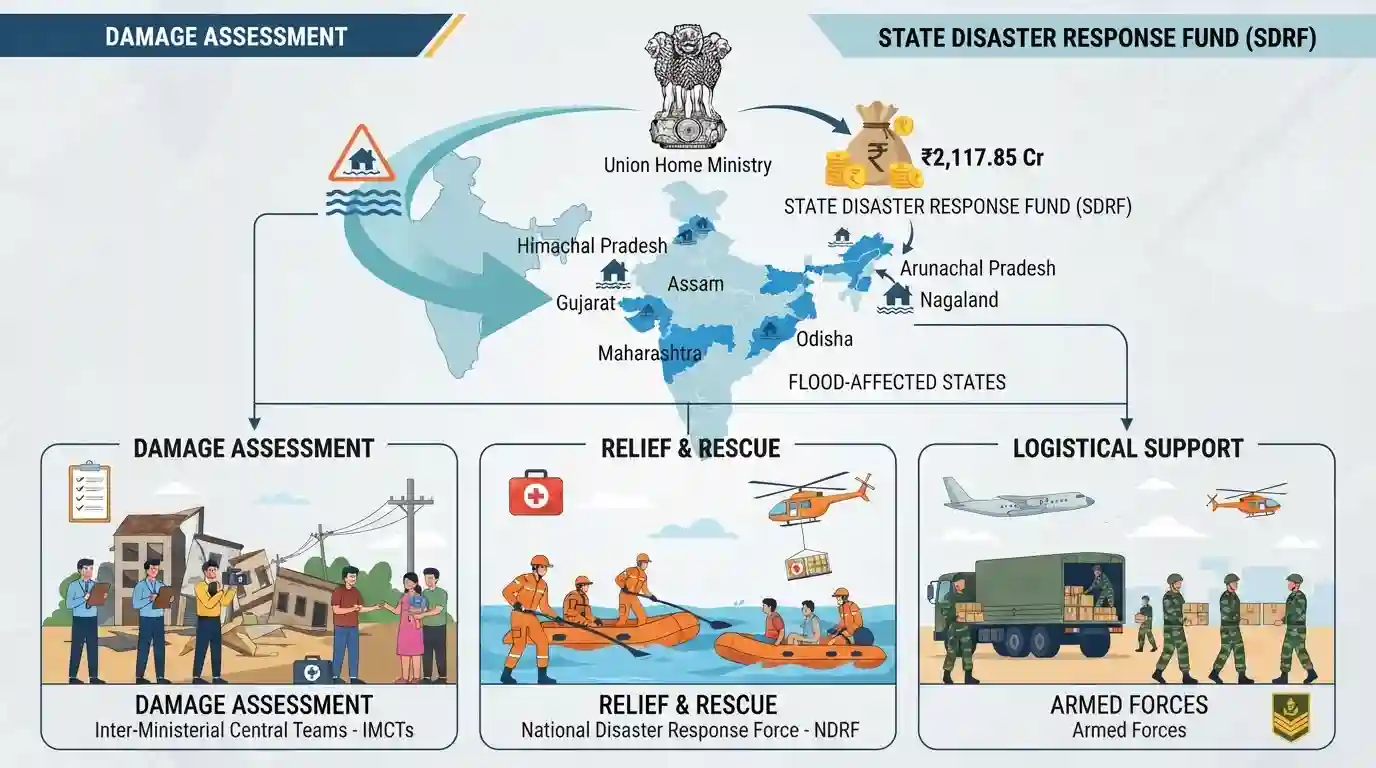
The Union Home Ministry has approved the advance release of ₹2,117.85 crore from the Central share of the State Disaster Response Fund (SDRF) for flood-affected states including Assam, Himachal Pradesh, Gujarat, Maharashtra, Odisha, Arunachal Pradesh, and Nagaland. The Central Government has proactively deployed Inter-Ministerial Central Teams (IMCTs) to assess damage, alongside the pre-deployment of National Disaster Response Force (NDRF) battalions and logistical assets from the Armed Forces to ensure prompt relief and rescue operations.
મુખ્ય મુદ્દા
- The Central Government approved an advance release of ₹2,117.85 crore to several flood-affected states from the Central share of the State Disaster Response Fund (SDRF).
- The SDRF is the primary fund available with State Governments for responses to notified disasters. The Central Government typically contributes 75% of SDRF allocations for general category States/UTs and 90% for special category States/UTs.
- In addition to financial aid, Inter-Ministerial Central Teams (IMCTs) are deputed to assess damages and recommend further assistance from the National Disaster Response Fund (NDRF).
- National Disaster Response Force (NDRF) teams and military logistical support have been pre-deployed for search and rescue in flood-prone zones.
મહત્વપૂર્ણ શબ્દો
State Disaster Response Fund (SDRF)

The primary statutory fund available with State Governments under Section 48(1)(a) of the Disaster Management Act, 2005, to meet immediate relief expenditures for victims of notified disasters.
UPSC context
GS Paper III (Disaster Management) and GS Paper II (Federalism); tests mechanism of center-state financial sharing during natural calamities.
National Disaster Response Force (NDRF)
A specialized multi-skilled response force constituted under Section 44 of the Disaster Management Act, 2005, for rapid search, rescue, and humanitarian assistance during natural or man-made disasters.
UPSC context
GS Paper III (Disaster Management and Security); tests the institutional architecture, role, and capabilities of specialized disaster-response units in India.
Inter-Ministerial Central Teams (IMCT)
Multidisciplinary central government teams constituted by the Home Ministry to conduct on-the-spot damage assessments after severe disasters, guiding the allocation of central relief funds.
UPSC context
GS Paper III (Disaster Management); tests administrative mechanisms for damage assessment and center-state disaster mitigation and relief cooperation.
Ministry of Home Affairs
The nodal ministry of the Government of India responsible for internal security, federal disaster management coordination, and administrative control over the National Disaster Response Force.
UPSC context
GS Paper II (Structure & Functioning of Executive); tests understanding of nodal agencies managing internal security and national-level crisis response.
પ્રિલિમ્સ ટ્રેપ
States cannot utilize any portion of the State Disaster Response Fund (SDRF) for disasters not explicitly included in the MHA's central list.
Under current disaster financing norms, states are permitted to use up to 10% of their annual SDRF allocation for local, state-specific disasters not included in the MHA's central list.
સંલગ્ન સ્થિર ખ્યાલો
What is the statutory basis and funding architecture of the State Disaster Response Fund (SDRF)?
- Statutory Basis: Constituted under Section 48(1)(a) of the Disaster Management Act, 2005, serving as the primary fund for state-level disaster relief.
- Funding Split: Shared 75:25 between Centre and General Category States/UTs, and 90:10 for Northeast and Himalayan (Special Category) States.
- Release Mechanism: Released in two equal annual installments based on the recommendations of the Finance Commission.
How does the NDRF differ from the SDRF in funding and operation?
- Funding Source: Unlike the co-funded SDRF, the NDRF is 100% centrally funded via the National Calamity Contingent Duty (NCCD) levied on customs/excise goods.
- Trigger Condition: SDRF is the immediate first-responder fund; NDRF is triggered only for disasters of 'grave severity' when state SDRF funds are exhausted.
- Assessment Mandate: NDRF release requires an assessment by an Inter-Ministerial Central Team (IMCT) to determine if state-level funds are insufficient.
આંતર-વિષય પેટર્ન
Disaster Finance & Fiscal Federalism
The shift from reactive relief to mitigation funds (NDMF/SDMF) under the 15th Finance Commission shows how disaster response allocations are tied to Centre-State fiscal devolution.
CAPF Deployment & Federalism
Proactive deployment of NDRF and military logistics by MHA intersects with federal dynamics, since disaster management is executionally a state-level subject under the DM Act.

Multi-statement questions in 2026 will likely test the 10% local disaster flexibility rule of SDRF vs. 100% Central funding of NDRF.
સંલગ્ન PYQ · 2
સંલગ્ન PYQ · 2
- 2024MainsGS3
Flooding in urban areas is an emerging climate-induced disaster. Discuss the causes of this disaster. Mention the features of two such major floods in the last two decades in India. Describe the policies and frameworks in India that aim at tackling such floods.
- 2024MainsGS3
What is disaster resilience? How is it determined? Describe various elements of a resilience framework. Also mention the global targets of Sendai Framework for Disaster Risk Reduction (2015–2030).
