Multi-Lane Free Flow Tolling System to Enhance Highway Infrastructure
Source:PIB ↗
Why It Matters
This development directly aligns with the UPSC GS Paper 3 syllabus on infrastructure and technology. A recent Mains question explicitly asked about electronic toll collection technology, its limitations, and proposed changes to make the process seamless. The MLFF system addresses these very themes by offering a barrier-less solution that resolves congestion and improves the efficiency of FASTag.
Summary
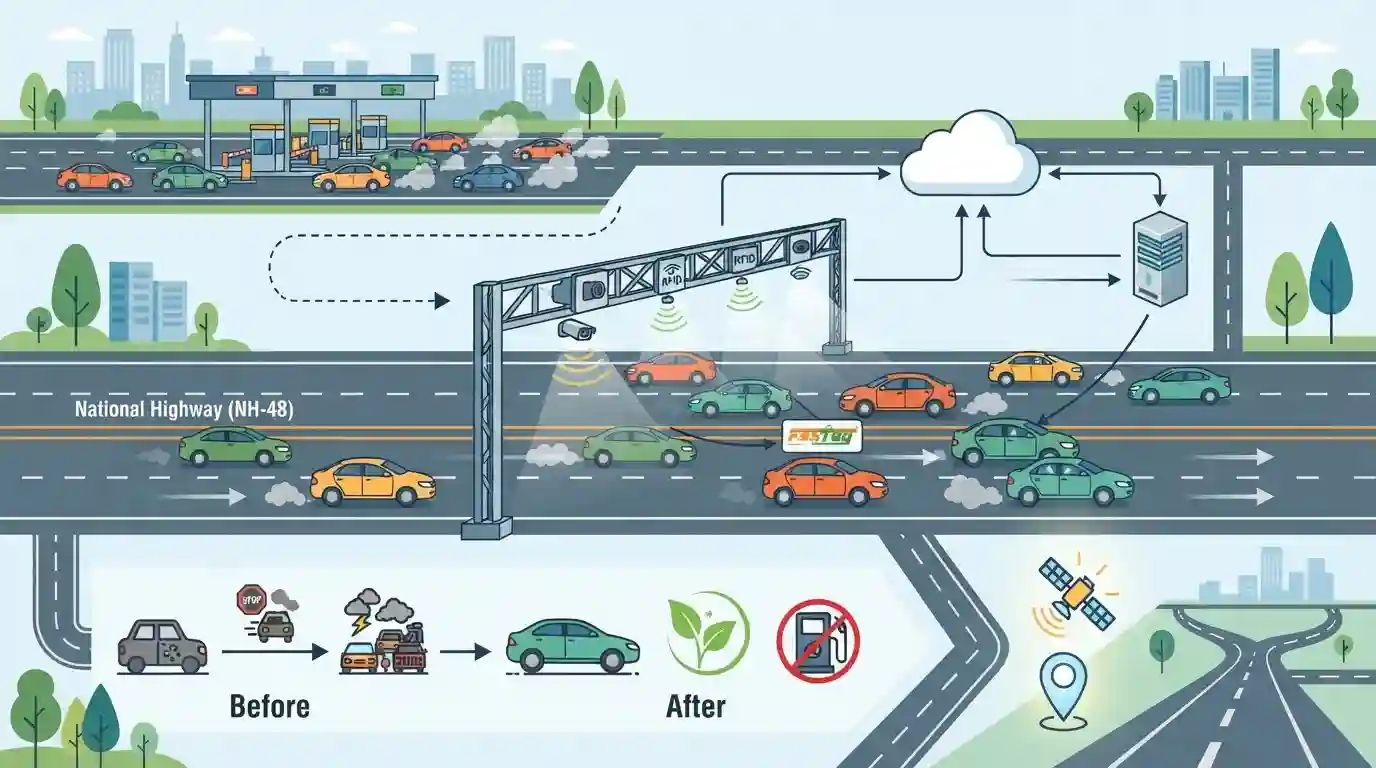
The National Highways Authority of India (NHAI) has successfully launched the Multi-Lane Free Flow (MLFF) Tolling System at the Shahjahanpur Toll Plaza on the Delhi-Jaipur section of National Highway 48 (NH-48). This advanced barrier-less system utilizes gantry-mounted cameras, RFID readers, and sensors to seamlessly deduct tolls via FASTag while vehicles maintain high speeds, completely bypassing the need to stop. The transition to MLFF signifies a major upgrade in India's transport infrastructure, aiming to eradicate toll plaza bottlenecks, curtail fuel wastage, lower carbon emissions, and pave the way for futuristic, seamless toll collection mechanisms like GPS-based tolling.
Key Points
- The Multi-Lane Free Flow (MLFF) Tolling System was successfully launched at the Shahjahanpur Toll Plaza on the Delhi-Jaipur section of NH-48 by NHAI.
- The system enables barrier-less toll collection by reading FASTags and capturing vehicle data through gantry-mounted sensors as vehicles travel at highway speeds.
- MLFF eliminates the need for vehicles to stop or slow down, significantly reducing congestion, fuel consumption, and vehicular emissions at toll plazas.
- The initiative marks a critical transition in India's highway infrastructure from traditional stop-and-go tolling to seamless electronic and satellite-based (GNSS) tolling.
- Improved traffic flow translates to better utilization of road infrastructure, enhanced commuter experience, and transparent revenue collection.
Important Terms
National Highways Authority of India (NHAI)

An autonomous statutory body under the Ministry of Road Transport and Highways, responsible for the development, maintenance, and management of the National Highways network in India.
UPSC context
GS Paper III: Infrastructure (Roads). Tests knowledge of key statutory agencies responsible for developing and managing national transport networks.
Multi-Lane Free Flow (MLFF)
A barrier-less, contactless tolling system that utilizes gantry-mounted cameras, RFID readers, and sensors to automatically deduct tolls from moving vehicles at highway speeds without requiring them to stop.
UPSC context
GS Paper III: Science & Technology and Infrastructure. Tests familiarity with smart transport systems and technologies designed to reduce transit times and carbon emissions.
FASTag
An electronic toll collection system in India operating on Radio Frequency Identification (RFID) technology, enabling cashless, automatic user fee deductions directly from linked prepaid or savings accounts as vehicles pass through toll plazas.
UPSC context
GS Paper III: Infrastructure / E-governance. Tests awareness of digital public infrastructure and financial technology applications in national logistics.
Automatic Number Plate Recognition (ANPR)
A computer vision technology that uses optical character recognition on camera images to read vehicle license plates, used for automated identification and verification of vehicles in cashless tolling systems.
UPSC context
GS Paper III: Science and Technology. Tests candidate knowledge of everyday tech applications, computer vision, and surveillance technologies in governance.
Indian Highways Management Company Limited (IHMCL)
A company incorporated by the NHAI, financial institutions, and concessionaires to implement and manage electronic toll collection, intelligent transport systems, and other tech-driven highway initiatives across India.
UPSC context
GS Paper III: Infrastructure and E-governance. Tests understanding of administrative bodies and public-private structures driving digital governance in infrastructure.
Prelims Trap
FASTag and current Multi-Lane Free Flow (MLFF) tolling systems rely on GPS and satellite navigation to deduct user fees.
FASTag uses passive Radio Frequency Identification (RFID) via gantry readers. Satellite-based GNSS tolling is an upcoming, distinct technology tracking distance via On-Board Units.
Static Concepts Connected
How does Passive RFID (FASTag) differ from upcoming GNSS tolling?
- Passive RFID: Batteryless tags are powered electromagnetically by radio waves transmitted from a physical gantry reader.
- GNSS Tolling: Uses satellite constellations (like GPS/NavIC) to monitor an On-Board Unit (OBU), creating virtual toll booths based on exact distance traveled.
What is the institutional framework for India's National Electronic Toll Collection (NETC)?
- IHMCL: Indian Highways Management Company Ltd, promoted by NHAI, governs the operational and structural implementation of the toll ecosystem.
- NPCI: The National Payments Corporation of India functions as the central clearing house and settlement agency across participating banks.
Cross-Topic Patterns
Infrastructure DPI + Financial Tech
The FASTag/NETC ecosystem integrates physical highway management with financial clearing via NPCI, mirroring how India scales its Digital Public Infrastructure (DPI) model across sectors.
Transport Efficiency + GHG Mitigation
Barrier-less tolling significantly cuts particulate matter and GHG emissions by ending vehicular idling, tying road transport upgrades directly to India's localized air quality and broader climate targets.

Expect a Prelims question comparing RFID (FASTag) with upcoming GNSS-based (satellite) tolling, focusing on active vs passive tech.
Linked PYQs · 2
Linked PYQs · 2
- 2024MainsGS3
What is the technology being employed for electronic toll collection on highways? What are its advantages and limitations? What are the proposed changes that will make this process seamless? Would this transition carry any potential hazards?
- 2022MainsGS3
Why is Public Private Partnership (PPP) required in infrastructural projects ? Examine the role of PPP model in the redevelopment of Railway Stations in India.
