VCF-SC Scheme Finances SC Startup to Boost Defense Electronics Sector
Source:PIB ↗
Why It Matters
The article provides an excellent case study linking social empowerment (GS2) with economic development and technological indigenization (GS3). It illustrates how affirmative financial schemes like VCF-SC transcend traditional welfare, enabling marginalized communities to contribute to high-end sectors like defense aerospace, and EV electronics, thus meeting both inclusive growth and 'Atmanirbhar Bharat' goals.
Summary
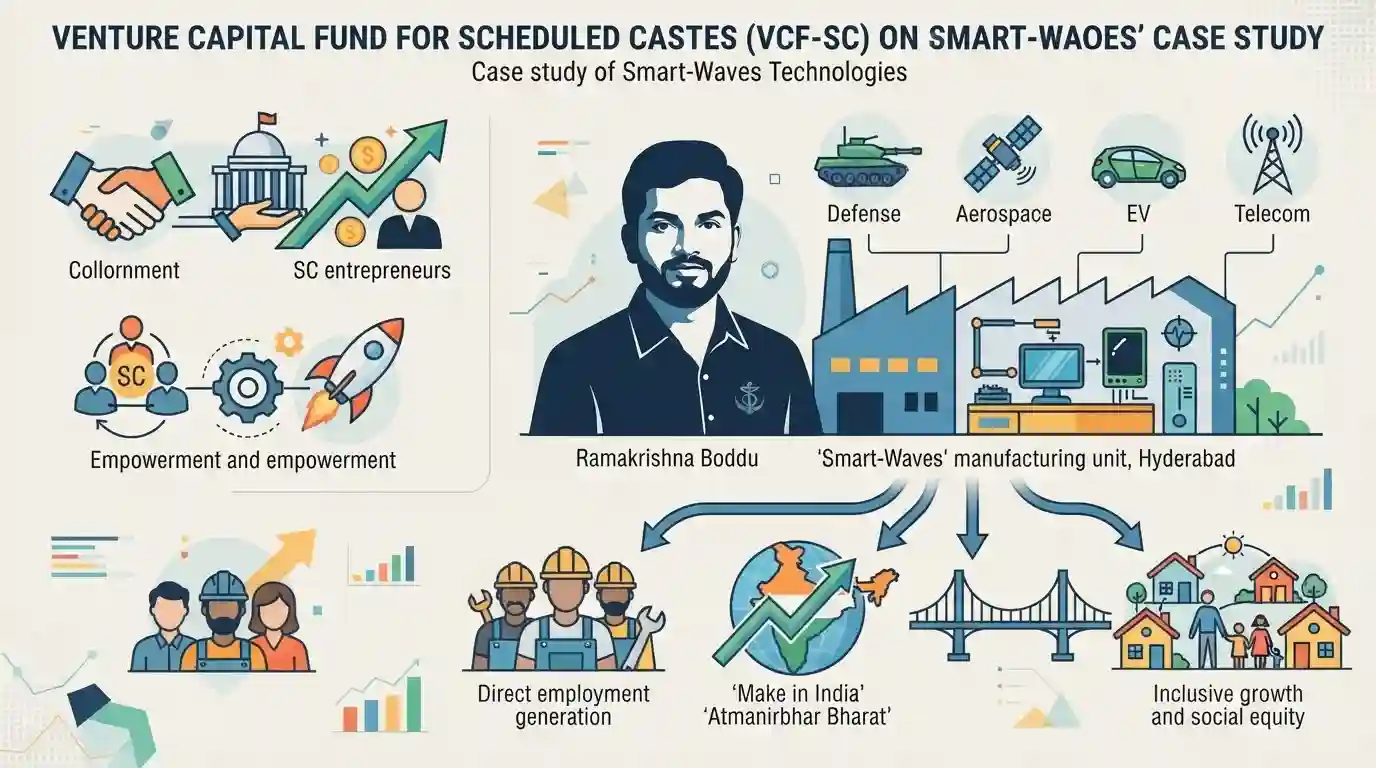
The article highlights the success of the Venture Capital Fund for Scheduled Castes (VCF-SC) through a case study of Smart-Waves Technologies Private Limited, founded by Ramakrishna Boddu, a Scheduled Caste entrepreneur. VCF-SC, launched by the Ministry of Social Justice & Empowerment and managed by IFCI Venture Capital Funds Ltd, provides financial support to SC entrepreneurs to foster inclusive growth. Smart-Waves, based in Hyderabad, manufactures advanced electronics for defense, aerospace, EVs, and telecom. The company generates direct employment and aligns with the "Atmanirbhar Bharat" (Self-Reliant India) and "Make in India" initiatives, demonstrating how targeted financial empowerment can simultaneously drive technological self-reliance, high-tech manufacturing, and social equity.
Key Points
- The Venture Capital Fund for Scheduled Castes (VCF-SC), managed by IFCI Venture Capital Funds Ltd under the Ministry of Social Justice & Empowerment, provides critical concessional finance to SC entrepreneurs.
- A successful beneficiary, Smart-Waves Technologies Private Limited in Hyderabad, utilized VCF-SC funding to scale up advanced electronics manufacturing for defense, aerospace, EVs, and telecommunications.
- The enterprise directly aligns with the 'Atmanirbhar Bharat' and 'Make in India' initiatives by replacing imported tech components with domestically manufactured ones.
- Beyond technological indigenization, such targeted funding mechanisms foster inclusive growth by generating employment and promoting socio-economic mobility among marginalized communities.
Important Terms
Venture Capital Fund for Scheduled Castes (VCF-SC)

A social sector initiative launched in 2014-15 by the Ministry of Social Justice and Empowerment to promote entrepreneurship among Scheduled Castes (SC) by providing concessional venture capital and equity-based financial assistance.
UPSC context
GS Paper II & III: Welfare schemes for vulnerable sections, inclusive growth, and financial inclusion policies.
Atmanirbhar Bharat
A comprehensive national campaign launched in May 2020 aiming to make India self-reliant through five pillars—economy, infrastructure, technology-driven systems, vibrant demography, and demand—while promoting global integration.
UPSC context
GS Paper III: Economic development, industrial growth, and self-reliance policies.
Make in India
A flagship program launched in September 2014 designed to transform India into a global manufacturing hub, attract foreign investment, encourage innovation, and generate employment in key sectors.
UPSC context
GS Paper III: Indian Economy, industrial growth, ease of doing business, and job creation.
IFCI Venture Capital Funds Ltd
A premier government-backed venture capital firm and subsidiary of IFCI Ltd that acts as the fund manager for social-sector venture capital initiatives supporting marginalized entrepreneurs.
UPSC context
GS Paper III: Mobilization of resources and institutional financial support for marginalized startups.
Ministry of Social Justice & Empowerment
The nodal ministry of the Government of India responsible for welfare, social justice, and empowerment of marginalized sections, including Scheduled Castes, Backward Classes, and persons with disabilities.
UPSC context
GS Paper II: Governance, policies, and institutional mechanisms for vulnerable sections.
Prelims Trap
The Venture Capital Fund for Scheduled Castes (VCF-SC) is an initiative implemented by the Ministry of Micro, Small and Medium Enterprises (MSME).
Despite dealing with startups and business capital, VCF-SC is under the Ministry of Social Justice and Empowerment, managed by IFCI Venture Capital Funds Ltd.
Static Concepts Connected
What is Venture Capital and how does it differ from Angel Investing?
- Capital Source: Venture capitalists pool institutional money from pension funds and corporations; angel investors invest their personal wealth.
- Investment Stage: Angel investors focus on early seed-stage ideas; VC firms typically step in during later, scalable growth stages.
- Governance Role: VCs demand high equity, active board participation, and influence over company strategy compared to passive angel investors.
How does the Indian Constitution mandate economic empowerment for vulnerable sections?
- Article 46: Directs the State to promote with special care the educational and economic interests of the weaker sections, specifically SCs and STs.
- Article 38(2): Mandates the State to minimize inequalities in income, status, facilities, and opportunities among individuals and groups.
- Policy Evolution: Modern economic interventions have transitioned from purely reservation-based public sector jobs to facilitating institutional credit and venture capital.
Cross-Topic Patterns
Social Justice + Defense Indigenization
Connecting social welfare funds (VCF-SC) with aerospace and defense manufacturing demonstrates how affirmative action directly strengthens national security and self-reliance.
Credit Deepening + Technology Incubation
Schemes like ASIIM link higher education incubators with venture capital, bridging academic innovation and commercial viability for marginalized communities.

Mains 2026 will likely test the transition of affirmative action from reservation-based employment to tech-entrepreneurship and IP creation.
Linked PYQs · 5
Linked PYQs · 5
- 2016PrelimsGS1
With reference to 'Stand Up India Scheme', which of the following statements is/are correct? 1. Its purpose is to promote entrepreneurship among SC/ST and women entrepreneurs. 2. It provides for refinance through SIDBI. Select the correct answer using the code given below.
- 2014PrelimsGS1
What does venture capital mean?
- 2017MainsGS3
What are the salient features of 'inclusive growth'? Has India been experiencing such a growth process? Analyse and suggest measures for inclusive growth.
- 2025MainsGS3
India aims to become a semiconductor manufacturing hub. What are the challenges faced by the semiconductor industry in India? Mention the salient features of the India Semiconductor Mission.
- 2014MainsGS3
Foreign Direct Investment (FDI) in the defence sector is now set to be liberalized. What influence this is expected to have on Indian defence and economy in the short and long run?
