VCF-SC Scheme Enables Inclusive Growth in Sustainable Aquaculture
Source:PIB ↗
ఇది ఎందుకు ముఖ్యం
Serves as an excellent, real-world case study for Mains answers in GS2 (empowerment of vulnerable sections through institutional financial support) and GS3 (inclusive growth, modern technology in agriculture, and the Blue Economy). It perfectly links social justice initiatives (VCF-SC) with high-tech sustainable entrepreneurship (RAS).
సారాంశం
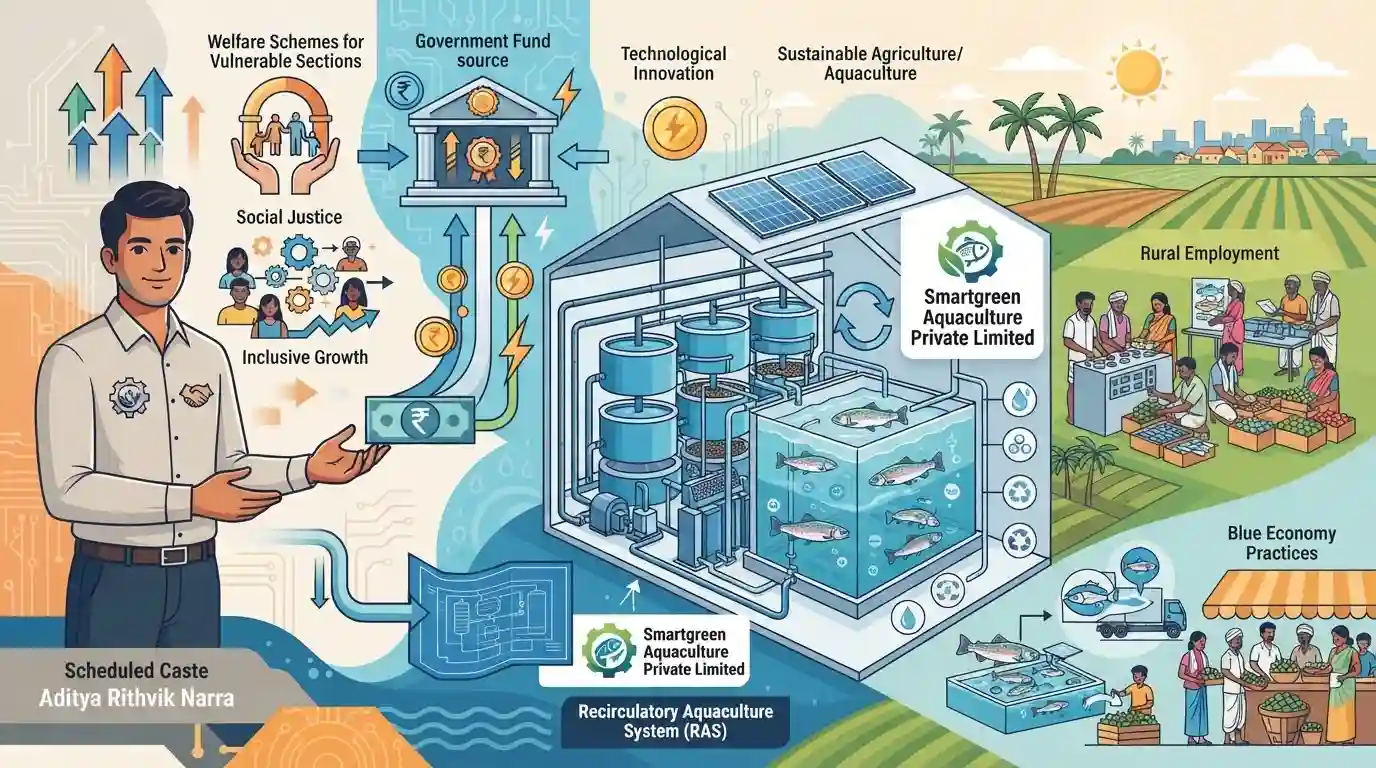
A landmark case study in inclusive entrepreneurship: Scheduled Caste entrepreneur Aditya Rithvik Narra utilized ₹15 crore from the Venture Capital Fund for Scheduled Castes (VCF-SC) to build India's first advanced Rainbow Trout Recirculatory Aquaculture System (RAS) facility in Telangana. By establishing Smartgreen Aquaculture Private Limited, the project exemplifies how targeted government financial backing for marginalized sections can drive technological innovation, sustainable blue economy practices, and rural employment.
ముఖ్య అంశాలు
- Mr. Aditya Rithvik Narra, a Scheduled Caste entrepreneur, established Smartgreen Aquaculture Private Limited in Ranga Reddy District, Telangana.
- The company built India's first advanced Rainbow Trout farming facility using a Recirculatory Aquaculture System (RAS), boasting a 360-tonne annual capacity.
- The project was propelled by a ₹15 crore financial assistance through equity and optionally convertible debentures from the Venture Capital Fund for Scheduled Castes (VCF-SC) in 2022.
- The successful venture generated employment for 25 people, accrued assets worth ₹40 crore, and advanced sustainable aquaculture practices aligned with India's fisheries ecosystem goals.
ముఖ్యమైన పదాలు
Venture Capital Fund for Scheduled Castes (VCF-SC)

A social sector initiative by the Ministry of Social Justice and Empowerment, providing equity-based concessional finance to promote entrepreneurship among Scheduled Caste entrepreneurs holding at least 51% shareholding.
UPSC context
GS Paper II: Welfare Schemes; GS Paper III: Inclusive Growth. Tests knowledge of state-led financial inclusion and socio-economic empowerment.
Recirculatory Aquaculture System (RAS)
A land-based, closed-loop aquaculture technology that filters, treats, and recycles water within a closed containment, reusing up to 90-99% of water to breed and harvest fish in controlled, biosecure conditions.
UPSC context
GS Paper III: Sustainable Agriculture and Technology Missions. Tests understanding of resource-efficient farming and agricultural innovation.
Ministry of Social Justice and Empowerment
The Government of India’s nodal ministry responsible for welfare, social justice, and empowerment of marginalized groups, including Scheduled Castes, Backward Classes, persons with disabilities, and senior citizens.
UPSC context
GS Paper II: Government Policies & Interventions. Tests understanding of institutional mechanisms for uplifting vulnerable populations.
Blue Economy
The sustainable use of ocean and aquatic resources for economic growth, improved livelihoods, and jobs while preserving the health and ecological integrity of marine and inland water ecosystems.
UPSC context
GS Paper III: Economic Development, Environment, Conservation. Tests knowledge of balancing economic growth with water body conservation.
ప్రిలిమ్స్ ఉచ్చు
In a Recirculatory Aquaculture System (RAS), biofilters physically trap suspended organic solids and remove dissolved phosphorus from the culture water.
Biofilters perform biological nitrification (converting toxic ammonia to nitrate). Solid waste removal is done by mechanical filters, and biofilters do not eliminate phosphorus.
అనుసంధానమైన స్థిర భావనలు
What are the biological steps of nitrogen elimination in Recirculatory Aquaculture Systems (RAS)?
- Ammonia Oxidation: Nitrosomonas bacteria convert toxic unionized ammonia excreted by fish into toxic nitrites.
- Nitrite Oxidation: Nitrobacter bacteria quickly convert these nitrites into relatively non-toxic nitrates, which safely accumulate.
- Media Substrate: Biofilters provide a high surface area plastic media for these aerobic, nitrifying bacteria to colonize.
How does the Venture Capital Fund for Scheduled Castes (VCF-SC) structurally differ from standard credit schemes?
- Equity-linked Instrument: It provides concessional finance via equity or optionally convertible debentures rather than simple term loans.
- No Hard Collateral: It targets the systemic credit-collateral gap by absorbing risk without demanding hard physical assets as collateral.
- Ownership Retention: Promoters must maintain at least 51% shareholding to ensure the enterprise remains SC-controlled.
అంతర-అంశ నమూనాలు
Aquaculture tech & Climate adaptation
Closed-loop RAS decouples high-value fisheries from erratic monsoons and warming natural waters, offering climate-resilient livelihoods across non-traditional tropical geographies.
State-backed VC & Social equity
Shifting welfare from debt-subsidies to equity-based venture capital (VCF-SC) transforms marginalized individuals from subsidized beneficiaries to asset-owning, high-tech employers.

VCF-SC equity structures combined with RAS closed-loop nitrogen cycle mechanics are prime targets for multi-statement GS3 questions.
అనుసంధాన PYQలు · 3
అనుసంధాన PYQలు · 3
- 2014PrelimsGS1
What does venture capital mean?
- 2025PrelimsGS1
With reference to investments, consider the following: I. Bonds II. Hedge Funds III. Stocks IV. Venture Capital How many of the above are treated as Alternative Investment Funds?
- 2014MainsGS2
Do government's schemes for up-lifting vulnerable and backward communities by protecting required social resources for them, lead to their exclusion in establishing businesses in urban economies ?
