Trade and Sustainable Development Policy Landscape Workshop
Source:PIB ↗
Why It Matters
The increasing use of environmental regulations as non-tariff trade barriers (e.g., EU's CBAM) poses a challenge to developing economies. Aspirants must understand how India’s domestic carbon initiatives (like CCTS, Indian Carbon Market, and EPR) serve a dual purpose: achieving national climate goals and defending industrial competitiveness in international trade and WTO engagements.
Summary
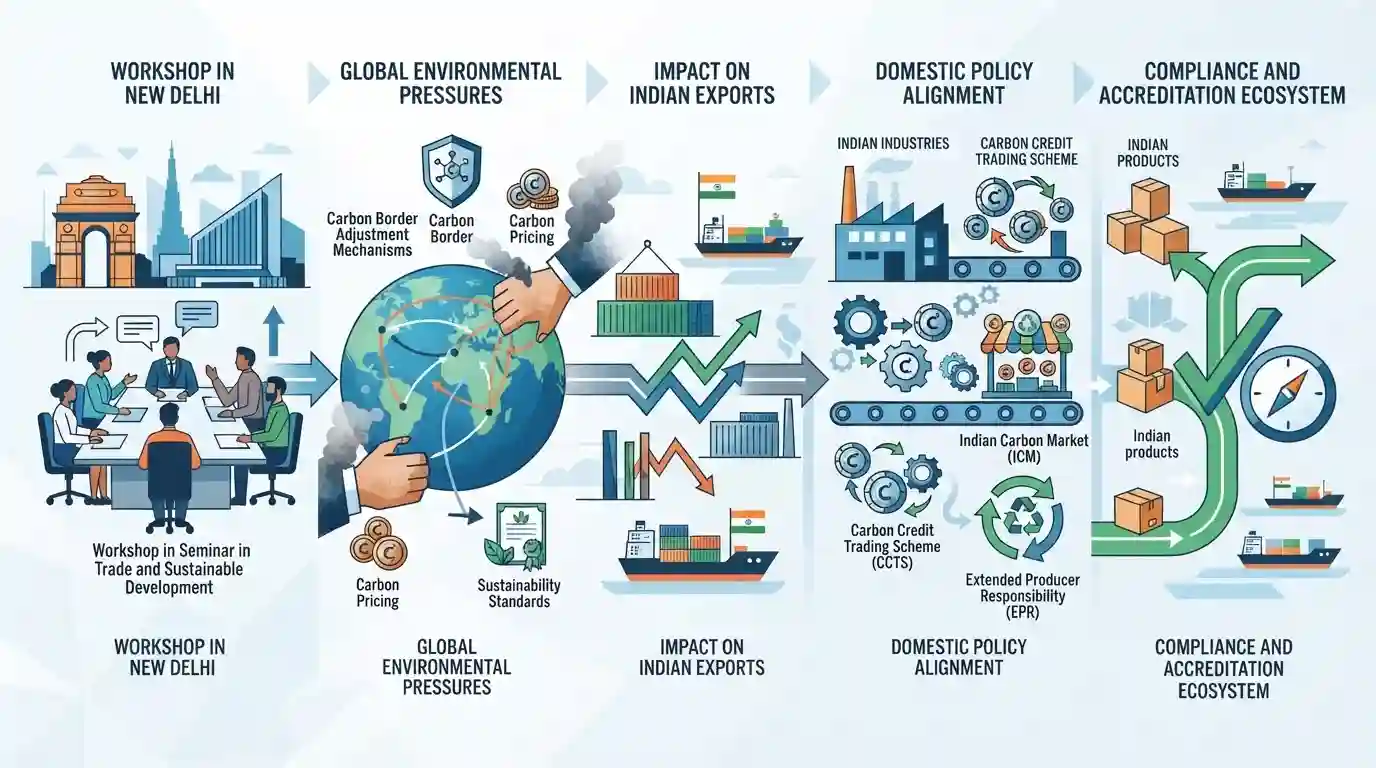
The Department of Commerce organized a workshop in New Delhi on the evolving policy landscape of Trade and Sustainable Development (TSD). The sessions highlighted that unilateral environmental measures—such as carbon border adjustment mechanisms, carbon pricing, and new sustainability standards—are increasingly influencing global trade and Free Trade Agreement (FTA) negotiations. To safeguard India's export competitiveness, discussions emphasized adopting a cross-sectoral approach that aligns the country's domestic architectures—including the Carbon Credit Trading Scheme (CCTS), Indian Carbon Market (ICM), and Extended Producer Responsibility (EPR)—with global trade disciplines. Strengthening domestic accreditation and conformity assessment ecosystems will be crucial to helping Indian industries navigate and comply with these emerging non-tariff barriers.
Key Points
- The Department of Commerce hosted a workshop on Trade and Sustainable Development (TSD) to address the growing intersection of global trade disciplines and environmental standards.
- Officials noted that unilateral environmental measures, such as Carbon Border Adjustment Mechanisms (CBAM) and carbon pricing, are becoming enduring features of international trade.
- India aims to leverage its domestic sustainability architecture, including the Indian Carbon Market (ICM), Carbon Credit Trading Scheme (CCTS), and Extended Producer Responsibility (EPR) frameworks.
- Strengthening the domestic conformity assessment ecosystem is necessary to support Indian industries in remaining globally competitive amidst evolving non-tariff sustainability barriers.
Prelims Trap
The Carbon Credit Trading Scheme is legislated under the Environment Protection Act and administered solely by the MoEFCC.
It is legislated under the Energy Conservation Act, 2001 (amended 2022) and administered by the Bureau of Energy Efficiency (BEE) under the Ministry of Power.
Static Concepts Connected
How does the PAT scheme transition into the Carbon Credit Trading Scheme?
- Structural shift: The Bureau of Energy Efficiency is transitioning the energy-efficiency-focused PAT scheme into the compliance market of the broader CCTS.
- Asset trade: The system transitions from trading Energy Saving Certificates (ESCerts) to Carbon Credit Certificates (CCCs) representing metric tonnes of CO2 equivalent.
What is the EU Carbon Border Adjustment Mechanism (CBAM) framework?
- Core objective: A carbon tariff designed to prevent 'carbon leakage' by taxing imports of carbon-intensive goods entering the European Union.
- Sectors covered: It targets six sectors initially: iron and steel, aluminium, cement, fertilisers, electricity, and hydrogen, heavily impacting Indian metal exports.
- Multilateral friction: Criticized by developing nations as a unilateral non-tariff trade barrier that violates Common But Differentiated Responsibilities (CBDR) principles.
Cross-Topic Patterns
Green Protectionism vs WTO Principles
Unilateral green measures like CBAM conflict with WTO's National Treatment clauses, transforming environmental standards into strategic non-tariff barriers in global trade disputes.
Carbon Markets as Trade Shields
Developing a robust domestic Carbon Credit Trading Scheme allows India to assert that equivalent carbon prices are paid locally, mitigating foreign CBAM financial liabilities.

Mains 2026: Expect questions on how unilateral green measures like CBAM act as non-tariff barriers, requiring domestic carbon market alignment.
Linked PYQs · 2
Linked PYQs · 2
- 2019PrelimsGS1
In India, 'extended producer responsibility' was introduced as an important feature in which of the following?
- 2023PrelimsGS1
Consider the following statements: Statement-I: Carbon markets are likely to be one of the most widespread tools in the fight against climate change. Statement-II: Carbon markets transfer resources from the private sector to the State. Which one of the following is correct in respect of the above statements?
