Panchayati Raj Good Governance Compendium and SDG Localization
Source:PIB ↗
Why It Matters
Provides concrete case studies and best practices of functional Gram Panchayats that are indispensable for enriching Mains GS-2 answers and Essays. It directly addresses frequent UPSC questions regarding the performance, functionality, and capacity building of local government institutions.
Summary
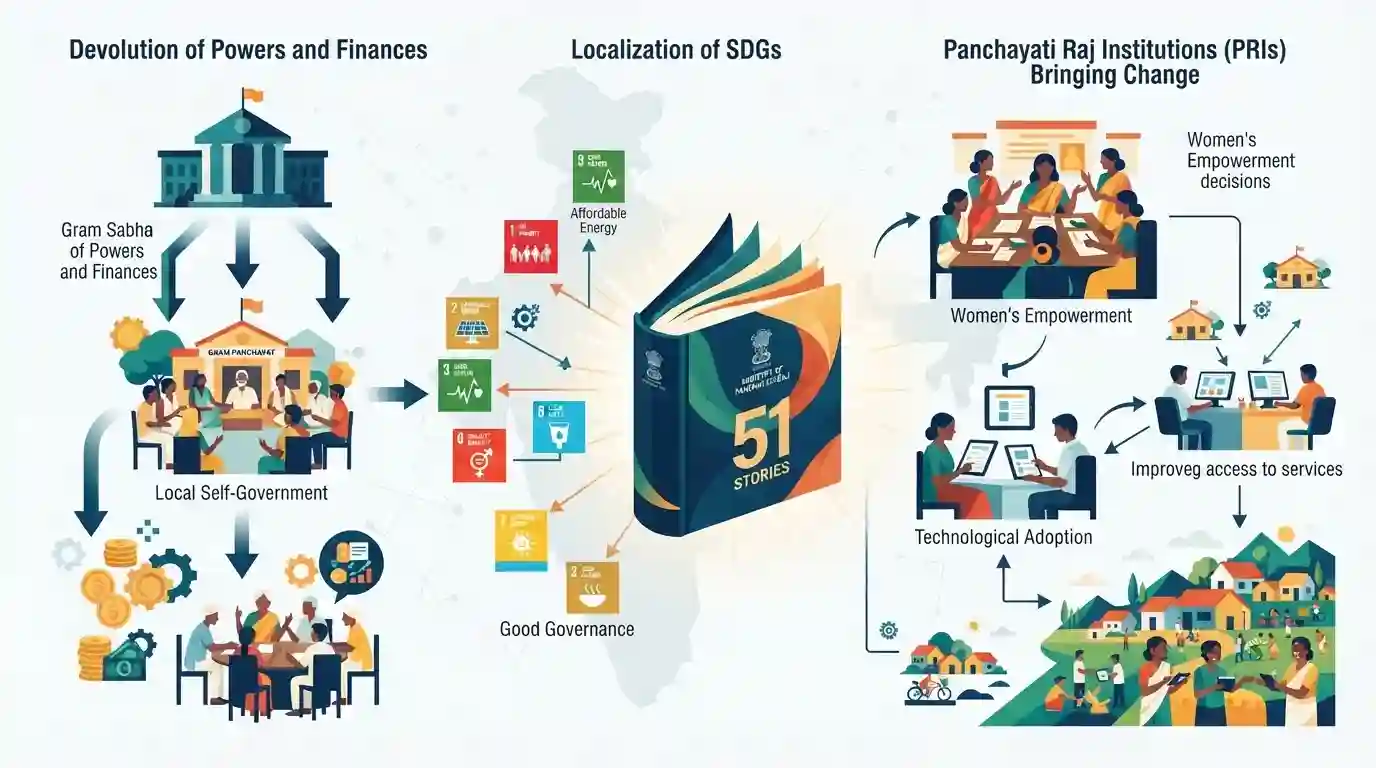
The Ministry of Panchayati Raj has released a compendium titled '51 Stories of Panchayats Bringing Change for Good Governance' to highlight the successful governance models implemented by Gram Panchayats across India. The document documents best practices that align with the Localization of Sustainable Development Goals (LSDGs), demonstrating how grassroots institutions can effectively tackle local challenges. By showcasing achievements in service delivery, women's empowerment, and technological adoption, the compendium aims to inspire other local bodies and foster peer-learning, proving that Panchayati Raj Institutions can function as vibrant centers of localized administration and economic progress.
Key Points
- Union Minister of State for Panchayati Raj released a compendium detailing 51 successful case studies of Gram Panchayats exhibiting good governance.
- The compendium underscores how local bodies are moving beyond traditional roles to become dynamic centers of economic growth and effective local administration.
- The success stories highlight achievements mapped to the Localization of Sustainable Development Goals (LSDGs), addressing themes like health, poverty alleviation, and basic service delivery.
- The initiative promotes peer-to-peer learning and sharing of best practices among PRIs nationwide, addressing challenges of functionality and administrative capacity.
Important Terms
Panchayati Raj Institutions (PRIs)

A three-tier rural local self-government system in India (village, intermediate, and district levels), constitutionalized by the 73rd Amendment Act, 1992, to foster grassroots democratic decentralization.
UPSC context
GS Paper II (Polity & Governance); tests local self-government, Article 243, and the devolution of powers and finances.
Localization of Sustainable Development Goals (LSDGs)
The process of adapting global Sustainable Development Goals (SDGs) to subnational and local contexts, translating them into village-level targets and actionable Gram Panchayat development plans.
UPSC context
GS Paper II & III (Governance & Sustainable Development); tests decentralized planning, bottom-up development, and grassroots SDG implementation.
Rashtriya Gram Swaraj Abhiyan (RGSA)
A Centrally Sponsored Scheme of the Ministry of Panchayati Raj aimed at strengthening the governance capacities of Panchayati Raj Institutions to deliver on the Localization of Sustainable Development Goals.
UPSC context
GS Paper II (Polity & Governance — Schemes); tests capacity building of local bodies, administrative reforms, and fiscal federalism.
Ministry of Panchayati Raj (MoPR)
The nodal Ministry of the Government of India established in 2004, responsible for driving decentralization, policy advocacy, and empowering rural local self-governments.
UPSC context
GS Paper II (Polity & Governance); tests functions of central executive ministries and the execution of institutional decentralization policies.
Gram Panchayats
The executive committee and lowest administrative tier of the Panchayati Raj system at the village level, responsible for local public works and preparing social development plans.
UPSC context
GS Paper II (Polity & Governance); tests grassroots executive administration, public service delivery, and participatory local planning.
Prelims Trap
The Ministry of Panchayati Raj tracks local governance progress by mapping all 17 individual global SDGs directly to village plans.
In practice, the MoPR has grouped the 17 global SDGs into 9 simplified thematic targets to make grassroots planning manageable for Gram Panchayats.
Static Concepts Connected
What is the 3-tier structure of Panchayati Raj and the source of its devolution?
- Constitutional Basis: Established via the 73rd Constitutional Amendment Act, 1992, inserting Part IX and the 11th Schedule.
- Three-Tier Structure: Consists of Gram Panchayat (village), Panchayat Samiti (block), and Zilla Parishad (district) tiers, with mandatory direct elections.
- Devolution Core: Article 243G empowers state legislatures to devolve powers and responsibilities for economic development and social justice.
What are the recommendations of key committees on democratic decentralization?
- Balwant Rai Mehta (1957): Recommended a 3-tier system with indirect elections at the block and district levels.
- Ashok Mehta (1977): Advised a 2-tier system (Zilla Parishad and Mandal Panchayat) and recommended official political party participation.
- L.M. Singhvi (1986): Strongly recommended constitutional recognition of local self-government, leading to the 73rd Amendment.
Cross-Topic Patterns
Localized SDGs and Climate Action
Panchayats leverage LSDG themes like 'Water Sufficient' and 'Clean & Green Village' to steer MGNREGS funds towards climate resilience and minor irrigation projects.
Digital fiscal devolution
The integration of eGramSwaraj with PFMS bridges local governance with national-level fiscal auditing, ensuring 15th Finance Commission grants are traced end-to-end.

2026 Prelims may test digital integration (eGramSwaraj, PFMS) against 11th Schedule subjects as a marker of fiscal accountability.
Linked PYQs · 4
Linked PYQs · 4
- 2024MainsGS2
Analyse the role of local bodies in providing good governance at local level and bring out the pros and cons merging the rural local bodies with the urban local bodies.
- 2020MainsGS2
The strength and sustenance of local institutions in India has shifted from their formative phase of 'Functions, Functionaries and Funds' to the contemporary stage of 'Functionality'. Highlight the critical challenges faced by local institutions in terms of their functionality in recent times.
- 2015MainsGS2
In absence of a well-educated and organized local level government system, 'Panchayats' and 'Samitis' have remained mainly political institutions and not effective instruments of governance. Critically discuss.
- 2026PrelimsGS1
Which of the following statements with respect to the Revamped Rashtriya Gram Swaraj Abhiyan (RGSA) is/are correct? 1. The period of its implementation is 1st April, 2021 to 31st March, 2026. 2. The key objective of the Revamped RGSA is to develop the governance capabilities of the Panchayati Raj Institutions to deliver on the Sustainable Development Goals. 3. The share of the Central funding for the Revamped RGSA is 100% for all States and Union Territories. Select the answer using the code given below:
