Centre for Development of Telematics Indigenous IP Portfolio
Source:PIB ↗
কেন এটি গুরুত্বপূর্ণ
The article highlights India's institutional progress in intellectual property creation, bridging the gap between basic R&D and technology commercialization in high-tech telecom and security systems. This aligns directly with GS3 topics on indigenous S&T development, cybersecurity, and self-reliance.
সারসংক্ষেপ
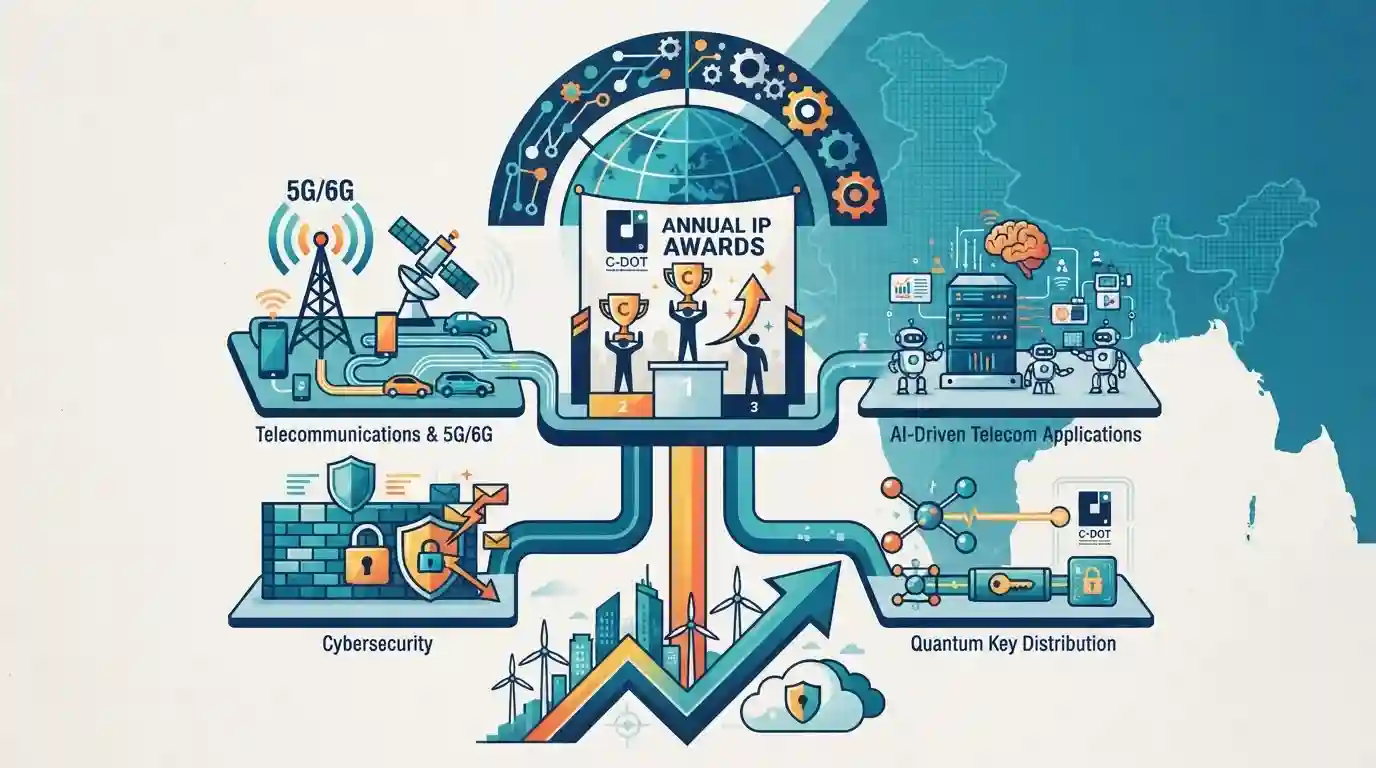
The Centre for Development of Telematics (C-DOT), the premier R&D center of the Department of Telecommunications (DoT), Ministry of Communications, held its Annual IP Awards Ceremony to recognize its researchers for their outstanding contributions to intellectual property. The event highlighted C-DOT's growing portfolio of patents, copyrights, and design registrations in advanced domains including 5G/6G communication, AI-driven telecom applications, cybersecurity, and Quantum Key Distribution (QKD). These indigenous innovations are vital to safeguarding critical information infrastructure, promoting disaster resilience, and driving India's goal of technological self-reliance under the 'Aatmanirbhar Bharat' initiative.
মূল বিষয়
- C-DOT hosted its Annual IP Awards Ceremony to honor its scientists and researchers for creating substantial intellectual property (IP), including patents, copyrights, and design registrations.
- The organization's innovation focus centers on cutting-edge telecom domains such as next-generation communication networks (5G/6G), Artificial Intelligence (AI) in telecom, and Digital Public Infrastructure (DPI).
- C-DOT has achieved major milestones in Quantum Communications, specifically in Quantum Key Distribution (QKD) and post-quantum cryptography, aligning with the goals of the National Quantum Mission.
- In disaster management, C-DOT's Common Alerting Protocol (CAP) compliant Integrated Public Alert System plays a crucial role in providing timely warnings and improving national disaster preparedness.
- Securing domestic patents is central to India's push for technological sovereignty, helping to mitigate cybersecurity vulnerabilities associated with imported hardware and software.
- Establishing indigenous Standard Essential Patents (SEPs) strengthens India's negotiating power and contribution to global standard-setting bodies like the 3GPP and ITU.
গুরুত্বপূর্ণ শব্দ
National Intellectual Property Rights (IPR) Policy

A comprehensive national policy adopted in 2016 to stimulate innovation, creativity, and the commercialization of IP assets in India, managed by DPIIT under a unified administrative umbrella.
UPSC context
GS Paper III (Economy/S&T); tests understanding of IPR frameworks, TRIPS compliance, and innovation ecosystems.
National Quantum Mission (NQM)
A ₹6,003.65 crore central mission (2023–2031) aimed at seeding and scaling up scientific and industrial R&D in quantum computing, communication, sensing, and quantum materials.
UPSC context
GS Paper III (Science & Technology); tests awareness of frontier technologies, quantum supremacy, and strategic technological missions.
Bharat 6G Mission
A strategic initiative targeting global leadership in 6G technology by 2030, transforming India from a technology importer to a major exporter of telecom intellectual property.
UPSC context
GS Paper III (S&T); tests knowledge of next-gen communication systems, indigenization, and digital infrastructure roadmap.
Centre for Development of Telematics (C-DOT)
Established in 1984, C-DOT is India's premier autonomous telecom R&D society under the Department of Telecommunications, focusing on the indigenous design of optical, wireless, and 5G/6G technologies.
UPSC context
GS Paper III (S&T); tests achievements of Indians in science and technology and indigenization of digital technology.
Aatmanirbhar Bharat
A national campaign launched in 2020 promoting self-reliance across five pillars: economy, infrastructure, technology-driven systems, vibrant demography, and demand, focusing on domestic manufacturing and reduced imports.
UPSC context
GS Paper III (Indian Economy/S&T); tests understanding of economic reforms, domestic manufacturing (PLI), and strategic self-sufficiency.
Department of Telecommunications (DoT)
A key department under the Ministry of Communications that formulates telecom policies, allocates spectrum, grants licenses, and regulates infrastructure, governed under the Telecommunications Act, 2023.
UPSC context
GS Paper II & III (Governance/Economy); tests telecom regulatory governance, legislative reforms, and digital infrastructure development.
Ministry of Communications
A Union cabinet-level ministry responsible for regulating postal services and telecommunications in India, supervising the Department of Posts and the Department of Telecommunications.
UPSC context
GS Paper II (Governance); tests structure, organization, and functioning of executive ministries managing critical infrastructure.
প্রিলিমস ফাঁদ
The Cell Broadcast System (CBS) used for emergency alerts relies on standard point-to-point SMS channels, making it vulnerable to network congestion.
CBS is a one-to-many broadcast system. It uses a dedicated logical channel entirely separate from point-to-point SMS, bypassing network congestion entirely during emergencies.
সংযুক্ত স্থির ধারণা
What is the significance of Standard Essential Patents (SEPs) and FRAND licensing?
- Essential standards: A patent is an SEP if it is technically impossible to manufacture standard-compliant devices (e.g., 5G or Wi-Fi systems) without infringing it.
- FRAND commitment: To prevent monopolistic lockouts, Standard Setting Organizations require SEP holders to license their patents under Fair, Reasonable, and Non-Discriminatory terms.
- Economic leverage: SEPs are crucial for geopolitical tech-dominance, enabling countries to collect massive global intellectual property royalties.
How does Quantum Key Distribution (QKD) differ from classical encryption?
- Security foundation: Classical encryption relies on the mathematical complexity of algorithms, while QKD relies on the fundamental physical laws of quantum mechanics.
- Eavesdropping detection: Based on the No-Cloning Theorem, any attempt to intercept the quantum key alters its state, immediately alerting the communicating parties of a breach.
আন্তঃবিষয় প্যাটার্ন
SEPs and Technology Sovereignty
Indigenous SEPs in 5G/6G transform India from a royalty-paying tech consumer into a global standard-setter, directly advancing strategic autonomy under the National Security Directive on Telecommunication Sector.
Disaster Resilience & DPI
Integrating C-DOT's SACHET with the NDMA leverages telecom R&D for disaster risk reduction, illustrating how Digital Public Infrastructure (DPI) translates to real-world climate resilience.

UPSC may test the technical distinction between Cell Broadcast Systems and SMS-alerts alongside NQM's QKD protocols in 2026.
সংযুক্ত PYQ · 4
সংযুক্ত PYQ · 4
- 2014MainsGS3
In a globalized world, Intellectual Property Rights assume significance and are a source of litigation. Broadly distinguish between the terms-Copyrights, Patents and Trade Secrets.
- 2024MainsGS3
What is the present world scenario of intellectual property rights with respect to life materials? Although, India is second in the world to file patents, still only a few have been commercialized. Explain the reasons behind this less commercialization.
- 2017PrelimsGS1
With reference to the 'National Intellectual Property Rights Policy', consider the following statements: 1. It reiterates India's commitment to the Doha Development Agenda and the TRIPS Agreement. 2. Department of Industrial Policy and Promotion is the nodal agency for regulating intellectual property rights in India. Which of the above statements is/are correct?
- 2026PrelimsGS1
Which of the following statements with regard to the National Quantum Mission (NQM) is/are correct? 1. It aims at developing intermediate-scale quantum computers with 50-1000 physical qubits. 2. Its implementation includes setting up of four Thematic Hubs (T-Hubs) in academic and national R&D institutes across India. Select the answer using the code given below :
