Revised Port Dependent Industries Captive Policy for Major Ports
Source:PIB ↗
આ શા માટે મહત્વનું છે
Infrastructure expansion and PPP models are central to India's economic growth strategy. This policy directly addresses the ease of doing business in the maritime sector, making it highly relevant for GS-3 discussions on infrastructure (ports), investment models (PPP), and industrial growth.
સારાંશ
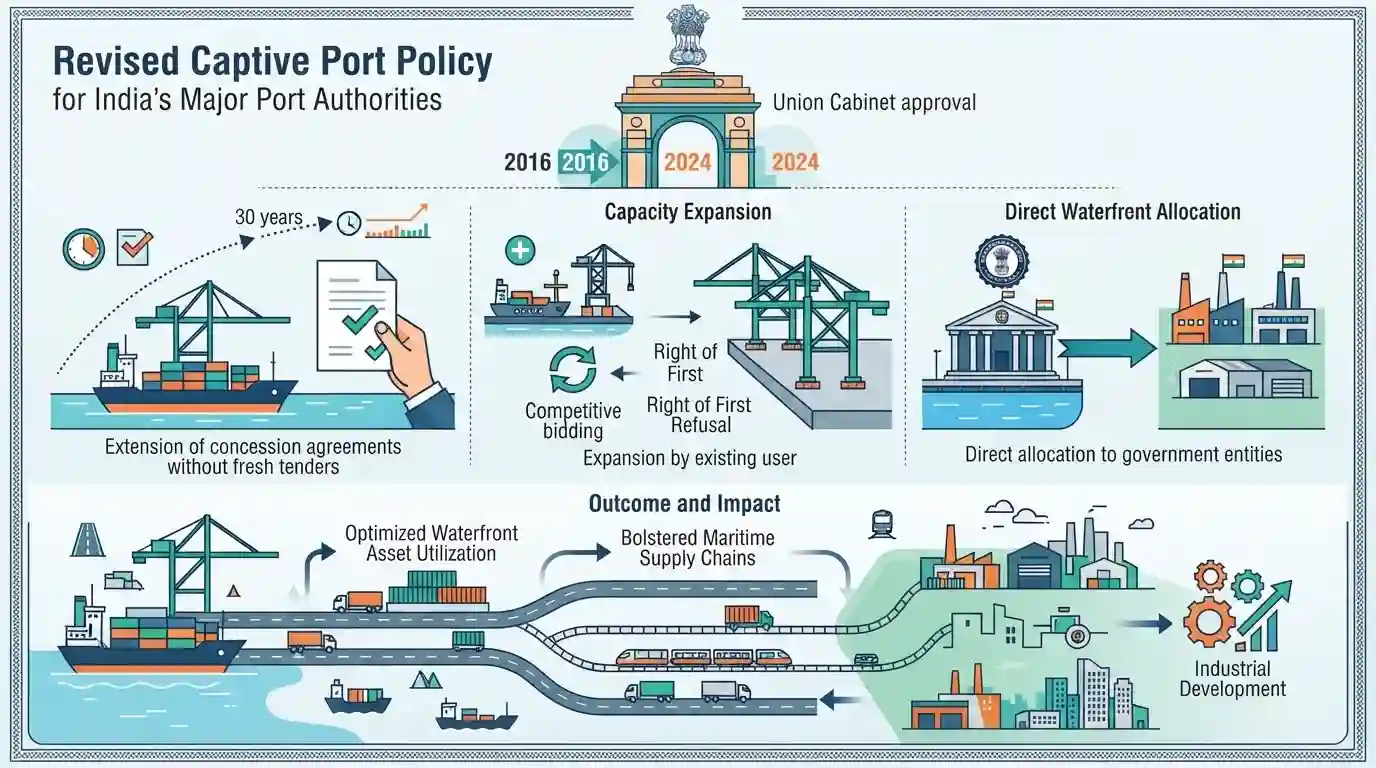
The Union Cabinet has approved a revised Policy for the Award of Waterfront and Associated Land to Port Dependent Industries (Captive Policy) across major ports in India. Updating the 2016 guidelines, the framework introduces reforms to accelerate private investment via the PPP model, enhance operational flexibility, and promote port-led industrial development. Key changes include permitting Major Port Authorities to extend concession agreements for up to 30 years without fresh tenders, enabling existing users to expand capacity via competitive bidding with a Right of First Refusal, and allowing direct waterfront allocation to government entities. The policy also features provisions for adapting to unforeseen events and changing regulations, ultimately aiming to optimize waterfront asset utilization and bolster India's maritime supply chains.
મુખ્ય મુદ્દા
- The Union Cabinet approved a revised Captive Policy for awarding waterfront and associated land to Port Dependent Industries (PDIs) at major ports, updating the 2016 framework.
- The policy aims to spur private investment via the Public-Private Partnership (PPP) model, creating a predictable framework for port-led industrial growth without financial implications for the government.
- Concession agreements of existing PDIs can now be renewed or extended for up to 30 years without a fresh tender process to provide long-term certainty to investors.
- Existing captive users can expand capacity (new berths, jetties, SBMs) through competitive bidding, retaining a Right of First Refusal (RoFR) to match the highest bid.
- For the first time, waterfront and land can be awarded to eligible government organisations (like CPSUs/SPSUs) at notified floor prices without competitive bidding.
- The revised framework accommodates business continuity by introducing 'Change in Law and Unforeseen Events' provisions, allowing revisions to business plans and cargo profiles.
મહત્વપૂર્ણ શબ્દો
Port Dependent Industries (PDI)

Industrial entities, such as oil refineries or steel plants, that rely on a specific major port for importing or exporting at least 70% of their captive cargo.
UPSC context
GS Paper III (Infrastructure & Industrial Policy). Tests understanding of port-led industrialization and logistics cost reduction strategies.
Major Port Authorities
Statutory governing bodies established under the Major Port Authorities Act, 2021, to manage, regulate, and operate India's 12 major public ports with operational autonomy.
UPSC context
GS Paper II (Statutory Bodies) & GS III (Infrastructure). Tests port governance reforms and transition to the landlord model.
Captive Policy
A policy framework regulating the allotment of port waterfront and land to port-dependent industries to construct dedicated captive berths and terminals under the PPP model.
UPSC context
GS Paper III (Investment Models & Infrastructure). Tests policies mobilizing private capital and enhancing the operational efficiency of maritime infrastructure.
Ministry of Ports, Shipping and Waterways (MoPSW)
The nodal Ministry of the Government of India responsible for formulating and administering policies, laws, and programs related to shipping, ports, and inland waterways.
UPSC context
GS Paper II (Government Ministries) & GS III (Infrastructure). Tests understanding of institutional mechanisms executing national maritime projects.
પ્રિલિમ્સ ટ્રેપ
The revised policy mandates compulsory competitive bidding for all waterfront and land allocations across major ports.
The revised policy specifically permits the direct award of waterfronts to government organizations (CPSUs/SPSUs) at notified floor prices, bypassing the competitive bidding process entirely.
સંલગ્ન સ્થિર ખ્યાલો
What is the Landlord Port Model?
- Asset Ownership: The statutory port authority acts as the landlord, retaining ownership of the land, basic infrastructure, and waterfront assets.
- Private Operations: Private companies lease the infrastructure to handle cargo operations, provide maritime services, and maintain the terminals.
- Regulatory Role: The port authority shifts away from being a direct service provider, functioning purely as a regulator and lessor.
What did the Kelkar Committee recommend for PPP projects?
- Flexible Contracts: Advised moving away from rigid, one-size-fits-all Model Concession Agreements (MCAs) to allow for periodic adjustments.
- Renegotiation Framework: Proposed legal mechanisms to renegotiate contracts, accommodating business continuity during 'unforeseen events' or changes in the law.
- Risk Allocation: Emphasized that statutory risks like land acquisition and environmental clearances should lie primarily with the government entity.
આંતર-વિષય પેટર્ન
Port-Led Industrialisation & Sagarmala
Port Dependent Industries (PDIs) are the linchpin of Sagarmala’s Coastal Economic Zone strategy, aiming to drastically cut logistics costs for bulk manufacturing by co-locating industries near deep-draft ports.
PPP Contract Flexibility & Kelkar Panel
The policy's introduction of 'Change in Law' clauses directly operationalizes Kelkar Committee recommendations to de-risk PPPs. This connects GS3 infrastructure financing with broader administrative contract reforms.

Expect a 2026 Prelims question testing the Landlord Port model's ownership-operation divide mixed with Major Ports Act 2021 provisions.
સંલગ્ન PYQ · 4
સંલગ્ન PYQ · 4
- 2022MainsGS3
Why is Public Private Partnership (PPP) required in infrastructural projects ? Examine the role of PPP model in the redevelopment of Railway Stations in India.
- 2021MainsGS3
“Investment in infrastructure is essential for more rapid and inclusive economic growth.” Discuss in the light of India's experience.
- 2013MainsGS3
Adoption of PPP model for infrastructure development of the country has not been free of criticism. Critically discuss pros and cons of the model.
- 2023PrelimsGS1
Consider the following pairs: Port Well known as 1. Kamarajar Port: First major port in India registered as a company 2. Mundra Port: Largest privately owned port in India 3. Visakhapatnam Port: Largest container port in India How many of the above pairs are correctly matched?
