CAQM PM Emission Standards Timeline Extension for NCR Industries
Source:PIB ↗
ఇది ఎందుకు ముఖ్యం
This development is crucial for understanding the practical governance challenges in tackling severe air pollution in Delhi-NCR. It demonstrates the interplay between strict environmental regulations, scientific recommendations (CPCB/IIT Kanpur), and the operational constraints of industries in adopting necessary pollution control technologies.
సారాంశం
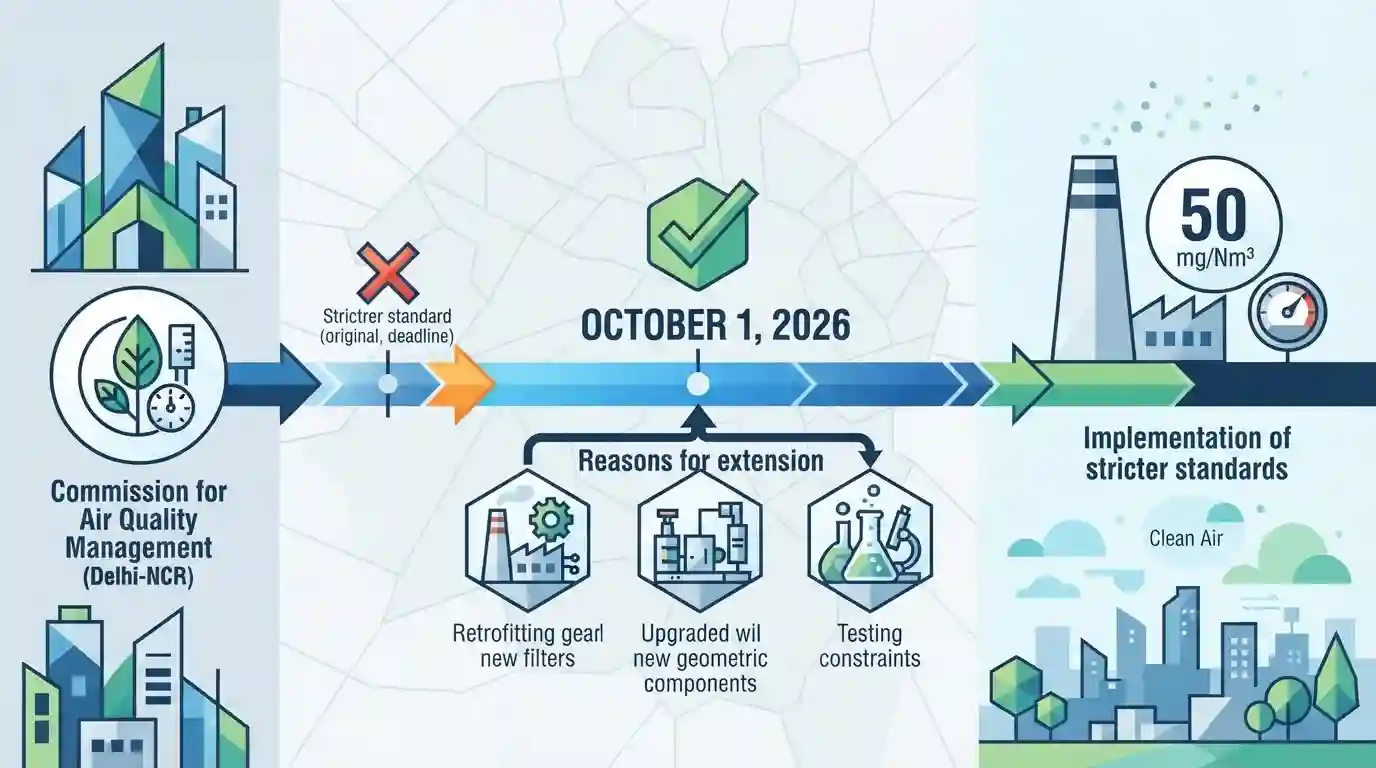
The Commission for Air Quality Management (CAQM) has amended Direction No. 98, extending the implementation timeline for stricter Particulate Matter (PM) emission standards for industries operating in the Delhi-NCR region. The revised uniform standard of 50 mg/Nm³ will now be enforced from October 1, 2026. This extension was granted to accommodate practical difficulties raised by industrial associations regarding the procurement, retrofitting, and adequacy assessment of Air Pollution Control Devices (APCDs), as well as constraints in the testing capacities of recognized laboratories.
ముఖ్య అంశాలు
- The Commission for Air Quality Management (CAQM) has extended the deadline for implementing revised PM emission standards for industries in Delhi-NCR to October 1, 2026.
- A strict, uniform Particulate Matter (PM) emission limit of 50 mg/Nm³ was originally mandated based on recommendations by CPCB and studies by IIT Kanpur.
- The timeline extension addresses practical challenges faced by industries, including delays in procuring and installing Air Pollution Control Devices (APCDs).
- Other compliance constraints include a shortage of agencies capable of conducting adequacy assessments and limited testing capacities at recognized laboratories.
ముఖ్యమైన పదాలు
Commission for Air Quality Management (CAQM)

A statutory body established under the CAQM Act 2021 to coordinate, monitor, and regulate air quality and pollution control efforts across the National Capital Region (NCR) and adjoining areas, replacing the earlier EPCA.
UPSC context
Crucial for GS III (Environment). Tests knowledge of statutory bodies, environmental pollution, and multi-state coordination to combat Delhi-NCR smog.
CAQM Act 2021
Legislation establishing the CAQM with statutory powers to restrict polluting activities, issue binding directions, and impose penalties across Delhi, Punjab, Haryana, Rajasthan, and UP, to ensure better enforcement of air quality standards.
UPSC context
Relevant for GS II and III (Statutory Bodies, Environmental Legislation). Tests knowledge of legal frameworks addressing regulatory overlap and stubble burning.
Direction No. 98
A statutory order by the CAQM mandating strict, uniform particulate matter (PM) emission limits of 50 mg/Nm³ for highly polluting industries in the Delhi-NCR region to curb industrial air pollution.
UPSC context
Relevant for GS III (Air Pollution). Highlights specific regulatory interventions, emission standard enforcement, and the balance between ecology and industry compliance.
Central Pollution Control Board (CPCB)
India's apex statutory pollution control body, established in 1974 under the Water Act. It oversees national environmental standards, advises the government, and coordinates with state boards under both the Water and Air Acts.
UPSC context
Core GS III (Environment) topic. Tests understanding of primary environmental governance frameworks and apex regulatory authorities setting industrial emission standards.
State Pollution Control Boards (SPCBs)
State-level statutory entities created under the Water and Air Acts to implement environmental laws locally. They monitor industrial emissions, enforce compliance, and execute directives issued by apex bodies like the CPCB and CAQM.
UPSC context
Important for GS II and III. Highlights decentralized environmental governance, local regulatory enforcement, and centre-state coordination in pollution control.
ప్రిలిమ్స్ ఉచ్చు
Under the CAQM Act, 2021, farmers face imprisonment of up to five years for stubble burning.
The CAQM Act explicitly decriminalized stubble burning for farmers, exempting them from jail terms. They are only subject to fiscal environmental compensation.
అనుసంధానమైన స్థిర భావనలు
What is CAQM's statutory relationship with CPCB and State boards?
- Overriding power: CAQM's directions hold supreme authority, overriding conflicting orders of CPCB and state SPCBs within its NCR-and-adjoining jurisdiction.
- Judicial recourse: Appeals against CAQM decisions lie exclusively with the National Green Tribunal (NGT), bypassing state high courts.
- Predecessor entity: CAQM permanently replaced the legacy Environment Pollution (Prevention and Control) Authority (EPCA) which had functioned under EPA 1986.
How do NAAQS and the National AQI differ in pollutant coverage?
- NAAQS scope: NAAQS monitors 12 ambient air pollutants, strictly excluding greenhouse gases like Carbon Dioxide (CO2).
- AQI subset: AQI is computed using a subset of only 8 pollutants from the 12 listed under NAAQS.
- Excluded toxins: Toxic heavy metals and organic compounds (Benzene, Benzo-a-pyrene, Arsenic, Nickel) are in NAAQS but excluded from AQI calculations.
అంతర-అంశ నమూనాలు
Green mandates vs supply chains
CAQM's extension reveals how aggressive environmental regulations depend heavily on industrial supply chain readiness, matching equipment manufacture, and laboratory testing capacity.
Airshed policing vs State autonomy
The overriding authority of the central CAQM over state boards highlights a shifting constitutional balance toward centralized ecological governance in shared interstate airsheds.

CAQM's overriding jurisdiction over SPCBs and the statutory exemption of farmers from imprisonment will be key 2026 prelims targets.
అనుసంధాన PYQలు · 4
అనుసంధాన PYQలు · 4
- 2022PrelimsGS1
In the context of WHO Air Quality Guidelines, consider the following statements: 1. The 24-hour mean of PM2.5 should not exceed 15 µg/m³ and annual mean of PM2.5 should not exceed 5 µg/m³. 2. In a year, the highest levels of ozone pollution occur during the periods of inclement weather. 3. PM10 can penetrate the lung barrier and enter the bloodstream. 4. Excessive ozone in the air can trigger asthma. Which of the statements given above are correct?
- 2016PrelimsGS1
In the cities of our country, which among the following atmospheric gases are normally considered in calculating the value of Air Quality Index? 1. Carbon dioxide 2. Carbon monoxide 3. Nitrogen dioxide 4. Sulfur dioxide 5. Methane Select the correct answer using the code given below.
- 2021MainsGS3
Describe the key points of the revised Global Air Quality Guidelines (AQGs) recently released by the World Health Organisation (WHO). How are these different from its last update in 2005? What changes in India's National Clean Air Programme are required to achieve these revised standards?
- 2024MainsGS3
Industrial pollution of river water is a significant environmental issue in India. Discuss the various mitigation measures to deal with this problem and also the government's initiatives in this regard.
