NAMASTE Scheme and Mechanised Sanitation Worker Rehabilitation
Source:PIB ↗
কেন এটি গুরুত্বপূর্ণ
The eradication of manual scavenging and the socio-economic empowerment of sanitation workers is a highly recurrent UPSC theme reflecting core constitutional mandates (Article 17 - Abolition of Untouchability, Article 21 - Right to Life with Dignity). Mechanization schemes like NAMASTE illustrate the evolution of governance from merely prohibiting hazardous labor to actively facilitating alternative livelihoods, entrepreneurship, and comprehensive rehabilitation for marginalized communities.
সারসংক্ষেপ
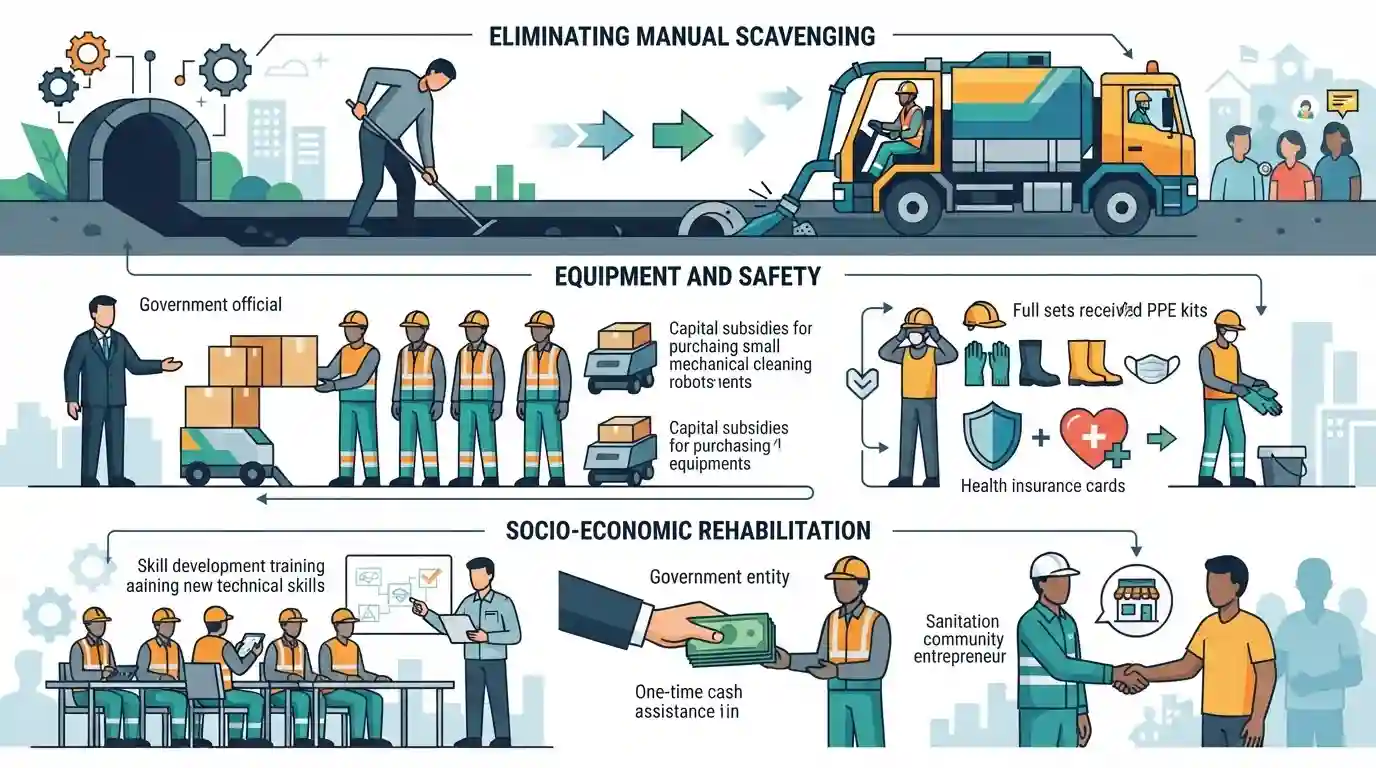
The Government is intensifying efforts to ensure the safety, dignity, and socio-economic rehabilitation of sanitation workers by eliminating hazardous manual cleaning and promoting a mechanized sanitation ecosystem. Spearheaded by the Ministry of Social Justice and Empowerment, flagship initiatives like the NAMASTE scheme aim to achieve zero sanitation fatalities by providing workers with capital subsidies to acquire mechanical cleaning equipment. Furthermore, the framework ensures occupational safety through the distribution of PPE kits and health insurance under Ayushman Bharat. To break the historical cycle of indignity faced by Safai Karamcharis, identified manual scavengers are offered comprehensive rehabilitation, including one-time cash assistance and skill development training, transforming vulnerable workers into sanitation entrepreneurs.
মূল বিষয়
- The government is shifting from manual scavenging to a mechanized sanitation ecosystem through the NAMASTE scheme to achieve zero fatalities in sanitation work.
- Sanitation workers are provided with capital subsidies and interest subvention to purchase cleaning machines, fostering entrepreneurship and self-reliance.
- Dignity and occupational safety are prioritized by equipping workers with PPE kits, safety devices, and comprehensive health insurance under PM-JAY.
- Identified manual scavengers receive comprehensive socio-economic rehabilitation, including One-Time Cash Assistance (OTCA) and skill development training with stipends.
- Efforts are focused on collectivizing Safai Karamcharis into Self-Help Groups (SHGs) to empower them to run sanitation enterprises.
গুরুত্বপূর্ণ শব্দ
NAMASTE Scheme (National Action for Mechanised Sanitation Ecosystem)

A joint central sector initiative aiming to achieve zero sanitation fatalities by eliminating hazardous manual cleaning, promoting 100% mechanization of sewer/septic tank work, and transforming workers into sanitation entrepreneurs.
UPSC context
GS Paper II (Governance/Social Justice); crucial for topics on welfare schemes for vulnerable sections and sanitation mechanization.
Prohibition of Employment as Manual Scavengers and their Rehabilitation Act, 2013
A landmark legislation that completely bans manual scavenging, outlaws hazardous manual cleaning of sewers and septic tanks without protective gear, and mandates the rehabilitation of identified manual scavengers.
UPSC context
GS Paper II (Social Justice/Legislations); tests understanding of legal protections, human rights, and social rehabilitation mechanisms.
Self-Employment Scheme for Rehabilitation of Manual Scavengers (SRMS)
A central scheme (now merged with NAMASTE) designed to rehabilitate identified manual scavengers and their dependents in alternative livelihoods through one-time cash assistance, skill training, and capital subsidies.
UPSC context
GS Paper II (Social Justice); evaluates government rehabilitation policies, livelihood transition programs, and financial inclusion.
Ayushman Bharat Pradhan Mantri Jan Arogya Yojana (AB-PMJAY)
The world's largest government-funded health assurance scheme, providing cashless secondary and tertiary hospitalisation coverage up to ₹5 lakh per family annually to poor and vulnerable households.
UPSC context
GS Paper II (Social Justice & Public Health); tests policies on universal health coverage, health security, and safety nets.
Ministry of Social Justice and Empowerment
The nodal Union ministry responsible for welfare, social justice, and empowerment of marginalized groups, including Scheduled Castes, OBCs, persons with disabilities, and sanitation workers.
UPSC context
GS Paper II (Governance); tests the institutional structure executing welfare benefits and social security for marginalized segments.
Ministry of Housing and Urban Affairs (MoHUA)
The nodal ministry in India responsible for formulating policies, coordinating activities, and implementing programs related to urban development, municipal administration, and urban sanitation.
UPSC context
GS Paper II & III (Governance, Urbanization); tests policies on urban infrastructure management, sanitation, and municipal labor safety.
প্রিলিমস ফাঁদ
NAMASTE is a Centrally Sponsored Scheme implemented solely by the Ministry of Social Justice and Empowerment for sewer and septic tank workers.
NAMASTE is a Central Sector Scheme jointly implemented by MoSJE and MoHUA, and its scope was expanded in 2024 to include solid waste pickers.
সংযুক্ত স্থির ধারণা
What is the legislative and judicial framework against manual scavenging?
- PEMSR Act 2013: Prohibits employment of manual scavengers and hazardous manual cleaning of sewers or septic tanks without protective gear, making violations a cognizable offence.
- Constitutional safeguards: Violated by manual scavenging, specifically Article 21 (dignity), Article 17 (untouchability), and Article 23 (prohibition of forced/hazardous labour).
- Judicial mandate: In Safai Karamchari Andolan v. UOI (2014), the Supreme Court ordered complete eradication of manual scavenging and mandatory compensation for sewer deaths.
What is the National Safai Karamcharis Finance & Development Corporation (NSKFDC)?
- Institutional status: A non-profit Section 8 company under the Ministry of Social Justice and Empowerment, established in 1997 to uplift sanitation workers.
- Financing node: Acts as the apex channelising agency to disburse concessional loans, capital subsidies, and skill training specifically for Safai Karamcharis.
আন্তঃবিষয় প্যাটার্ন
AMRUT 2.0 + Zero-Fatality Sanitation
Urban municipal funding under AMRUT 2.0 must tie directly with NAMASTE's mechanisation tools, linking municipal engineering to fundamental human rights and safety.
Circular Economy + Waste Picker Protection
Integrating waste pickers into NAMASTE aligns informal labour networks with formal Extended Producer Responsibility (EPR) frameworks under Solid Waste Management rules.

Expect a multi-statement question testing the expanded scope of NAMASTE (including waste pickers), its joint ministries, and NSKFDC's role.
সংযুক্ত PYQ · 3
সংযুক্ত PYQ · 3
- 2016PrelimsGS1
'Rashtriya Garima Abhiyaan' is a national campaign to
- 2019MainsGS2
Performance of welfare schemes that are implemented for vulnerable sections is not so effective due to absence of their awareness and active involvement at all stages of policy process. Discuss.
- 2017MainsGS2
To ensure effective implementation of policies addressing water, sanitation and hygiene needs the identification of the beneficiary segments is to be synchronized with the anticipated outcomes." Examine the statement in the context of the WASH scheme.
