Jan Bhagidari Campaign and Groundwater Revival in Vizianagaram
Source:PIB ↗
આ શા માટે મહત્વનું છે
With India being the world's largest consumer of groundwater, decentralized models of watershed management and traditional water-harvesting revival (like the cascade tank systems of Vizianagaram) offer a cost-effective, sustainable, and highly replicable solution. It perfectly illustrates the shift from top-down administrative mandates to bottom-up, community-owned resource management, which is a frequent theme in both UPSC GS Paper 1 (Geography/Water resources) and GS Paper 3 (Agriculture/Environment).
સારાંશ
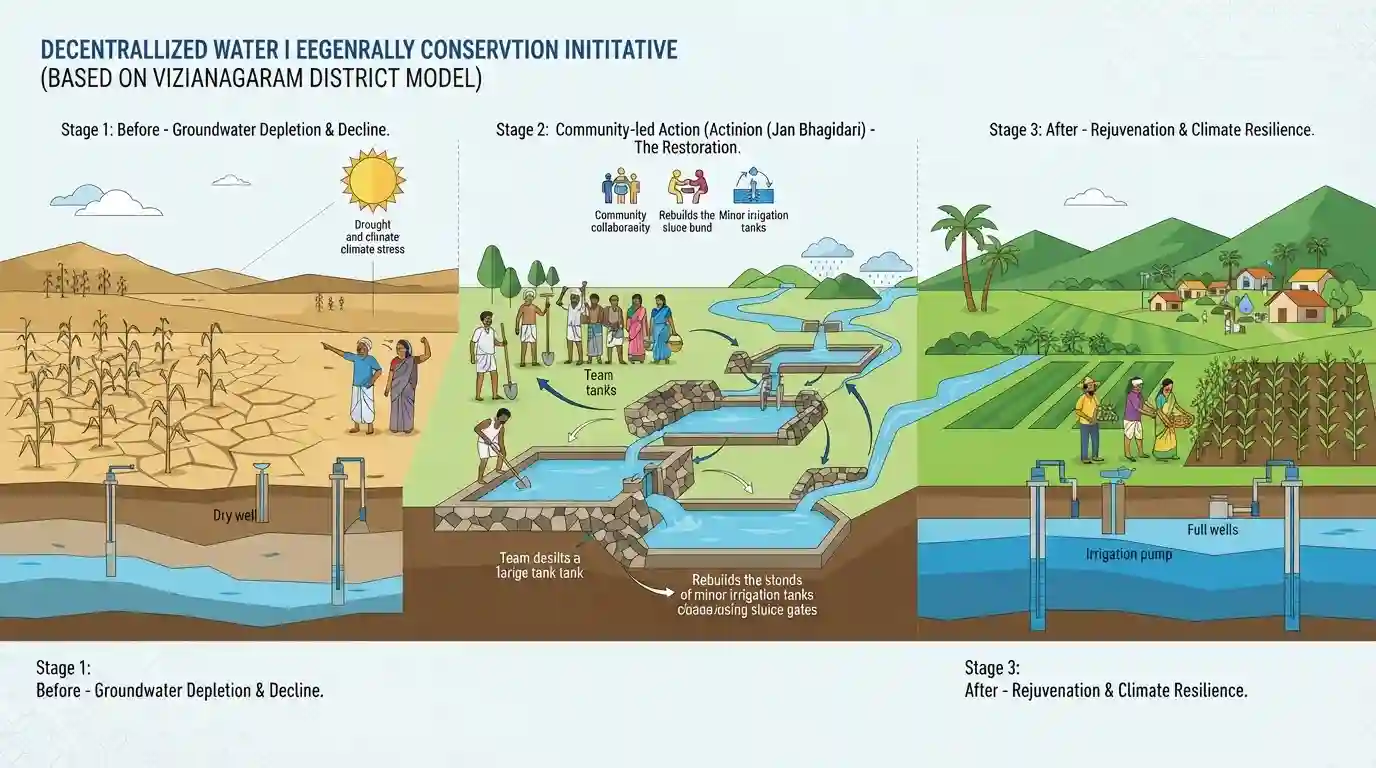
The article highlights a highly successful decentralized water conservation initiative in Vizianagaram district, Andhra Pradesh, under the 'Jal Sanchay Jan Bhagidari: Catch the Rain' campaign. By focusing on the restoration of traditional minor irrigation tanks and interconnected cascade tank systems, and driving the efforts through community participation ('Jan Bhagidari'), the district successfully reversed groundwater depletion. This community-led rejuvenation has improved water security, revived local agriculture, and provided a scalable model for climate-resilient water resource management in India.
મુખ્ય મુદ્દા
- The initiative is a key part of the 'Jal Sanchay Jan Bhagidari: Catch the Rain' campaign, emphasizing community-driven ('Jan Bhagidari') water conservation.
- Vizianagaram district in Andhra Pradesh successfully revived its traditional minor irrigation tanks and interconnected cascade tank systems to capture and store monsoon runoff.
- Core interventions included clearing blocked supply channels, desilting silted-up tanks, and strengthening tank bunds to maximize rainwater percolation and storage.
- The project harnessed grassroots community participation, actively involving local farmers, Water Users Associations, and women's self-help groups in the restoration process.
- The initiative led to a substantial rise in local groundwater levels, rejuvenation of defunct borewells, improved cropping intensity (multiple cropping), and secured drinking water access.
- The model showcases the effective administrative convergence of various rural development funds, such as MGNREGS, to construct sustainable green-grey infrastructure.
મહત્વપૂર્ણ શબ્દો
Jal Sanchay Jan Bhagidari: Catch the Rain

A nationwide, community-led water conservation campaign promoting rainwater harvesting, groundwater recharge, and the restoration of traditional minor irrigation tanks using low-cost local interventions.
UPSC context
Crucial for GS-3 (Water Conservation); demonstrates decentralized, climate-resilient water management and community-led environmental governance models.
Jal Shakti Abhiyan
A time-bound, mission-mode water conservation campaign by the Indian government focusing on harvesting rainfall, restoring water bodies, and intensive afforestation in water-stressed districts.
UPSC context
Relevant for GS-2 (Policies) and GS-3 (Environment), testing mission-driven governance approaches to addressing India's pressing water crisis.
MGNREGS
A statutory rural wage employment program extensively leveraged for building durable community assets, including desilting tanks, digging recharge pits, and creating minor irrigation structures.
UPSC context
Tests GS-2 (Welfare Schemes) and GS-3 (Environment) regarding the productive convergence of employment generation with grassroots ecological restoration.
Ministry of Jal Shakti
The central nodal ministry established to ensure holistic, integrated management of India's water resources, overseeing national missions for safe drinking water, sanitation, and river rejuvenation.
UPSC context
Relevant for GS-2 (Governance), focusing on institutional frameworks for managing national water security and integrated river basin planning.
Water Users Associations (WUAs)
Grassroots, statutory bodies formed by local farmers to manage irrigation systems, maintain cascade tanks, ensure equitable water distribution, and promote participatory water management.
UPSC context
Important for GS-2 (Local Governance) and GS-3 (Agriculture), highlighting participatory mechanisms in sustaining and operating local irrigation infrastructure.
Self-Help Groups (SHGs)
Small, community-based micro-finance collectives, predominantly of women, who are increasingly mobilized as frontline actors in executing local water conservation and civic projects.
UPSC context
Tests GS-2 (Role of SHGs) on the mobilization of social capital and women's empowerment for grassroots environmental governance.
પ્રિલિમ્સ ટ્રેપ
The 'Jal Sanchay Jan Bhagidari' initiative is a 100% centrally funded scheme with no provisions for private or corporate financial contributions.
The 'Jal Sanchay Jan Bhagidari' initiative explicitly operates on the '3Cs' principle—Community, CSR, and Cost—meaning it relies heavily on collaborative non-state funding, unlike traditional 100% centrally-funded schemes.
સંલગ્ન સ્થિર ખ્યાલો
What are Cascade Tank Systems (Eris/Cheruvulu) and how do they function?
- Definition: Interconnected series of traditional minor irrigation tanks constructed sequentially along a valley slope to capture monsoon runoff.
- Hydrological flow: Excess water from upstream tanks flows naturally through channels into downstream tanks, preventing soil erosion and flash floods.
- Aquifer recharge: They systematically replenish shallow unconfined aquifers across entire catchment areas rather than isolated pockets.
What is Participatory Irrigation Management (PIM)?
- Core objective: A water governance framework transferring management, maintenance, and water distribution responsibilities of canal/minor irrigation from the state to water users.
- Institutional tool: Legally operationalized through Water Users Associations (WUAs), which are democratically elected bodies of local farmers.
- Legal backing: Empowered by state-specific legislations to maintain field channels, distribute water equitably, and resolve local disputes.
આંતર-વિષય પેટર્ન
Traditional Hydrology + Climate Adaptation
Reviving historic cascade tanks offers a decentralized, low-energy alternative to deep groundwater extraction, directly mitigating climate-induced monsoon variability in dryland zones.
MGNREGS + Asset Creation
Using MGNREGS's 60% NRM mandate for desilting represents administrative convergence, transforming a labor safety net into a creator of permanent community assets.

Multi-statement questions on traditional cascade tanks (Eris/Cheruvulu) and their fiscal convergence under MGNREGS likely in 2026.
સંલગ્ન PYQ · 3
સંલગ્ન PYQ · 3
- 2018MainsGS1
The ideal solution of depleting ground water resources in India is water harvesting system." How can it be made effective in urban areas?
- 2020MainsGS3
Suggest measures to improve water storage and irrigation system to make its judicious use under depleting scenario.
- 2026PrelimsGS1
Which among the following is/are the objective(s) of the Rainfed Area Development (RAD) initiative under the National Mission for Sustainable Agriculture (NMSA) ? 1. Encouraging monoculture in rainfed areas 2. Increasing rice cultivation in irrigated regions 3. Enhancing productivity and minimising climatic risks through Integrated Farming Systems (IFS) Select the answer using the code given below :
