Public Examinations Amendment Bill Passage in Rajya Sabha
Source:PIB ↗
ఇది ఎందుకు ముఖ్యం
The amendment bill addresses the critical issue of transparency in public examinations—a direct overlap with recent Mains PYQs. It introduces sweeping technological safeguards like AI authentication into the administrative apparatus, blending e-governance with systemic accountability.
సారాంశం
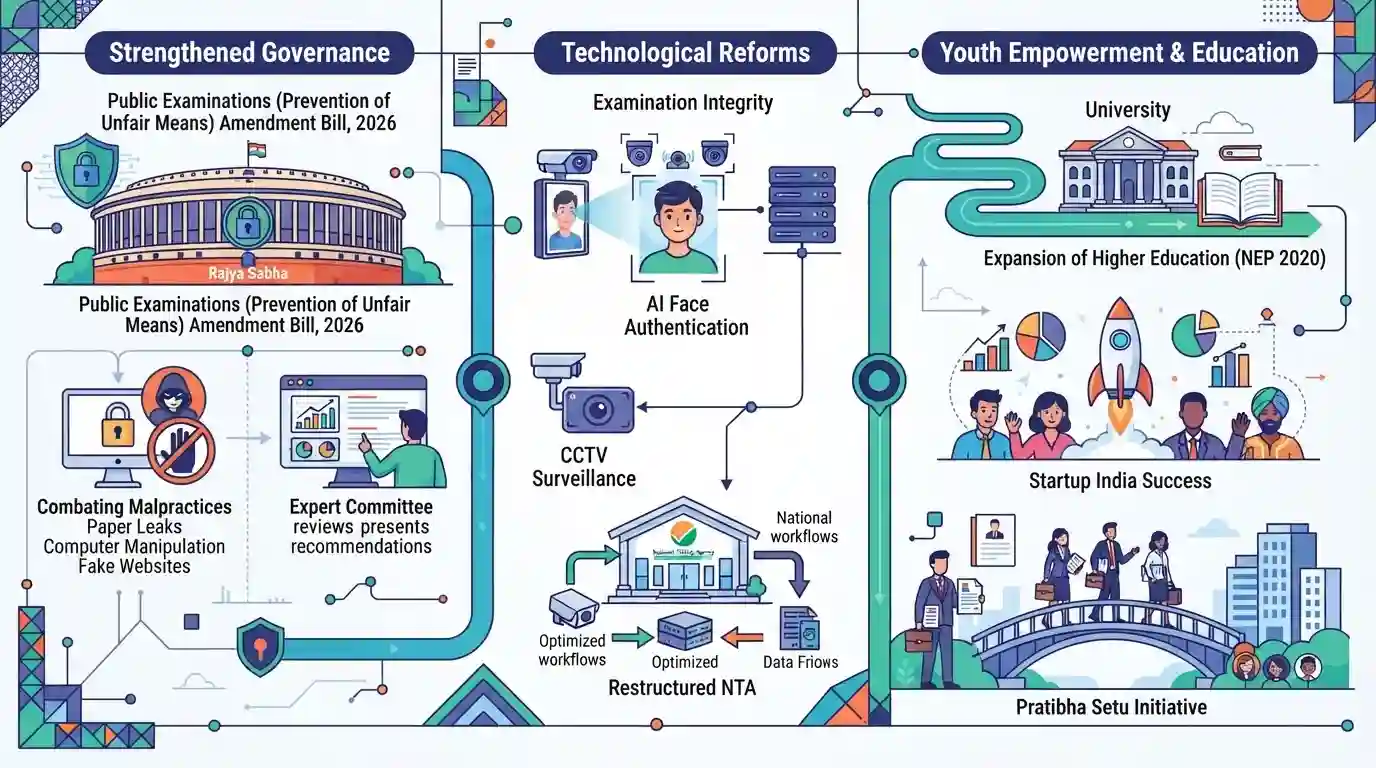
The Rajya Sabha has passed the Public Examinations (Prevention of Unfair Means) Amendment Bill, 2026, aimed at ensuring transparent and credible public examinations. Building upon the 2024 Act, the legislation goes beyond addressing paper leaks to combat a wide spectrum of malpractices, including computer system manipulation and fake websites. An expert committee’s recommendations have led to systemic and technological reforms such as AI-enabled face authentication, CCTV surveillance, and the restructuring of the National Testing Agency. The discussion also highlighted broader strides in youth empowerment, showcasing the expansion of higher education under NEP 2020, the success of Startup India, and the Pratibha Setu initiative connecting civil service candidates with employers.
ముఖ్య అంశాలు
- The Rajya Sabha passed the Public Examinations (Prevention of Unfair Means) Amendment Bill, 2026, broadening the scope of the 2024 Act to tackle various malpractices like answer sheet tampering and fake exam websites.
- To reinforce the examination ecosystem, 35 out of 46 recommendations from an expert committee have been enacted, including AI facial authentication, multi-layer frisking, and Aadhaar biometrics.
- Key systemic overhauls target central recruitment bodies and involve restructuring the National Testing Agency (NTA).
- The government cited substantial progress in the education sector linked to NEP 2020, noting steep rises in the number of universities, AIIMS, and medical colleges since 2014.
- Additional governance and employment initiatives highlighted include the growth of Startup India and 'Pratibha Setu', a portal matching meritorious civil service candidates with prospective employers.
ముఖ్యమైన పదాలు
Public Examinations (Prevention of Unfair Means) Amendment Bill, 2026

A 2026 legislative amendment strengthening the 2024 Act by increasing penalties (up to 10 years imprisonment, ₹5 crore fines) for organized exam offenses and creating Special Fast Track Courts for swift trials.
UPSC context
GS Paper 2 (Governance). Crucial for analyzing transparency, government policies, and administrative reforms in recruitment processes.
Public Examinations (Prevention of Unfair Means) Act, 2024
A comprehensive national law enacted to curb cheating, paper leaks, and computer tampering in public exams, prescribing severe prison terms for organized syndicates and debarring compromised private service providers.
UPSC context
GS Paper 2 (Governance). Tests knowledge of statutory frameworks designed to ensure integrity and fairness in institutional recruitment.
Pratibha Setu
A UPSC-managed portal (formerly Public Disclosure Scheme) connecting verified employers with high-achieving candidates who cleared the Mains and interview stages but narrowly missed the final merit list.
UPSC context
GS Paper 2 (Human Resources). Relevant for issues of youth empowerment, talent utilization, and public sector employment reforms.
National Testing Agency (NTA)
An autonomous testing organization responsible for conducting major national entrance exams, recently subjected to sweeping restructuring to eliminate outsourcing vulnerabilities and enhance technological security against leaks.
UPSC context
GS Paper 2 (Education). Important for analyzing institutional efficiency, accountability in higher education, and systemic examination reforms.
National Education Policy (NEP) 2020
India's comprehensive policy framework aimed at overhauling the education system by promoting holistic, multidisciplinary learning and expanding equitable access to higher education to empower the youth.
UPSC context
GS Paper 2 (Social Justice). Fundamental for answering questions on educational reforms, human capital, and youth skill development.
ప్రిలిమ్స్ ఉచ్చు
The Public Examinations Act automatically applies to and covers all state-level public service commission examinations.
The Act primarily targets central recruitment bodies (like UPSC, SSC, RRB, NTA). It does not automatically apply to state PSCs unless state governments formally adopt its model framework.
అనుసంధానమైన స్థిర భావనలు
What is the legal status and mandate of the National Testing Agency (NTA)?
- Registration status: Established as an autonomous and self-sustained premier testing organization registered under the Societies Registration Act, 1860.
- Core mandate: Conducts transparent, standardized entrance tests for admissions to premier higher educational institutions, ensuring highly efficient evaluation metrics.
What are the core punitive measures under the parent Public Examinations Act, 2024?
- Individual penalty: Imposes imprisonment of 3 to 5 years and fines up to ₹10 lakh for individuals committing scheduled offenses.
- Organized crime: Prescribes 5 to 10 years imprisonment and a minimum fine of ₹1 crore for organized paper leak syndicates.
అంతర-అంశ నమూనాలు
E-Governance vs. Cyber Vulnerabilities
The shift to digital-first examinations tests the boundary between e-governance administrative efficiency and the rising threat of sophisticated AI-driven hacking, deepfakes, and system manipulation.
Education Equity vs. Exam Integrity
Standardized testing integrity directly influences equitable access to higher education under NEP 2020, where leaks disproportionately marginalize students from vulnerable socioeconomic backgrounds.

Expect a GS2/GS3 integration testing federal jurisdiction over exams and the legal liabilities of third-party digital test providers.
అనుసంధాన PYQలు · 3
అనుసంధాన PYQలు · 3
- 2024MainsGS2
What are the aims and objects of recently passed and enforced, The Public Examination (Prevention of Unfair Means) Act, 2024? Whether University/State Education Board examinations, too, are covered under the Act ?
- 2020MainsGS2
National Education Policy 2020 is in conformity with the Sustainable Development Goal-4 (2030). It intends to restructure and reorient education system in India. Critically examine the statement.
- 2024MainsGS2
e-governance is not just about the routine application of digital technology in service delivery process. It is as much about multifarious interactions for ensuring transparency and accountability. In this context evaluate the role of the 'Interactive Service Model' of e-governance.
