Telecom Manufacturing Zone Establishment in Gwalior
Source:PIB ↗
কেন এটি গুরুত্বপূর্ণ
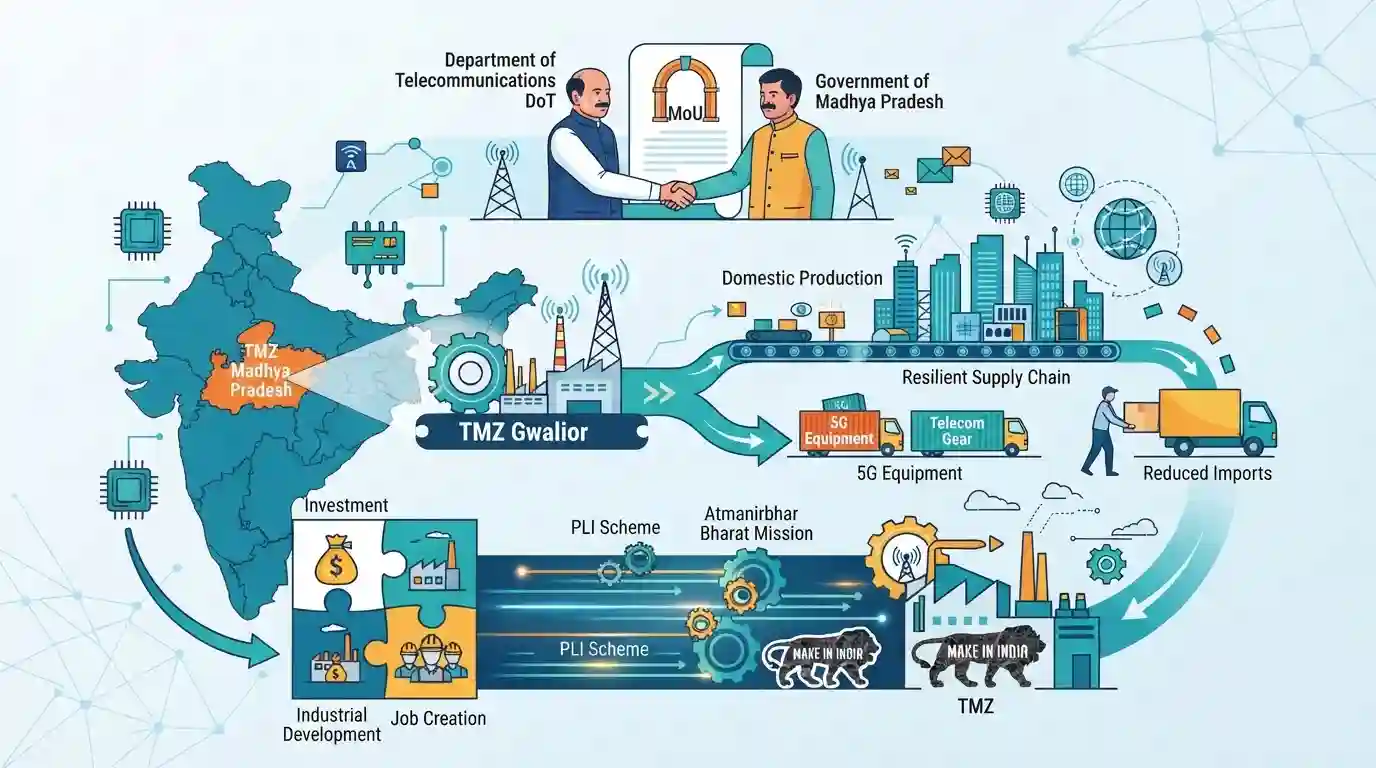
Developing domestic telecom manufacturing capabilities is critical for India's strategic autonomy, data security, and economic growth. The establishment of a dedicated manufacturing zone demonstrates actionable steps under industrial policies like the PLI scheme and highlights how Centre-State synergy can drive localized industrialization and high-tech manufacturing.
সারসংক্ষেপ
The Department of Telecommunications (DoT) has signed a Memorandum of Understanding (MoU) with the Government of Madhya Pradesh to establish a Telecom Manufacturing Zone (TMZ) in Gwalior. This initiative aims to foster the domestic production of telecom equipment, build a resilient local supply chain, and reduce India's dependence on imported technology. By aligning with the 'Make in India' and 'Atmanirbhar Bharat' missions, the TMZ will complement existing efforts like the Production Linked Incentive (PLI) scheme. The collaboration also highlights cooperative federalism, driving regional industrial development, investment, and job creation in central India.
মূল বিষয়
- The Department of Telecommunications (DoT) and the Government of Madhya Pradesh signed an MoU to establish a Telecom Manufacturing Zone (TMZ) in Gwalior.
- The initiative is aimed at boosting domestic production of telecom equipment, thereby reducing import dependency in a critical technology sector.
- It aligns with the broader national goals of 'Atmanirbhar Bharat' and 'Make in India' by creating a robust local supply chain.
- The project serves as a model of cooperative federalism, with the Centre and State collaborating to provide policy support, land, and infrastructure.
- The TMZ is expected to attract significant investments (including from PLI beneficiaries), promote technological advancement in telecom infrastructure, and generate regional employment.
গুরুত্বপূর্ণ শব্দ
Production Linked Incentive (PLI) Scheme

A flagship Government of India scheme launched in 2020 offering financial incentives of 4% to 6% on incremental sales to boost domestic manufacturing, attract investments, and enhance export competitiveness across 14 key sectors.
UPSC context
GS Paper III (Indian Economy); tests knowledge of manufacturing-led growth strategies, import substitution, and industrial policies.
Telecom Manufacturing Zone (TMZ)
India's first dedicated 350-acre industrial cluster, established in Gwalior in 2026, featuring a plug-and-play ecosystem designed to aggregate the entire telecom value chain, from R&D and testing to high-tech manufacturing.
UPSC context
GS Paper III (Infrastructure & Tech); tests knowledge of sector-specific industrial clusters, regional development, and telecom-led manufacturing.
Atmanirbhar Bharat
A national campaign launched in 2020 focused on making India self-reliant through economic stimulus and structural reforms across five core pillars: economy, infrastructure, systems, demography, and demand.
UPSC context
GS Paper III (Economy); tests macroeconomic strategies for economic sovereignty, domestic industrial development, and supply-chain resilience.
Make in India
A major national initiative launched in 2014 designed to facilitate investment, foster innovation, build best-in-class manufacturing infrastructure, and transform India into a premier global design and manufacturing hub.
UPSC context
GS Paper III (Industrial Policy); tests understanding of programs targeting foreign direct investment and growing the secondary sector.
Department of Telecommunications (DoT)
An executive department under the Ministry of Communications responsible for formulating developmental policies, licensing, and regulating telecommunications services while promoting domestic R&D and private investments in digital infrastructure.
UPSC context
GS Paper II (Governance); tests understanding of regulatory bodies, digital infrastructure planning, and executive policymaking.
Cooperative Federalism
A constitutional governance concept where the Union and State governments work collaboratively to resolve common development bottlenecks, coordinate policies, and execute joint welfare and industrial initiatives.
UPSC context
GS Paper II (Polity & Constitution); tests federal relations, center-state partnerships, and decentralized governance frameworks.
প্রিলিমস ফাঁদ
The Union Government holds the majority stake in the SPV executing India’s first Telecom Manufacturing Zone.
The Madhya Pradesh Government actually holds 51% equity, while the Union DoT holds 49%, despite the Centre providing the initial grant-in-aid.
সংযুক্ত স্থির ধারণা
What is a Special Purpose Vehicle (SPV) in infrastructure projects?
- Distinct legal entity: Created as a distinct legal entity to isolate financial risk, ensuring that liabilities do not transfer to parent organizations.
- Ring-fenced assets: Guarantees that project-specific funding, like Union grants, is exclusively utilized for the designated infrastructure.
What are the core national objectives regarding domestic telecom manufacturing?
- Import substitution: Aims to reduce heavy reliance on imported hardware, safeguarding India's critical communication networks from external disruptions.
- Security compliance: Mandates 'trusted sources' to secure networks against backdoors, spyware, and physical chain tampering.
আন্তঃবিষয় প্যাটার্ন
Telecom hardware and cyber sovereignty
Localizing manufacturing satisfies India's 'trusted source' mandate, preventing hardware-level backdoors in critical national communication networks.
Fiscal federalism via SPV structures
The asymmetric equity model (51% State, 49% Union) redefines cooperative federalism, leveraging state-owned land assets against Union financial grants.

Cooperative federalism-led SPV models and state-level plug-and-play zones will likely feature as core solutions for GS3 manufacturing in 2026.
সংযুক্ত PYQ · 4
সংযুক্ত PYQ · 4
- 2025MainsGS3
Discuss the rationale of the Production Linked Incentive (PLI) scheme. What are its achievements? In what way can the functioning and outcomes of the scheme be improved?
- 2023MainsGS3
Faster economic growth requires increased share of the manufacturing sector in GDP, particularly of MSMEs. Comment on the present policies of the Government in this regard.
- 2023PrelimsGS1
Consider the following statements: Statement-I: India accounts for 3.2% of global export of goods. Statement-II: Many local companies and some foreign companies operating in India have taken advantage of India's 'Production-linked Incentive' scheme. Which one of the following is correct in respect of the above statements?
- 2024MainsGS2
What changes has the Union Government recently introduced in the domain of Centre-State relations ? Suggest measures to be adopted to build the trust between the Centre and the States and for strengthening federalism.
