Educational Empowerment Schemes and Scholarships for OBC Students
Source:PIB ↗
Why It Matters
Understanding these schemes is critical for GS2 answers dealing with social justice, affirmative action, and the mechanisms (like DBT and DACE) the state uses to bridge historical educational and employment gaps for marginalized communities.
Summary
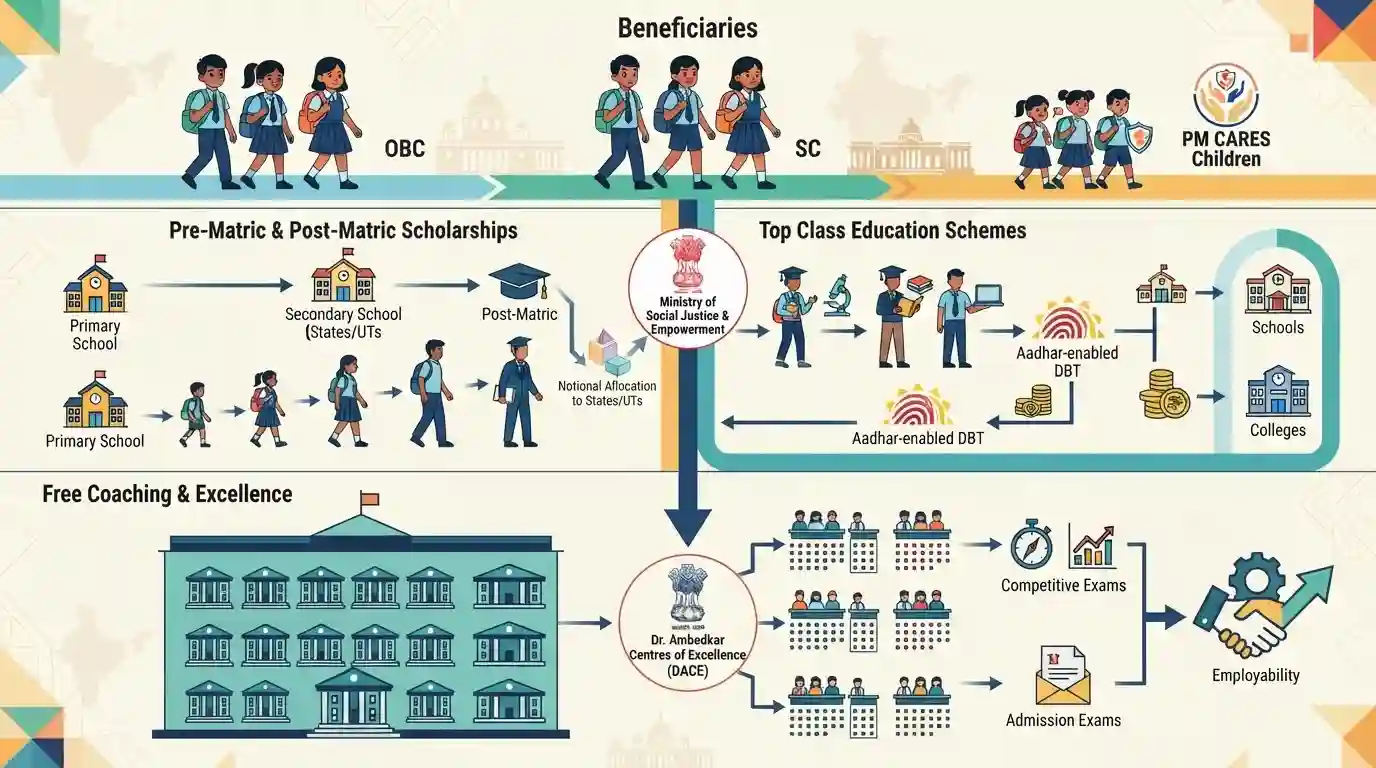
The Government of India, through the Ministry of Social Justice and Empowerment, is implementing several educational empowerment schemes for OBCs, SCs, and beneficiaries of the PM CARES Children Scheme. Key initiatives include Pre-Matric and Post-Matric Scholarships (funded via notional allocation to States/UTs) and Top Class Education Schemes for Schools and Colleges (disbursed via Aadhaar-enabled Direct Benefit Transfer). To improve employability and higher education prospects, the Central Sector Scheme of Free Coaching operates through Dr. Ambedkar Centres of Excellence (DACE) in 19 Central Universities, offering 100 dedicated seats per university to help marginalized students crack competitive and admission exams.
Key Points
- The Department of Social Justice and Empowerment operates multiple educational initiatives targeting OBCs, SCs, and PM CARES Children to bridge educational disparities.
- Pre-Matric and Post-Matric Scholarship schemes allocate funds notionally to States and UTs to assist eligible beneficiaries.
- Top Class Education schemes for schools and colleges employ Aadhaar-enabled Direct Benefit Transfer (DBT) to provide financial assistance directly to students.
- The Central Sector Scheme of Free Coaching is implemented via Dr. Ambedkar Centres of Excellence (DACE) established in 19 Central Universities.
- Each empanelled Central University under DACE offers 100 coaching seats to help students prepare for recruitment exams and admissions into professional or technical institutions.
Important Terms
Pre-Matric Scholarship Scheme for OBCs & Others

A centrally sponsored scheme providing financial assistance to disadvantaged OBC students in classes 9 and 10 to minimize dropouts. Funds are routed to States/UTs via notional allocation, aiming to improve secondary school retention.
UPSC context
Relevant for GS Paper 2 (Social Justice/Welfare Schemes), highlighting early-stage educational interventions for vulnerable communities.
Post-Matric Scholarship Scheme for OBCs & Others
A centrally supported initiative helping socially and educationally backward students pursue post-secondary education (Class 11 to post-graduation). It covers tuition, hostel fees, and maintenance allowances to promote higher education access.
UPSC context
Vital for GS Paper 2 (Welfare Schemes), demonstrating state-led affirmative action to reduce educational disparities in higher studies.
Top Class Education Scheme in Colleges for OBCs & Others
An educational empowerment scheme offering full financial assistance directly (via DBT) to meritorious OBC students enrolled in premier higher education institutes like IITs and IIMs, covering tuition and living expenses.
UPSC context
Essential for GS Paper 2 (Vulnerable Sections), highlighting government efforts to ensure equity and excellence in elite institutions.
Central Sector Scheme of Free Coaching for SCs, OBCs and PM CARES Children
Implemented through Dr. Ambedkar Centres of Excellence, this scheme provides free, high-quality coaching and stipends to marginalized youth aiming for competitive recruitment and technical admission exams like the UPSC.
UPSC context
Maps to GS Paper 2 (Social Empowerment), illustrating capacity-building measures designed to boost public sector representation for disadvantaged groups.
Ministry of Social Justice & Empowerment
The nodal Union ministry responsible for ensuring the welfare, social justice, and educational empowerment of disadvantaged and marginalized populations, including Scheduled Castes, Other Backward Classes, Transgender individuals, and Persons with Disabilities.
UPSC context
Foundational for GS Paper 2 (Governance), as knowing its mandate is key to analyzing India’s socio-economic welfare and statutory frameworks.
Prelims Trap
All SC and OBC students falling within the income criteria are eligible for the Central Sector Scheme of Free Coaching.
SC and OBC candidates belonging to minority communities are explicitly excluded from this MSJE scheme and must apply to the Ministry of Minority Affairs.
Static Concepts Connected
What is the structural difference between Central Sector and Centrally Sponsored Schemes?
- Funding pattern: Central Sector schemes are 100% funded by the Union; Centrally Sponsored schemes share costs between Centre and States (e.g., 60:40).
- Implementation agency: Central Sector schemes are implemented directly by Central ministries; Centrally Sponsored schemes are executed through State/UT machineries.
- Syllabus domain: Central Sector usually targets Union List subjects; Centrally Sponsored targets State or Concurrent List subjects to drive national priorities.
Which constitutional provisions govern the educational advancement of OBCs and SCs?
- Articles 15(4) & 15(5): Allows the State to make special provisions, including reservation in educational institutions, for socially and educationally backward classes.
- Article 338B: Establishes the National Commission for Backward Classes (NCBC) with constitutional status to safeguard OBC interests.
- Article 340: Empowers the President to appoint a commission to investigate the conditions of socially and educationally backward classes.
Cross-Topic Patterns
DBT architecture in social welfare
Direct transfers to students' bank accounts bypass institutional intermediaries, relying heavily on Jan Dhan-Aadhaar-Mobile (JAM) infrastructure but exposing vulnerabilities in rural digital connectivity.
Cooperative federalism in welfare delivery
Split-funding models in Pre/Post-Matric scholarships require matching state resources, meaning state fiscal health directly impacts timely scholarship disbursements to marginalized students.

Distinction between Central Sector and Centrally Sponsored schemes in social justice DBT payouts likely to feature in Prelims 2026.
Linked PYQs · 2
Linked PYQs · 2
- 2019MainsGS2
Performance of welfare schemes that are implemented for vulnerable sections is not so effective due to absence of their awareness and active involvement at all stages of policy process. Discuss.
- 2023MainsGS2
“Development and welfare schemes for the vulnerable, by its nature, are discriminatory in approach.” Do you agree? Give reasons for your answer.
