Indigenous Diving Support Vessel Nipun and Defence Indigenisation
Source:PIB ↗
Why It Matters
This development is crucial for understanding India's progress in defense indigenisation and its strategic capacity for complex naval operations like deep-sea submarine rescue, which directly bolsters maritime security and operational readiness.
Summary
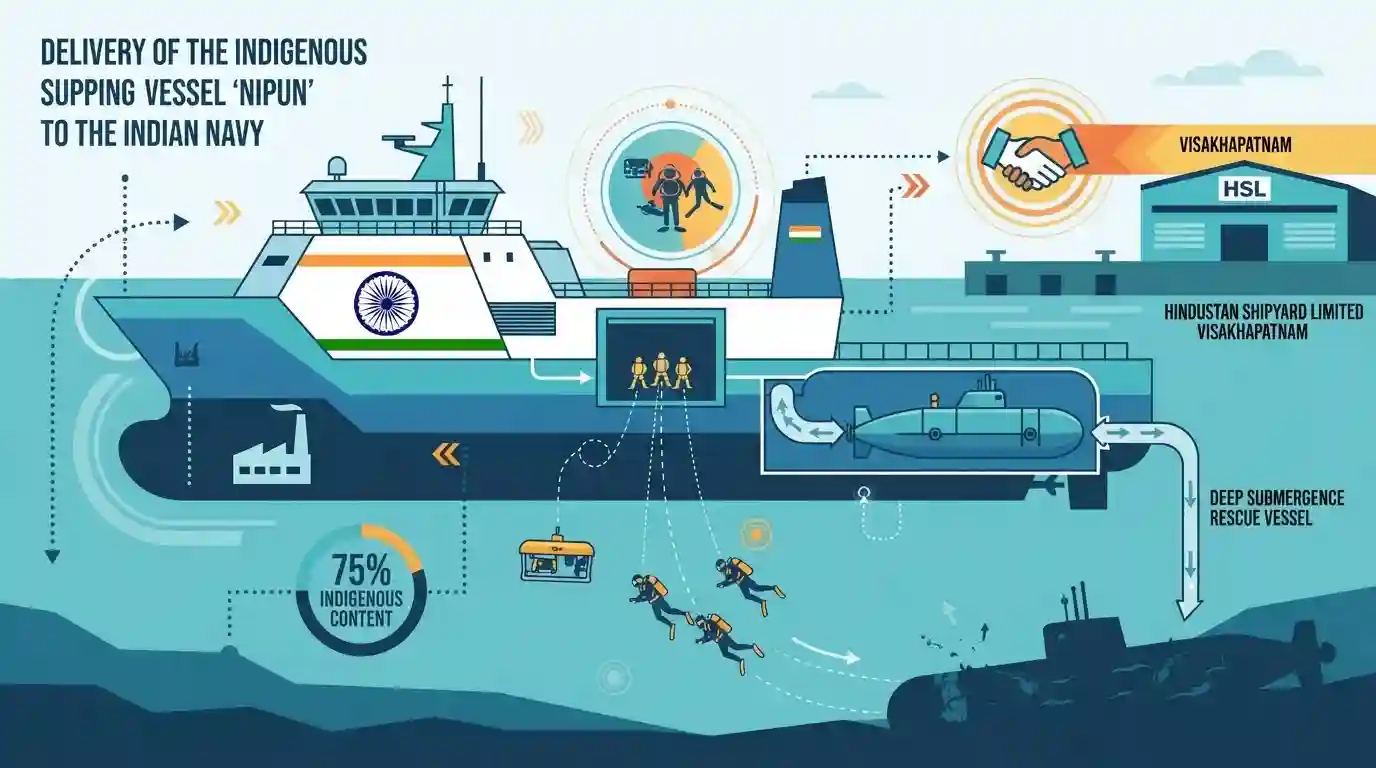
The Indian Navy has successfully received 'Nipun', the second Indigenous Diving Support Vessel (DSV), from Hindustan Shipyard Limited (HSL) at Visakhapatnam. The vessel, boasting nearly 75% indigenous content in line with 'Aatmanirbhar Bharat', is designed to support deep-sea dive operations and enhance maritime rescue capabilities. It features advanced Deep Sea Saturation Diving systems and Remotely Operated Vehicles (ROVs). Crucially, Nipun will function as a Mother Ship for the Deep Submergence Rescue Vessel (DSRV), enabling the swift evacuation of personnel in the event of a submarine emergency.
Key Points
- The Indian Navy received 'Nipun', its second indigenous Diving Support Vessel (DSV), built by Hindustan Shipyard Limited (HSL) in Visakhapatnam.
- The vessel is equipped with Deep Sea Saturation Diving capability and Remotely Operated Vehicles (ROVs) to conduct deep-sea dive and rescue operations.
- Nipun will serve as the Mother Ship for the Deep Submergence Rescue Vessel (DSRV), vital for evacuating personnel during submarine emergencies.
- With nearly 75% indigenous content, the vessel significantly advances India's 'Aatmanirbhar Bharat' (self-reliance) goals in defense shipbuilding.
Important Terms
Nipun (Diving Support Vessel)

The Indian Navy's second indigenously built Diving Support Vessel by Hindustan Shipyard Limited. It features deep-sea saturation diving systems, Remotely Operated Vehicles, and supports deep-submergence submarine rescue missions.
UPSC context
Highly relevant for GS Paper 3 (Defence Technology) and Prelims for testing naval asset modernization.
Deep Submergence Rescue Vessel (DSRV)
A specialized underwater vehicle used by the Indian Navy to rescue personnel from distressed submarines at depths up to 650 meters. It can be rapidly mobilized to underwater disaster sites.
UPSC context
Crucial for GS Paper 3 (Security). Highlights India's advanced maritime rescue capabilities and underwater disaster response.
Hindustan Shipyard Limited (HSL)
A major Ministry of Defence public sector shipyard located in Visakhapatnam. It plays a crucial role in India's strategic defense by building naval assets like diving support vessels and submarines.
UPSC context
Relevant for GS Paper 3 (Indigenisation of Technology). Highlights key defense public sector undertakings supporting Aatmanirbhar Bharat.
Deep-Sea Saturation Diving
A specialized diving technique allowing divers to remain in high-pressure deep-sea environments for extended periods without risking decompression sickness. It is critical for complex underwater salvage and maintenance missions.
UPSC context
Important for GS Paper 3 (Science & Technology). Tests awareness of specialized maritime and oceanographic operational techniques.
Indian Register of Shipping (IRS)
An internationally recognized, non-profit Indian ship classification society established in 1975. It provides survey, inspection, and certification services to ensure the safety and seaworthiness of maritime assets.
UPSC context
Relevant for Prelims and GS Paper 3 (Maritime Infrastructure), testing knowledge of maritime regulatory and classification bodies.
Remotely Operated Vehicles (ROVs)
Unmanned, highly maneuverable underwater robotic machines operated from the surface. The Navy uses them for deep-sea salvage missions, underwater inspections, and monitoring divers in hazardous ocean environments.
UPSC context
Relevant for GS Paper 3 (Science & Technology - Robotics). Tests understanding of modern autonomous underwater defence technologies.
Prelims Trap
INS Nipun is India's first indigenous Deep Submergence Rescue Vessel (DSRV).
INS Nipun is the second Diving Support Vessel (DSV) and acts as a 'Mother Ship', not the DSRV itself. The first DSV is INS Nistar.
Static Concepts Connected
What is Saturation Diving and why is it critical for deep-sea operations?
- Mechanism: Divers live in a pressurized environment matching depth pressure, completely saturating their body tissues with inert breathing gas.
- Primary Advantage: It reduces the risk of decompression sickness (the bends) by eliminating the need for daily, dangerous decompression cycles after deep dives.
- Strategic Application: Enables prolonged, continuous underwater presence for submarine rescue, intricate seabed salvage, and complex underwater repairs.
How does India operationalize its role as a 'Net Security Provider' in the IOR?
- First Responder: Deploying rapid HADR (Humanitarian Assistance and Disaster Relief) and specialized rescue assets, such as DSRVs, during regional crises (e.g., assisting Indonesia in 2021).
- Capacity Building: Providing equipment, training, and strategic platforms to littoral states to enhance collective maritime security.
- Maritime Domain Awareness: Hosting the IFC-IOR to share real-time merchant shipping data, tackling piracy, IUU fishing, and securing sea lanes.
Cross-Topic Patterns
DSVs and the Deep Ocean Mission
The deep-sea saturation diving and ROV capabilities developed for these naval vessels directly overlap with India's Samudrayaan project and deep-sea polymetallic nodule exploration under the Blue Economy.
Submarine Rescue as Defence Diplomacy
Offering specialized DSRV capabilities to neighboring navies elevates India's strategic stature, operationalizing the SAGAR doctrine and countering extra-regional naval presence in the Indian Ocean Region.

Expect a multi-statement Prelims question mixing DSV/DSRV technical features, Project Samudrayaan, and India's 'Net Security Provider' role.
Linked PYQs · 2
Linked PYQs · 2
- 2026PrelimsGS1
Which of the following items of defence hardware is/are manufactured in India ? 1. Su-30 MKI Fighter Jets 2. T-90 MK-III Tanks 3. Akula Class Submarine Select the answer using the code given below :
- 2022MainsGS3
What are the maritime security challenges in India ? Discuss the organisational, technical and procedural initiatives taken to improve the maritime security.
