Maritime Infrastructure Capacity Expansion and Viksit Bharat Roadmap
Source:PIB ↗
ఇది ఎందుకు ముఖ్యం
The maritime sector handles approximately 95% of India's external trade by volume. Port modernization, capacity expansion, and self-reliance in shipbuilding are essential prerequisites for reducing logistics costs and realizing the 'Viksit Bharat 2047' vision. For UPSC aspirants, understanding the shift towards PPP models, the development of deep-water ports (like Vadhavan), and the revitalization of inland waterways provides crucial context for questions on economic infrastructure and port-led development.
సారాంశం
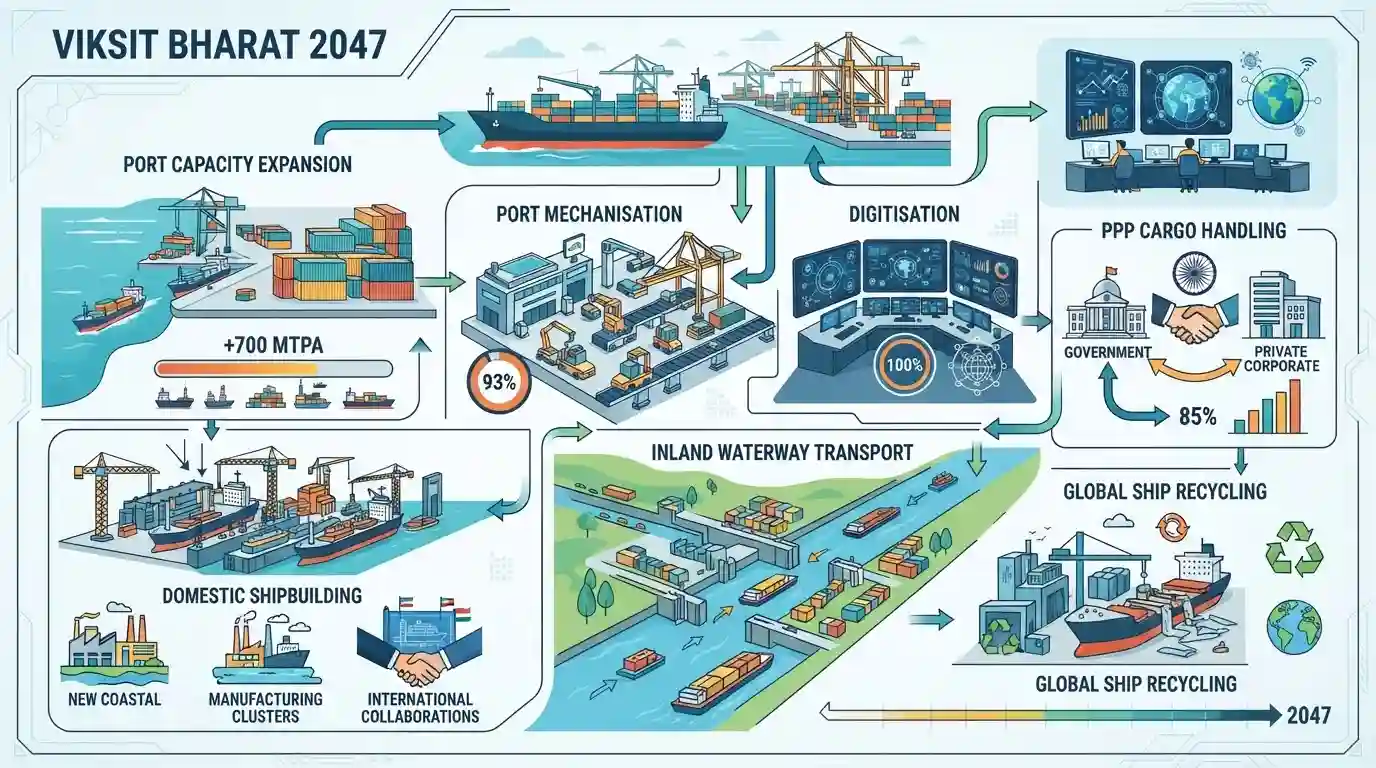
The Ministry of Ports, Shipping and Waterways is aggressively executing its 'Viksit Bharat 2047' roadmap by ramping up maritime infrastructure, shipbuilding, and inland water transport. Key targets for 2030 include adding 700 MTPA of port capacity, achieving 93% port mechanisation, transitioning to 100% digitisation, and increasing PPP cargo handling to 85%. Simultaneously, India is expanding its domestic shipbuilding capabilities through new coastal manufacturing clusters and international collaborations, while also achieving record milestones in inland waterway cargo transport and global ship recycling.
ముఖ్య అంశాలు
- The government aims to expand port capacity by an additional 700 MTPA by 2030, driven by mega projects like Vadhavan Port, Tuticorin Outer Harbour, and Kandla Tuna Tekra Terminal.
- Major ports are targeting 93% mechanisation and 100% digitisation by 2030, with PPP models expected to handle 85% of cargo.
- To boost domestic manufacturing under 'Make in India', greenfield shipbuilding clusters have received in-principle approvals across five coastal states, aided by a tripartite MoU with South Korea's HD Hyundai-KSOE.
- Cargo movement across India's inland waterways crossed the milestone of 200 million tonnes, underscoring the success of the Maritime India Vision 2030.
- India has strengthened its position globally, recording a 41% surge in shipbuilding output and retaining its status as the world's largest ship recycling nation.
ముఖ్యమైన పదాలు
Viksit Bharat 2047

India's ambitious government roadmap to become a fully developed nation by its 100th year of independence (2047), emphasizing massive infrastructure scaling, private investment, and global manufacturing competitiveness.
UPSC context
GS Paper III (Growth & Development). Tests knowledge of India's macroeconomic targets and long-term infrastructure vision.
Maritime India Vision 2030
A blueprint for India's maritime sector setting ambitious targets, including adding 700 MTPA port capacity, reaching 93% cargo mechanisation, and driving massive inland waterway transport growth by 2030.
UPSC context
GS Paper III (Infrastructure: Ports). Evaluates awareness of specific governmental targets for maritime and logistics capacity building.
Public-Private Partnership (PPP)
A collaborative investment model involving government and private entities to build and run public infrastructure. India's maritime roadmap aims to increase the share of PPP cargo handling at ports to 85% by 2030.
UPSC context
GS Paper III (Investment Models). Tests understanding of how private capital drives operational efficiency in state infrastructure.
HD Hyundai-KSOE
South Korea’s shipbuilding giant (Korea Shipbuilding & Offshore Engineering) collaborating with the Indian government through an MoU to develop major greenfield shipbuilding clusters in states like Tamil Nadu.
UPSC context
GS Paper III (Industrial Policy). Relevant for questions on foreign direct investment, technology transfer, and heavy manufacturing clusters.
ప్రిలిమ్స్ ఉచ్చు
Under the Landlord Port Model, the public port authority retains complete ownership of both the land and all cargo handling equipment.
In a Landlord Port, the port authority owns only the land and regulatory rights, while private concessionaires lease, install, and operate the cargo-handling infrastructure.
అనుసంధానమైన స్థిర భావనలు
What are the key port management models under public-private partnerships?
- Landlord model: Port authority owns land and acts as regulator; private operators lease terminals and manage cargo operations.
- Tool model: Port authority owns land and superstructure/equipment, but leases operations to private entities.
- Service model: Port authority owns all assets and performs all regulatory and operational functions directly.
What is the Hong Kong Convention (HKC) for ship recycling?
- Governance: Adopted under the International Maritime Organization (IMO) to ensure safe, green ship dismantling.
- Mandates: Ships must maintain an Inventory of Hazardous Materials (IHM); recycling yards must secure formal authorization.
- India's status: India acceded in 2019 and passed the Recycling of Ships Act to operationalize its targets.
అంతర-అంశ నమూనాలు
Blue Economy + Indo-Pacific Security
Deep-draft transshipment hubs like Galathea Bay secure strategic choke points, reducing dependency on foreign transshipment hubs while projecting maritime presence in the Six Degree Channel.
Inland Waterways + Climate Adaptation
Shifting cargo to inland waterways reduces transportation emissions by up to 80% compared to road transport, supporting India's National Action Plan on Climate Change.

Expect a GS-3 question linking Vadhavan's Landlord model and Galathea Bay's proximity to key Indo-Pacific sea lanes.
అనుసంధాన PYQలు · 4
అనుసంధాన PYQలు · 4
- 2026PrelimsGS1
Consider the following statements with reference to the Sagarmala Programme of the Government of India : I. The Sagarmala Programme seeks to achieve port-led economic growth through cost-effective and sustainable coastal infrastructure. II. The success of the Sagarmala Programme is reflected in significant growth in coastal and inland waterway shipping, along with improved global port rankings. III. Sagarmala 2.0 aims to position India as a global maritime innovation hub aligned with Atmanirbhar Bharat and Viksit Bharat 2047 visions. Which of the following relationships among the above statements is/are correct ? 1. Statement II validates the effectiveness of the strategies envisioned in statement I. 2. Statement III extends the objectives of statement I by embedding them into a future-oriented innovation framework. 3. Statement I contradicts statement III by focusing only on traditional infrastructure instead of modern innovation. Select the answer using the code given below :
- 2023PrelimsGS1
Consider the following pairs: Port Well known as 1. Kamarajar Port: First major port in India registered as a company 2. Mundra Port: Largest privately owned port in India 3. Visakhapatnam Port: Largest container port in India How many of the above pairs are correctly matched?
- 2022MainsGS3
Why is Public Private Partnership (PPP) required in infrastructural projects ? Examine the role of PPP model in the redevelopment of Railway Stations in India.
- 2026PrelimsGS1
In what way(s) does the Vizhinjam International Seaport represent a structural shift in India's maritime trade and logistics policy? 1. By functioning exclusively as a domestic cargo hub to reduce reliance on coastal shipping and eliminate the need for foreign collaborations. 2. By focusing primarily on passenger cruise tourism and heritage shipping to increase Kerala's profile as a maritime heritage destination. 3. By leveraging its natural deep draft and strategic location to reduce dependence on foreign trans-shipment ports, enhance revenue retention, and reposition India in regional maritime trade. Select the answer using the code given below :
