Mahanadi Water Dispute Settlement and Cooperative Federalism
Source:PIB ↗
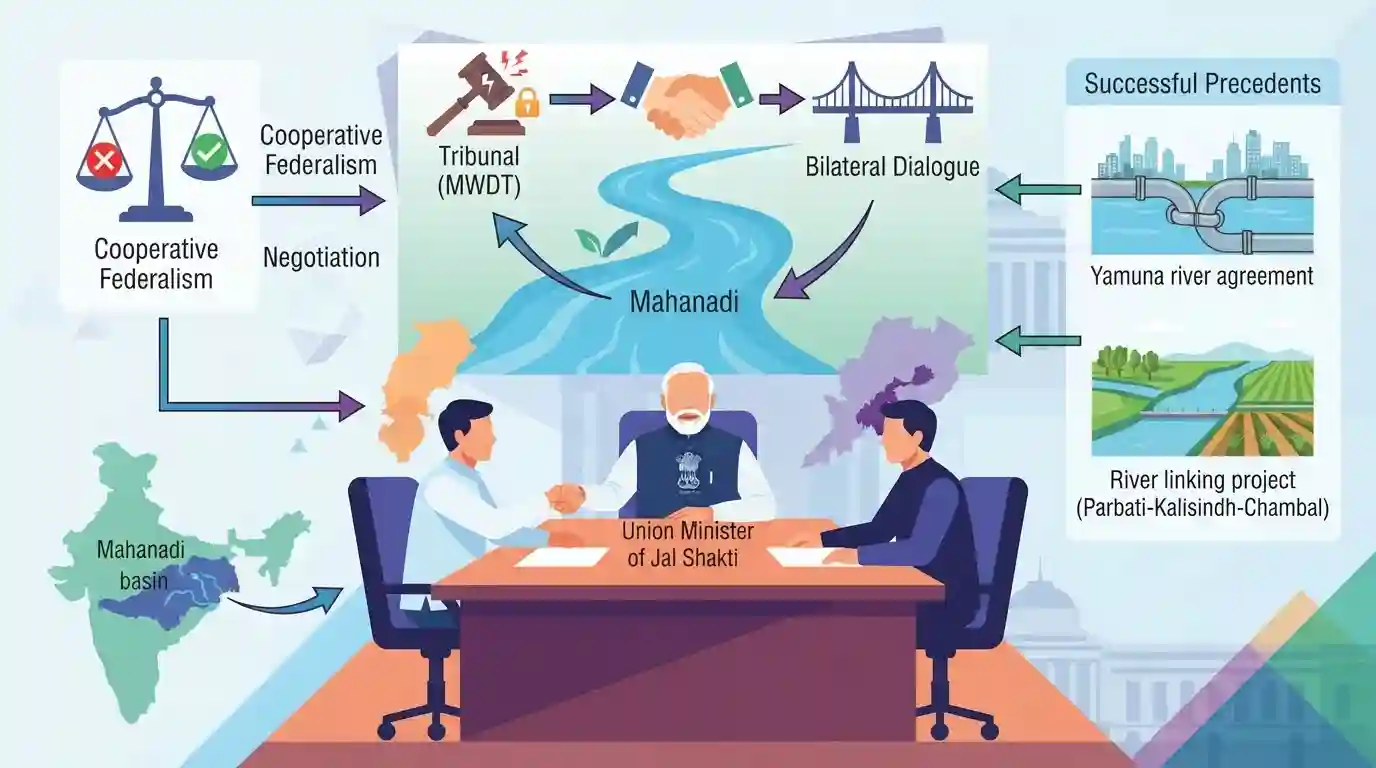
Why It Matters
This highlights the practical challenges of resolving inter-state river water disputes under Article 262 and the ISRWD Act, 1956. It underscores the importance of cooperative federalism and political dialogue as effective alternatives to the often delayed and protracted tribunal processes for resource sharing.
Summary
The Union Minister of Jal Shakti, Shri C. R. Paatil, hosted a high-level meeting with the Chief Ministers of Chhattisgarh and Odisha to seek an amicable, out-of-tribunal settlement for the Mahanadi water sharing dispute. Emphasizing the principles of cooperative federalism, the meeting explored resolving the long-standing conflict through bilateral dialogue rather than relying solely on the Mahanadi Water Disputes Tribunal (MWDT), which was constituted in 2018 under the Inter-State River Water Disputes Act, 1956. By drawing parallels to recent successful negotiations like the Yamuna water project agreement and the Modified Parbati–Kalisindh–Chambal Link Project, the central government aims to expedite conflict resolution and ensure optimal utilization of the Mahanadi basin's water resources for both states.
Key Points
- The Union Minister of Jal Shakti chaired a meeting with the Chief Ministers of Chhattisgarh and Odisha to foster an amicable resolution to the ongoing Mahanadi Water Dispute.
- The Mahanadi Water Disputes Tribunal (MWDT) was established on March 12, 2018, under the Inter-State River Water Disputes Act, 1956, following a formal request by the state of Odisha.
- The dialogue aims to leverage cooperative federalism to bypass prolonged legal proceedings and find a mutually beneficial solution for water sharing.
- Previous successful out-of-court resolutions, such as the agreements on the Yamuna water project and the Modified Parbati-Kalisindh-Chambal (MPKC) Link Project, were cited as models.
Prelims Trap
The Supreme Court has original jurisdiction under Article 131 to directly adjudicate and settle inter-state river water sharing disputes.
Article 262 empowers Parliament to exclude Supreme Court jurisdiction. Under the 1956 Act, tribunals—not the Supreme Court—have exclusive adjudicatory jurisdiction.
Static Concepts Connected
What is the constitutional framework governing inter-state water disputes in India?
- Article 262: Empowers Parliament to legislate on the adjudication of disputes relating to inter-state waters and to exclude the jurisdiction of all courts.
- Seventh Schedule Split: Places water under State List Entry 17, but subjects it to Union List Entry 56 for regulation and development of inter-state rivers.
- 1956 Legislation Act: Enables the creation of ad-hoc tribunals for dispute resolution, explicitly barring the jurisdiction of the Supreme Court over these disputes.
What are the key geographical features of the Mahanadi River basin?
- Origin and Course: Originates near Sihawa in Chhattisgarh, flowing eastwards through Odisha to drain into the Bay of Bengal.
- Basin Coverage: Extends over five states: Chhattisgarh, Odisha, Madhya Pradesh, Jharkhand, and Maharashtra.
- Tributary System: Left-bank tributaries include Seonath, Hasdeo, Mand, and Ib; right-bank tributaries include Jonk, Ong, and Tel.
Cross-Topic Patterns
Cooperative Federalism vs Tribunal Adjudication
Shifting from rigid tribunals to executive-led bilateral mediation reflects a pragmatic evolution in solving inter-state river disputes through consensual political negotiation.
Inter-basin Transfers and Federal Disputes
Inter-state river linking initiatives like the MPKC project highlight how GS3 environmental engineering depends heavily on resolving complex GS2 federal water sharing arrangements.

Constitutional limits of Article 262 vs Article 131, combined with Mahanadi tributary mapping, is prime material for a hybrid 2026 question.
Linked PYQs · 3
Linked PYQs · 3
- 2015MainsGS2
The concept of cooperative federalism has been increasingly emphasized in recent years. Highlight the drawbacks in the existing structure and the extent to which cooperative federalism would answer the shortcomings.
- 2025PrelimsGS1
With reference to ancient India (600-322 BC), consider the following pairs: Territorial region River flowing in the region I. Asmaka : Godavari II. Kamboja : Vipas III. Avanti : Mahanadi IV. Kosala : Sarayu How many of the pairs given above are correctly matched?
- 2012MainsGS2
The situation today is far different to that prevalent fifty years back when the Indus Water Treaty was signed." Highlight the complexity of the current challenges on both sides of the border in this regard. Do you think that a review of the Treaty is in India's best interests?
