Ethanol Blended Petrol Programme and Vehicle Engine Compatibility
Source:PIB ↗
ఇది ఎందుకు ముఖ్యం
The Ethanol Blended Petrol (EBP) Programme is a cornerstone of India's strategy for achieving energy security, reducing the crude oil import bill, and mitigating climate change. Understanding its technical viabilities and economic impacts helps in assessing India's transition to renewable energy sources and agricultural value addition.
సారాంశం
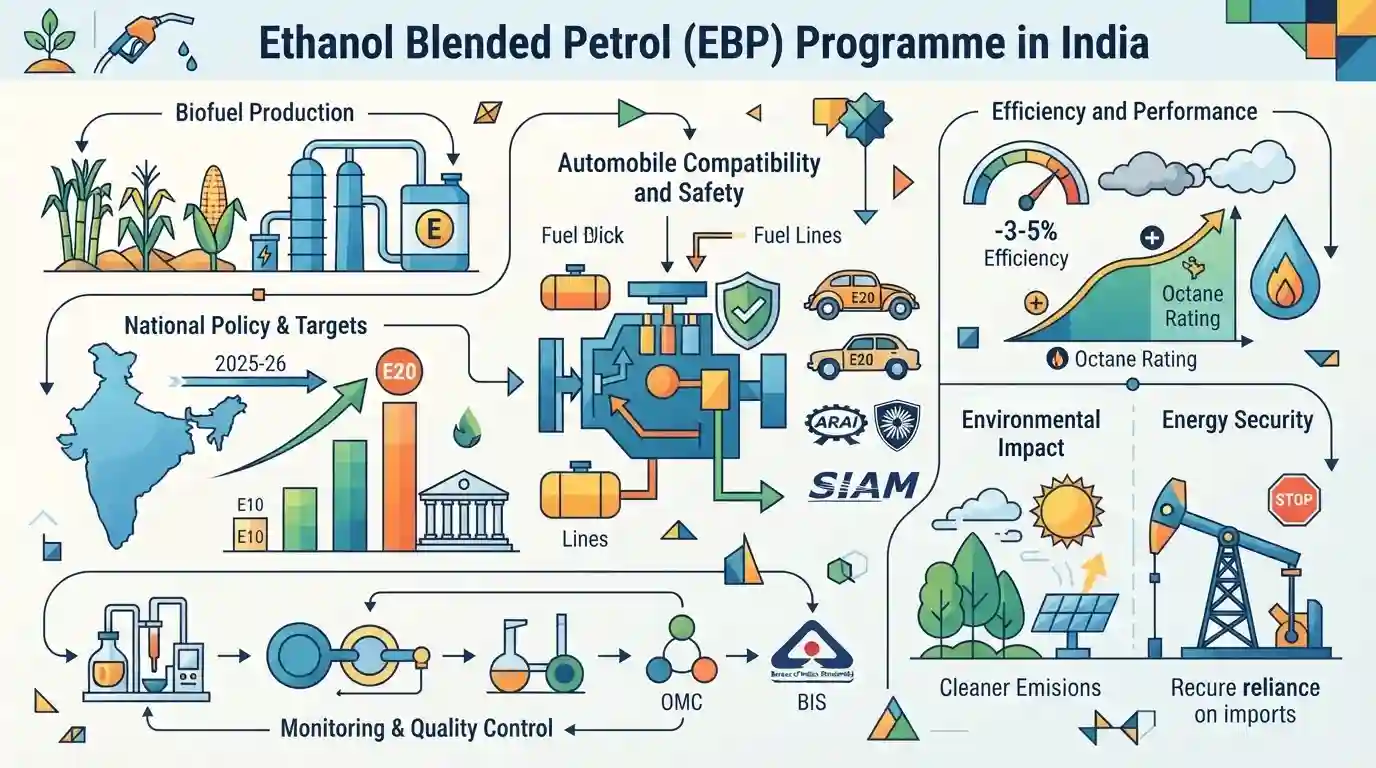
The Government of India has systematically debunked misconceptions regarding the Ethanol Blended Petrol (EBP) Programme, specifically defending the safety and efficiency of E20 fuel. Official data, backed by bodies like ARAI and SIAM as well as major automakers, confirms that E20 does not cause abnormal engine corrosion or component failure, even in older vehicles. While a minor drop in fuel efficiency (3-5%) may occur in E10-calibrated vehicles, the fuel offers significant environmental and performance benefits, including cleaner combustion and higher octane ratings. The initiative is heavily monitored by OMCs and BIS to maintain fuel purity, supporting India's march toward a 20% blending target by 2025-26.
ముఖ్య అంశాలు
- The Government of India clarified that E20 (20% ethanol-blended petrol) does not harm vehicle engines, noting that E15+ blends have been used for over 3.5 years without systemic engine failures.
- The national ethanol blending average has risen significantly, growing from roughly 1.53% in 2013-14 to a 20% target set for 2025-26 under the EBP Programme.
- Ethanol provides cleaner combustion, higher octane rating, and superior anti-knock characteristics, despite causing a marginal 3-5% drop in mileage in older vehicles designed primarily for E10 fuel.
- Leading auto manufacturers and automotive research bodies (ARAI, SIAM) affirm E20's safety, with fuel quality regulated by strict Bureau of Indian Standards (BIS) specifications and OMCs to prevent adulteration.
ప్రిలిమ్స్ ఉచ్చు
Biofuels produced in SEZs/EOUs can be exported without restrictions regardless of the origin of the feedstock.
Exports are unrestricted only when produced using imported feedstocks; utilizing domestic feedstocks remains heavily regulated to protect India's domestic blending targets.
అనుసంధానమైన స్థిర భావనలు
What are the four generations of biofuels based on their feedstocks?
- 1G Biofuels: Uses edible food crops like sugarcane, corn, and starch directly for fuel extraction.
- 2G Biofuels: Utilizes non-food biomass, agricultural waste, and ligno-cellulosic materials like rice straw or bagasse.
- 3G Biofuels: Relies on engineered micro-organisms like algae, requiring no arable land for feedstock production.
- 4G Biofuels: Combines genetically engineered feedstocks with carbon capture and storage technologies to achieve carbon-negative footprints.
How do Octane and Cetane numbers differ in engine fuels?
- Octane Rating: Measures petrol's resistance to pre-ignition or knocking; higher values allow safer, higher engine compression.
- Cetane Rating: Measures the ignition delay of diesel fuel; higher values indicate faster self-ignition under compression.
- Ethanol Blend Impact: Ethanol acts as an octane booster (RON ~108.5), improving petrol's combustion efficiency and reducing knocking.
అంతర-అంశ నమూనాలు
Biofuels vs. Food Security
Diverting starch and sugar crops for E20 targets can trigger food inflation and water distress, pitting national energy security directly against agricultural sustainability.
Automobile Trade and Technical Barriers
Tightening domestic fuel-blending mandates acts as a non-tariff barrier, forcing foreign auto-exporters to align with India-specific engine calibration standards.

UPSC is likely to test the National Policy on Biofuels targets (2025-26 amendment) alongside 1G vs 2G feedstock classifications in 2026.
అనుసంధాన PYQలు · 3
అనుసంధాన PYQలు · 3
- 2020PrelimsGS1
According to India's National Policy on Biofuels, which of the following can be used as raw materials for the production of biofuels ? 1. Cassava 2. Damaged wheat grains 3. Groundnut seeds 4. Horse gram 5. Rotten potatoes 6. Sugar beet Select the correct answer using the code given below:
- 2025PrelimsGS1
Consider the following statements : Statement I: Of the two major ethanol producers in the world, i.e., Brazil and the United States of America, the former produces more ethanol than the latter. Statement II: Unlike in the United States of America where corn is the principal feedstock for ethanol production, sugarcane is the principal feedstock for ethanol production in Brazil. Which one of the following is correct in respect of the above statements?
- 2025PrelimsGS1
Consider the following substances: I. Ethanol II. Nitroglycerine III. Urea Coal gasification technology can be used in the production of how many of them?
