Cabinet Committee on Security Review of West Asia Crisis
Source:PIB ↗
কেন এটি গুরুত্বপূর্ণ
The West Asia conflict directly threatens India's macroeconomic stability through potential oil price hikes and supply chain disruptions. Understanding the government's coordinated response via the CCS highlights India's strategic imperatives concerning diaspora safety, energy dependence, and freedom of navigation.
সারসংক্ষেপ
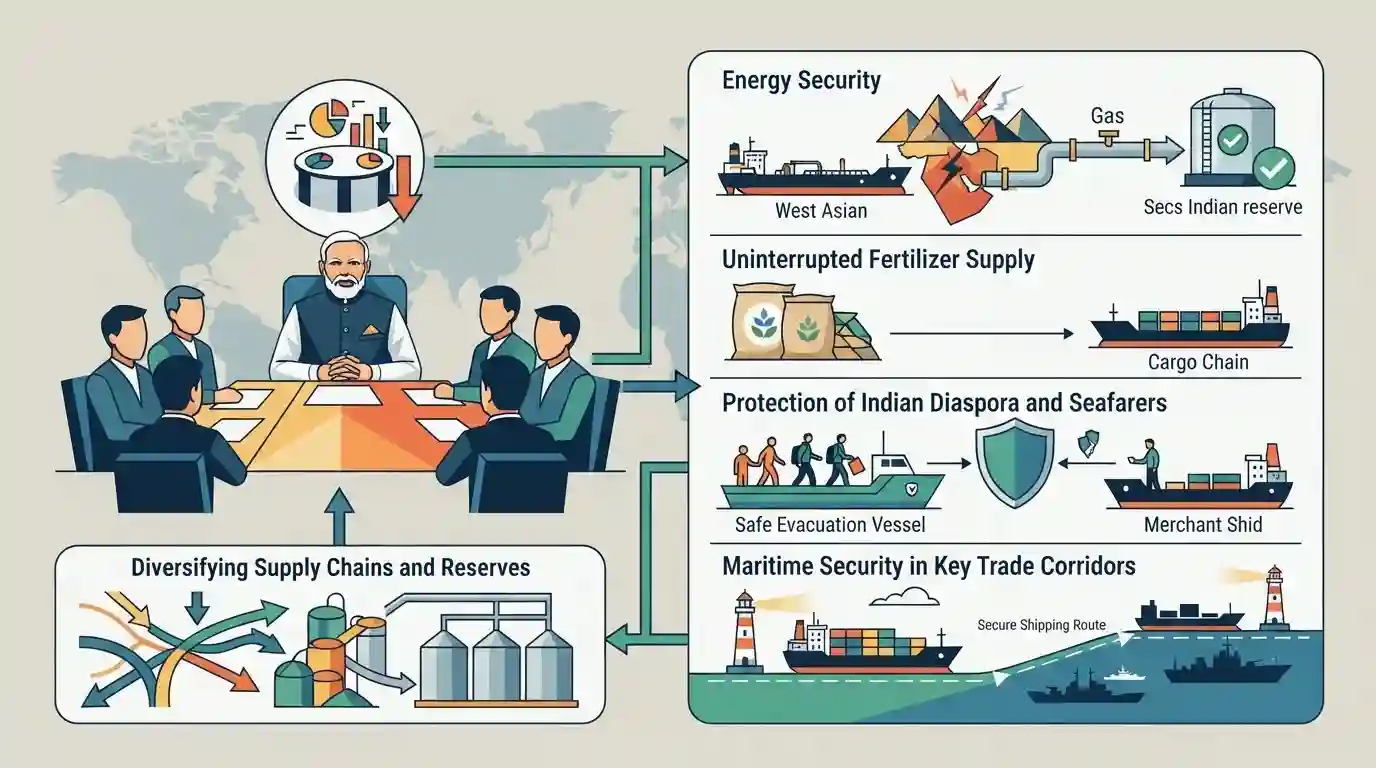
Prime Minister Narendra Modi chaired a meeting of the Cabinet Committee on Security (CCS) to assess the geopolitical, economic, and strategic implications of the ongoing conflict in West Asia. The meeting focused on critical vulnerabilities such as energy security, the uninterrupted supply of fertilizers, the protection of the Indian diaspora and seafarers, and maritime security in key trade corridors. Emphasis was placed on diversifying supply chains, maintaining robust domestic energy and agricultural reserves, and ensuring the safety of Indian interests amidst regional volatility.
মূল বিষয়
- High-level review by the Cabinet Committee on Security (CCS) chaired by the PM to assess the multi-dimensional fallout of the ongoing West Asian crisis.
- Focus on protecting India's energy security through diversification of petroleum, LPG, and LNG import sources, and mitigating potential global price shocks.
- Securing the agricultural supply chain by ensuring an uninterrupted supply of crucial fertilizers for the domestic farming sector.
- Prioritizing the safety, security, and potential evacuation readiness for the large Indian diaspora and Indian seafarers operating in high-risk zones.
- Addressing maritime security challenges in strategic choke points (like the Red Sea) to protect India's critical sea trade and shipping corridors.
গুরুত্বপূর্ণ শব্দ
Cabinet Committee on Security (CCS)

The apex executive body in India responsible for national security, defence policy, strategic foreign affairs, and defence expenditure, chaired by the Prime Minister with key senior cabinet ministers.
UPSC context
GS Paper II (Cabinet Committees) & GS Paper III (Internal Security); tests governance, defense decision-making, and constitutional structure.
Maritime Security
The safeguarding of the maritime domain—including territorial waters, Exclusive Economic Zones, and key trade corridors—against threats like piracy, ocean-borne terrorism, and geopolitical disruptions.
UPSC context
GS Paper III (Security Challenges and Border Management); tests coastal defense mechanisms, strategic trade routes, and international maritime diplomacy.
Indian Diaspora
The global community of overseas Indians, comprising Non-Resident Indians (NRIs) and Overseas Citizens of India (OCIs), crucial for remittances, soft power, and bilateral relations.
UPSC context
GS Paper II (Bilateral, Regional, and Global Groupings and Agreements); tests the economic, social, and political influence of overseas communities.
Energy Security
The continuous and reliable availability of energy sources (primarily crude oil and natural gas) at affordable and accessible prices, ensuring uninterrupted economic and industrial development.
UPSC context
GS Paper III (Infrastructure: Energy) & GS Paper II; tests resource diversification, strategic oil reserves, and external trade policies.
প্রিলিমস ফাঁদ
The National Security Advisor (NSA) is a formal member of the Cabinet Committee on Security (CCS).
The CCS consists only of the Prime Minister and the Ministers of Defence, Home, Finance, and External Affairs. The NSA is an advisor, not a cabinet member.
সংযুক্ত স্থির ধারণা
What is the composition and status of the Cabinet Committee on Security (CCS)?
- Political executive: Chaired by the Prime Minister; includes Ministers of Defence, Home Affairs, Finance, and External Affairs.
- Extra-constitutional status: Cabinet committees are established under the Rules of Business, 1961, and are not explicitly mentioned in the Constitution.
- Strategic mandate: Decides on national security, defense procurement, internal security, and foreign affairs issues.
What are the primary maritime chokepoints affecting India's trade in West Asia?
- Strait of Hormuz: Connects Persian Gulf to Gulf of Oman; crucial transit route for India's oil imports from Iraq and Saudi Arabia.
- Bab-el-Mandeb Strait: Connects Red Sea to Gulf of Aden; key gateway for India's massive trade volume with Europe.
- Suez Canal: Artificial waterway facilitating direct maritime trade between the Indian Ocean and the Mediterranean Sea.
আন্তঃবিষয় প্যাটার্ন
West Asian conflicts + Domestic inflation
Disruptions in West Asia trigger dual shocks: spiking crude oil prices and restricting supply of natural gas and chemical fertilizers, directly causing domestic food and energy inflation.
Maritime security + Net security provider
Escalating threats in the Bab-el-Mandeb force India to step up naval escort operations, reinforcing its role as a key security provider in the Western Indian Ocean.

West Asian geopolitical risk will likely be tested by linking physical maritime chokepoints with fertilizer raw material import dependencies.
সংযুক্ত PYQ · 4
সংযুক্ত PYQ · 4
- 2025MainsGS2
"Energy security constitutes the dominant kingpin of India's foreign policy, and is linked with India's overarching influence in Middle Eastern countries.” How would you integrate energy security with India's foreign policy trajectories in the coming years?
- 2017MainsGS2
The question of India's Energy Security constitutes the most important part of India's economic progress. Analyze India's energy policy cooperation with West Asian countries.
- 2025MainsGS3
Why is maritime security vital to protect India's sea trade? Discuss maritime and coastal security challenges and the way forward.
- 2022MainsGS3
What are the maritime security challenges in India ? Discuss the organisational, technical and procedural initiatives taken to improve the maritime security.
