Real Estate Regulation and Development Act Implementation Status
Source:PIB ↗
Why It Matters
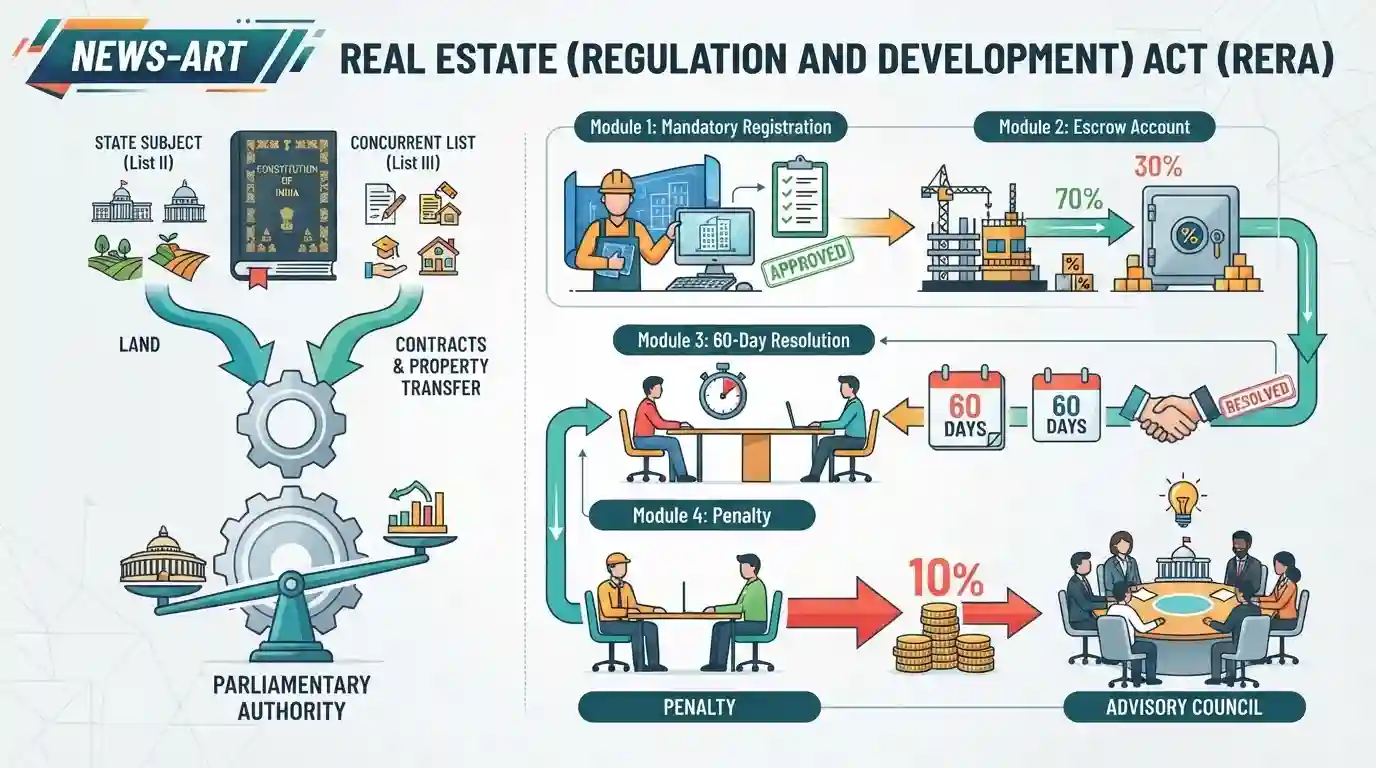
This update highlights a crucial constitutional interface: how the Parliament legislates on overlapping areas of State and Concurrent lists (Land vs. Contracts/Property Transfer). It is highly relevant for GS Paper 2 (Federalism, Division of Powers) and GS Paper 3 (Urban Development, Infrastructure and Real Estate regulation).
Summary
The Ministry of Housing and Urban Affairs updated the Lok Sabha on the ongoing implementation of the Real Estate (Regulation and Development) Act, 2016 (RERA). Although land is a State subject under the Seventh Schedule, Parliament utilized its Concurrent List powers over contracts and property transfer to legislate RERA. The Act mandates project registration, enforces a 10% penalty for violations, requires a 70% escrow account for construction funds, provides 60-day fast-track dispute resolution, and establishes a Central Advisory Council (CAC) to advise the government and protect homebuyers.
Key Points
- Constitutional Harmonization: While Land and Colonization are State subjects (Entry 18, List II), RERA was enacted using Concurrent List powers (Entries 6, 7, and 46 of List III) covering property transfer, contracts, and court jurisdictions.
- Mandatory Project Registration: Promoters must register projects before marketing or sales. Failure to do so carries a penalty of up to 10% of the estimated project cost.
- Financial Discipline: Promoters must deposit 70% of realized homebuyer funds into a separate escrow bank account, dedicated strictly to land acquisition and construction costs to prevent fund diversion.
- Fast-track Grievance Redressal: RERA mandates the disposal of disputes within 60 days. Section 40 allows recovery of unpaid penalties or compensation as arrears of land revenue.
- Central Advisory Council (CAC): Constituted under Section 41, chaired by the Minister of Housing and Urban Affairs, it advises the Central Government on safeguarding homebuyer interests and implementing the Act.
- Administrative Autonomy: MoHUA is actively engaging with states to enhance the operational, administrative, and financial autonomy of State Regulatory Authorities, including ensuring adequate staffing.
Important Terms
Real Estate (Regulation and Development) Act, 2016

A central legislation enacted to regulate the Indian real estate sector, protect homebuyers' interests, and ensure transparency, accountability, and time-bound project delivery through mandatory registration and standard disclosures.
UPSC context
GS Paper II (Government Policies) and GS Paper III (Infrastructure); tests statutory provisions, consumer protection, and federal legislative powers.
Real Estate Regulatory Authorities
State-level statutory bodies mandated by the RERA Act, 2016 to register real estate projects, host public project databases, adjudicate promoter-buyer disputes, and enforce sector compliance.
UPSC context
GS Paper II (Statutory & Regulatory Bodies); tests regulatory decentralization, alternative dispute resolution mechanisms, and housing sector oversight.
Central Advisory Council
A statutory advisory body established under Section 41 of RERA, chaired by the Union Housing Minister, to advise the Central Government on RERA implementation, consumer protection, and real estate policies.
UPSC context
GS Paper II (Government Policies & Statutory Bodies); tests multi-stakeholder policy coordination and central-state cooperation in consumer welfare.
Ministry of Housing & Urban Affairs
The nodal ministry of the Government of India responsible for formulating policies, administering programs, and coordinating legislative frameworks related to urban development, housing, and municipal affairs.
UPSC context
GS Paper II (Ministries/Departments); tests administrative structure, execution of urban governance reforms, and implementation of housing policies.
Prelims Trap
Parliament enacted RERA using its residual powers because 'Land' is explicitly listed as a State subject.
While 'Land' is indeed a State subject, Parliament did not use residual powers or override the State List. It used Concurrent List entries (Transfer of Property, Contracts) to pass RERA.
Static Concepts Connected
How did Parliament constitutionally legislate RERA if 'Land' is a State subject?
- State List Domain: 'Land' and 'Colonization' fall under Entry 18 of the State List (List II).
- Concurrent List Invocation: Parliament bypassed this limitation by invoking Entry 6 (Transfer of Property) and Entry 7 (Contracts) of the Concurrent List.
- Article 246 Application: Under Article 246, Parliament has concurrent power to make laws on these subjects, allowing RERA to regulate real estate transactions uniformly.
What are the key financial and grievance redressal mandates of RERA?
- 70% Escrow Rule: Promoters must deposit 70% of realized homebuyer funds into a separate escrow account exclusively for land and construction.
- 60-Day Redressal: Disputes must be disposed of within 60 days to ensure fast-track grievance redressal.
- Arrears Recovery: Unpaid interest, penalty, or compensation by developers can be recovered legally as 'arrears of land revenue'.
Cross-Topic Patterns
IBC vs RERA: Homebuyers as Financial Creditors
Homebuyers are recognized as financial creditors under the IBC. When a developer defaults, IBC resolution proceedings often overlap with and take precedence over RERA grievance mechanisms.
Real Estate financing and NBFC liquidity
RERA's 70% escrow requirement restricts developers from diverting funds to new land banks, increasing their reliance on NBFCs and formal credit, tying real estate health directly to shadow banking stability.

Expect a Polity question testing how Parliament uses Concurrent List entries (Contracts/Property) to regulate State subjects like Land.
Linked PYQs · 2
Linked PYQs · 2
- 2024PrelimsGS1
Which one of the following statements is correct as per the Constitution of India?
- 2019MainsGS2
From the resolution of contentious issues regarding distribution of legislative powers by the courts, 'Principle of Federal Supremacy' and 'Harmonious Construction' have emerged. Explain.
