National Common Mobility Card and Urban Public Transport Policies
Source:PIB ↗
কেন এটি গুরুত্বপূর্ণ
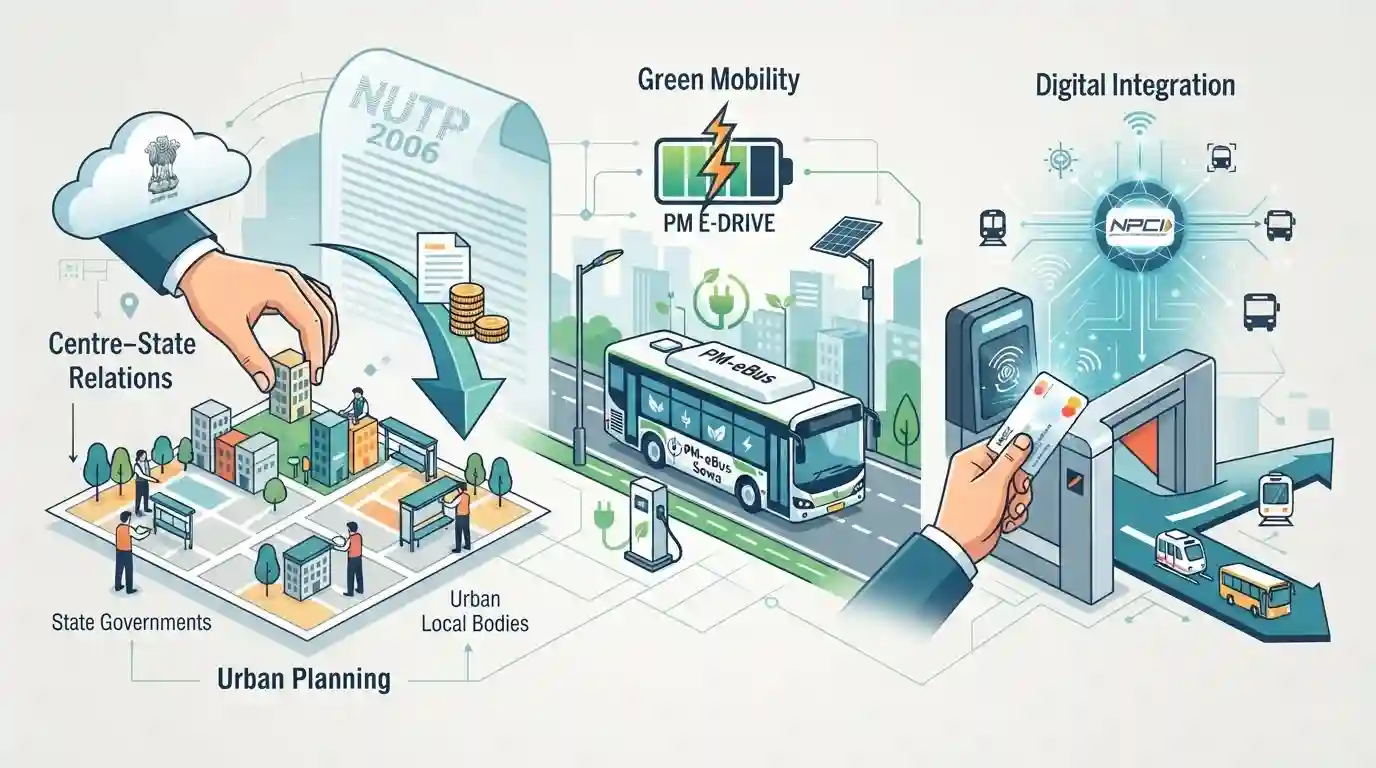
Highlights India's policy architecture for sustainable urban transit, the constitutional division of power (urban planning as a State subject), and structural initiatives (NCMC, PM-eBus Sewa) that drive the transition to modern, low-carbon public transport in lieu of a single consolidated National Mission.
সারসংক্ষেপ
The Ministry of Housing and Urban Affairs (MoHUA) has clarified that there is no overarching 'National Smart Public Transport Mission' currently proposed by the Central Government. Instead, because urban planning is a State subject, the Centre supports State Governments and Urban Local Bodies through financial assistance and policy guidelines. Key interventions driving modernization include the PM-eBus Sewa and PM E-DRIVE schemes, which incentivize the transition to green mobility. Furthermore, the Centre is heavily focused on digital integration via the National Common Mobility Card (NCMC)—developed by the NPCI—to provide seamless interoperability across diverse transit systems like metros and buses. The core framework remains anchored in the National Urban Transport Policy (NUTP) 2006.
মূল বিষয়
- The Central Government clarified that no 'National Smart Public Transport Mission' is currently under consideration.
- Urban transport planning and execution remain squarely within the jurisdiction of State governments and Urban Local Bodies.
- Central financial and technical assistance is channeled through targeted initiatives like PM-eBus Sewa and the PM E-DRIVE scheme to accelerate electric vehicle adoption in public transit.
- The National Common Mobility Card (NCMC), developed on the qSPARC standard by NPCI, is being aggressively promoted to enable seamless 'One Nation, One Card' multi-modal interoperability.
- India continues to rely on the foundational National Urban Transport Policy (NUTP) 2006, prioritizing the movement of people over vehicles.
প্রিলিমস ফাঁদ
The National Common Mobility Card (NCMC) is a closed-loop system requiring active internet connectivity for commuter transaction processing.
NCMC is an open-loop card built on NPCI's qSPARC standard, designed specifically to support offline transactions to prevent gate bottlenecks in low-connectivity transit zones.
সংযুক্ত স্থির ধারণা
How does the Constitution distribute legislative powers over urban planning and municipal governance?
- Seventh Schedule List II: Under the Seventh Schedule, urban development, city planning, and local transport fall squarely within List II (State List), restricting direct parliamentary legislation.
- Twelfth Schedule Entries: Introduced by the 74th Amendment Act, this schedule lists 18 municipal duties, notably Entry 4 (roads/bridges) and Entry 17 (public amenities, parking, and bus stops).
What is the global 'Avoid-Shift-Improve' (ASI) framework in urban transport policy?
- Avoid/Reduce: Minimizing travel demand and distance through compact, integrated transit-oriented development and mixed land-use planning.
- Shift/Maintain: Moving commuters from personal motorized vehicles to low-emission public transit and active, non-motorized transport options like walking and cycling.
- Improve: Enhancing vehicle design, fuel quality, and operational efficiency through mass electrification and smart traffic management systems.
আন্তঃবিষয় প্যাটার্ন
Fiscal Federalism in Green Infra
How the Centre uses financial instruments like the PM-eBus Payment Security Mechanism to bypass municipal credit weaknesses, driving local green transition despite transport being a State subject.
Digital Public Infrastructure & Mobility
Explores the convergence of NPCI's open payment standards (qSPARC) with physical mass-transit, showing how DPI drives physical urban integration across states.

Expect a 2026 Prelims question testing the tech standards of NCMC (qSPARC/offline payments) alongside the constitutional limits of urban transit.
সংযুক্ত PYQ · 5
সংযুক্ত PYQ · 5
- 2014MainsGS3
National Urban Transport Policy emphasises on 'moving people' instead of 'moving vehicles'. Discuss critically the success of the various strategies of the Government in this regard.
- 2023MainsGS3
The adoption of electric vehicles is rapidly growing worldwide. How do electric vehicles contribute to reducing carbon emissions and what are the key benefits they offer compared to traditional combustion engine vehicles?
- 2017PrelimsGS1
Consider the following statements: 1. National Payments Corporation of India (NPCI) helps in promoting the financial inclusion in the country. 2. NPCI has launched RuPay, a card payment scheme. Which of the statements given above is/are correct?
- 2023MainsGS2
“The states in India seem reluctant to empower urban local bodies both functionally as well as financially.” Comment.
- 2025PrelimsGS1
Consider the following types of vehicles : I. Full battery electric vehicles II. Hydrogen fuel cell vehicles III. Fuel cell-electric hybrid vehicles How many of the above are considered as alternative powertrain vehicles?
